Within Ciudad Real UFOs
Did Newspapers Shape Ciudad Real's First Saucers?
Ciudad Real's early saucer report shows how newspaper language helped turn ambiguous lights into UFO stories.
On this page
- The Lanza report and its timing
- Press contagion in early Spanish UFO culture
- What the case can and cannot prove
Page outline Jump by section
Introduction
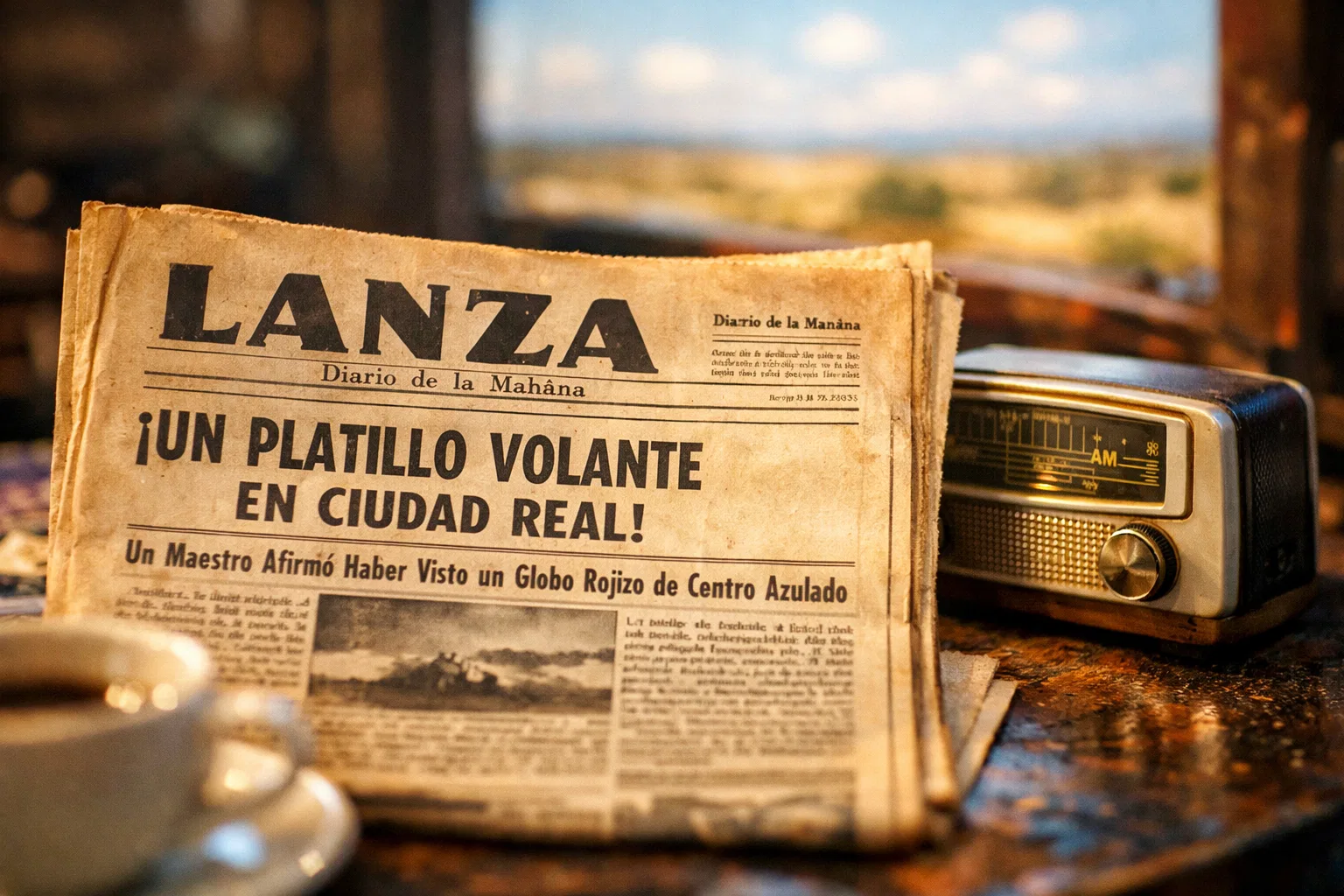
Ciudad Real’s first important flying-saucer moment was not a dramatic landing, a military chase or a heavily investigated mystery. It was a newspaper-era event: an early 1950 report in Lanza that echoed almost exactly the wording of another saucer story already circulating in the Spanish press. That is why the case matters. It shows how, in the first Spanish saucer wave, a vague light in the sky could be transformed by headline language, recent press examples and public expectation into a “flying saucer” story before there was much local evidence to test. UFO historian Ignacio Cabria highlights the Lanza item because it appeared just after reports from Algeria describing a reddish globe with a bluish centre; the Ciudad Real paper then reported a national schoolteacher seeing a very similar object in the early morning. Cabria’s question remains the most useful one: coincidence, or influence from the press?[Academia]academia.eduPDF) Así nos invadieron los «platillos volantes»PDF) Así nos invadieron los «platillos volantes»
This page treats the 1950 Ciudad Real case less as proof of an unknown craft and more as a small but revealing example of how Spanish UFO culture was made. In a province whose later UFO record is scattered rather than dominated by one official case, the Lanza report is valuable because it catches the phenomenon at the moment when language, expectation and local reporting were beginning to shape what witnesses thought they had seen.
The Lanza Report and Its Timing
The key Ciudad Real reference sits in the first weeks of Spain’s 1950 saucer excitement. Cabria’s study of the Spanish press wave says that, after 6 March reports from Algeria described an object as a reddish globe with a bluish centre, Lanza, the Ciudad Real newspaper, published a local account only days later in which a national schoolteacher said he had seen, in the early morning, a reddish globe with a bluish centre. The similarity is the point: it is not just that two people reported lights; it is that the later report reproduced a highly specific colour pattern soon after the earlier story had entered circulation.[Academia]academia.eduPDF) Así nos invadieron los «platillos volantes»PDF) Así nos invadieron los «platillos volantes»
That does not prove the teacher copied the Algeria story, nor does it prove that the object was invented. People really do see odd dawn lights, bright planets, aircraft, meteors, balloons and atmospheric effects. What the timing does show is that the witness account reached the public through a newspaper environment already primed to label ambiguous aerial observations as saucers. Cabria argues that the phrase “flying saucers” gave meaning to ambiguous things in the sky, letting observers and journalists classify unclear experiences under a fashionable new category.[Academia]academia.eduPDF) Así nos invadieron los «platillos volantes»PDF) Así nos invadieron los «platillos volantes»
The Lanza report is therefore best read as an early example of framing. The underlying observation may have been sincere, but the public meaning attached to it was not neutral. Once the saucer vocabulary was available, a light no one could immediately explain could become part of a national story about mysterious visitors, secret technology or even “Martians”. Cabria notes that by spring 1950 Spain was receiving saucer reports from many parts of the country, while newspapers amplified speculation about where the objects came from and what they meant.[Academia]academia.eduPDF) Así nos invadieron los «platillos volantes»PDF) Así nos invadieron los «platillos volantes»
Ciudad Real’s place in this moment is modest but important. The province was not leading an official investigation or producing a landmark technical file. It was showing how a provincial newspaper could connect a local witness claim to a wider press-fed pattern. For readers trying to understand Ciudad Real’s UFO history, that is more useful than treating the report as a self-contained mystery.

Why This Was a Press Wave, Not Just a Sightings Wave
The 1950 wave was not simply a series of independent sightings that newspapers happened to record. It was also a media event. Cabria describes the Spanish saucer wave as a process in which ambiguous observations became a cultural phenomenon through press repetition, headlines and borrowed meanings. In his account, the term itself helped organise uncertainty: once “flying saucer” was available, many different lights and objects could be grouped into one recognisable story.[Academia]academia.eduPDF) Así nos invadieron los «platillos volantes»PDF) Así nos invadieron los «platillos volantes»
That is especially visible in the Ciudad Real example because the local report seems to arrive with ready-made descriptive language. The object is not presented only as “a light”, “a meteor-like glow” or “an unknown object”. It enters the press landscape with a shape and colour scheme that had just been reported elsewhere. The effect is subtle but powerful: the reader is encouraged to see the Ciudad Real event as another instance of the same phenomenon rather than as a separate, uncertain observation.
This does not require deliberate sensationalism by every local reporter. Newsrooms often work by comparison. A new story is easier to explain when it resembles a story readers have already seen. In early 1950, the comparison available to Spanish newspapers was the flying saucer. The result was a feedback loop:
- Foreign reports supplied the template. Early stories from the United States, North Africa and elsewhere gave Spanish papers examples of how saucers were supposed to look and behave.
- Local witnesses supplied fresh material. A teacher, driver, villager or group of neighbours could become part of the national wave by reporting an odd light or shape.
- Newspapers supplied the public meaning. Reports became more than isolated sky observations once editors placed them under the same saucer vocabulary.
- Readers learned what to look for. After repeated stories, later witnesses may have interpreted ordinary or ambiguous sights through the new template.
The broader Castilla-La Mancha pattern supports this reading. A regional catalogue-style account of early reports notes that Spanish saucer news “shot up” in March and April 1950 and lists several Ciudad Real province items soon after the Lanza example: Chillón on 27 March, Villarta de San Juan on 28 March, Calzada de Calatrava on 29 March, Puertollano on 31 March, and Ciudad Real city on 14 April. The same source notes recurring motifs in late-March Ciudad Real reports, including mist around an object and, in two cases, cars on the road.[guadalajaramisteriosa.blogspot.com]guadalajaramisteriosa.blogspot.com1947 1953 ovnis en castilla la mancha1947 1953 ovnis en castilla la mancha
Those later items should be handled carefully because they are mostly newspaper-derived summaries rather than modern investigations with physical evidence, meteorological reconstruction and witness interviews. Even so, they are useful as cultural evidence. They show that once the saucer frame entered the provincial press, Ciudad Real did not produce one isolated report and stop. It produced a cluster of localised stories shaped by the language and imagery of the moment.
What Changed When a Light Became a Saucer
The word “saucer” did more than describe a shape. It changed the range of explanations people were invited to consider. A reddish or bluish object in the morning sky might have been interpreted in older language as a meteor, a lantern, an aircraft, a weather phenomenon or a religiously tinged prodigy. In 1950, it could instead be pulled into a modern story of advanced machines, secret weapons, foreign powers or visitors from other worlds.
That shift did not begin in Ciudad Real. The modern saucer story is usually traced to Kenneth Arnold’s 24 June 1947 sighting in the United States, where his description of objects moving “like a saucer” helped produce the now-famous “flying saucer” label. TIME’s retrospective account notes that Arnold’s reported motion was widely converted in press usage into a description of saucer-shaped objects, after which many further reports followed.[Time]time.comThis Is Why People Think UFOs Look Like 'Flying SaucersThis Is Why People Think UFOs Look Like 'Flying Saucers
Spain received that vocabulary through agencies, foreign reports and domestic newspapers. Cabria notes that after 1947 there had been some Spanish references to strange objects in the sky, but the major Spanish public arrival came in spring 1950, when reports appeared from many areas in quick succession and the press began to treat the subject as a national curiosity.[Academia]academia.eduPDF) Así nos invadieron los «platillos volantes»PDF) Así nos invadieron los «platillos volantes»
For Ciudad Real, this means the Lanza episode belongs to a moment of translation: not just translation from one language into another, but from raw perception into a new cultural category. A witness report became part of the saucer wave because the press had a ready-made frame. That is why this small item matters more than its evidential weight might suggest. It is one of the province’s earliest signs that UFO history is also media history.
The Local Pattern After the First Report
The strongest reason not to isolate the early Lanza item is that more Ciudad Real province reports followed during the same spring wave. The regional roundup of Castilla-La Mancha reports lists a static disc at Chillón near Almadén on 27 March, a Villarta de San Juan road incident on 28 March involving mist and a small opaque glowing object, a Calzada de Calatrava case on 29 March involving thick mist and a green luminous oval object, and a Puertollano report on 31 March describing discs amid mist above houses. It also lists a 14 April report from Ciudad Real city in which neighbours allegedly saw a bluish saucer with four tails for nearly an hour.[guadalajaramisteriosa.blogspot.com]guadalajaramisteriosa.blogspot.com1947 1953 ovnis en castilla la mancha1947 1953 ovnis en castilla la mancha
Taken literally, that is a strange run of reports. Taken historically, it is exactly the kind of clustering one expects during a press wave. The details vary, but the setting is consistent: ordinary local places, short newspaper reports, dramatic sky language and little surviving hard evidence. The late-March repetition of mist is especially interesting because it suggests either similar environmental conditions, story borrowing, journalistic shaping, or a shared local image of how such an encounter should appear. None of those possibilities requires hoaxing. They are all normal ways stories evolve when people are trying to describe uncertain experiences.
The road cases also show why local UFO history is difficult to evaluate retrospectively. A car journey through mist, a brief light, a frightening impression and a later newspaper account can be meaningful testimony, but it leaves little for later researchers to test. Without precise times, directions, weather records, astronomical checks and independent interviews, the historian can say that a report circulated; they cannot responsibly say that an unknown craft was present.
This is where Ciudad Real’s 1950 material differs from later official UFO files in Spain. The Ministry of Defence’s declassified UFO collection is built around case files that normally include a location, date, summary, considerations, conclusions and, where available, witness interviews, incident reports and meteorological information.[Biblioteca Virtual Defensa]bibliotecavirtual.defensa.gob.esOpen source on gob.es. The public title listing for that official collection begins with cases from later decades and shows 83 listed entries, many involving places outside Ciudad Real.[Biblioteca Virtual Defensa]bibliotecavirtual.defensa.gob.es› Listado de títulos… The 1950 Lanza moment does not appear as that kind of air-force dossier; it survives chiefly as press history.
The Main Doubt: Coincidence or Contagion?
The central doubt is not whether a teacher may have seen something. The central doubt is what kind of evidence the report provides. Cabria’s own framing is cautious: the close match between the Algeria description and the Ciudad Real description raises the question of coincidence or press influence.[Academia]academia.eduPDF) Así nos invadieron los «platillos volantes»PDF) Así nos invadieron los «platillos volantes» That is the right level of scepticism. It neither dismisses the witness as dishonest nor treats the newspaper text as a clean observational record.
“Press contagion” does not mean that newspapers magically made people see things. It means that reporting can influence what people notice, how they describe it, and how editors present it. In the Lanza case, the distinctive colour pairing is the warning sign. A reddish globe with a bluish centre is specific enough to make repetition meaningful, especially when the second report followed so quickly after the first.
There are several possible readings:
- A real but ordinary object was described through saucer language. The witness may have seen a planet, aircraft, meteorological effect or balloon and interpreted it through the current press frame.
- A real unusual sighting was coincidentally similar. Coincidence cannot be ruled out, especially when colour perception in sky observations can be imprecise.
- The report was shaped in retelling. The teacher’s original words may have been adjusted by conversation, newsroom wording or comparison with agency copy.
- The story was weak from the start. Without a full original interview, corroborating witnesses or technical checks, the evidential base remains thin.
The most balanced conclusion is that the Lanza item is strong evidence for local participation in Spain’s 1950 saucer culture, but weak evidence for an unexplained aerial event. It tells us a great deal about how Ciudad Real entered the UFO imagination; it tells us much less about what was physically in the sky.
Why the Case Still Matters for Ciudad Real
The value of the 1950 press wave in Ciudad Real is that it helps explain later local UFO history. Once a province has a public vocabulary for saucers, later reports do not begin from nothing. They are interpreted through earlier stories, remembered examples, press habits and national UFO debates. Ciudad Real’s later UFO references, including the better-known 1980s conference culture in the capital, belong to a longer process in which newspapers, witnesses and specialist writers shaped the province’s place in Spanish UFO lore.
The early Lanza report also offers a useful corrective to sensational readings of provincial UFO history. It reminds readers that a case can be historically important without being evidentially strong. The 1950 item matters because it shows the mechanism: a local newspaper, a recent external template, a witness claim and a public eager to understand odd lights through a new modern myth.
That mechanism is not unique to Ciudad Real, but the province gives a compact example of it. The March and April 1950 reports show how quickly the saucer idea could move from international news into local roads, villages and city skies. In a place not strongly represented in later official military UFO files, the press archive becomes the main arena where the early story can be studied.
What the 1950 Case Can and Cannot Prove
The 1950 Lanza episode can prove that Ciudad Real was touched early by Spain’s flying-saucer press wave. It can show that local reporting absorbed and repeated the descriptive patterns of wider saucer news. It can also show that the province’s UFO history began, at least in part, as a media-shaped phenomenon rather than as a sequence of official investigations.
It cannot prove that an extraterrestrial craft, secret aircraft or unknown physical object crossed the Ciudad Real sky. The evidence is too limited for that. The surviving value lies in comparison, timing and language, not in technical reconstruction. A strong UFO case usually needs independent witnesses, precise observation data, checks against astronomy and weather, and some record of investigation. The Lanza example gives us a historically revealing newspaper trace, not a complete case file.
That is why the best reading is neither credulous nor dismissive. The report should not be inflated into “Ciudad Real’s first confirmed UFO”. It should be understood as one of the province’s earliest documented entries into the saucer age: a moment when a morning light, a teacher’s testimony and a newspaper’s borrowed vocabulary helped turn uncertainty into local UFO history.
Amazon book picks
Further Reading
Books and field guides related to Did Newspapers Shape Ciudad Real's First Saucers?. Use these as the next step if you want deeper reading beyond the article.
The Demon-Haunted World
Supports the page’s question of how reports and beliefs spread.
The Report on Unidentified Flying Objects
Provides institutional context for the same early Cold War saucer era.
The Coming of the Saucers
Connects Ciudad Real’s press wave to the original flying saucer boom.
eBay marketplace picks
Marketplace Samples
Live-tested eBay searches with available results related to this page.



Endnotes
1.
Source: academia.edu
Title: (PDF) Así nos invadieron los «platillos volantes»
Link:https://www.academia.edu/40902385/As%C3%AD_nos_invadieron_los_platillos_volantes_
2.
Source: guadalajaramisteriosa.blogspot.com
Title: 1947 1953 ovnis en castilla la mancha
Link:https://guadalajaramisteriosa.blogspot.com/2022/09/1947-1953-ovnis-en-castilla-la-mancha.html
3.
Source: time.com
Title: This Is Why People Think UFOs Look Like ‘Flying Saucers’
Link:https://time.com/3930602/first-reported-ufo/
4.
Source: independent.academia.edu
Title: Ignacio Cabria
Link:https://independent.academia.edu/IgnacioCabria
5.
Source: academia.edu
Link:https://www.academia.edu/116893052/Entre_uf%C3%B3logos_creyentes_y_contactados_Una_historia_social_de_los_ovnis_en_Espa%C3%B1a
6.
Source: academia.edu
Title: Saucers in the Sixties
Link:https://www.academia.edu/47496557/Saucers_in_the_Sixties_UFOs_in_Latin_America_and_Spain
7.
Source: academia.edu
Title: Los expedientes OVNI desclasificados Online
Link:https://www.academia.edu/35429868/Los_expedientes_OVNI_desclasificados_Online
8.
Source: academia.edu
Title: Spanish Air Force UFO Files The Secrets End pdf
Link:https://www.academia.edu/35786573/Spanish_Air_Force_UFO_Files_The_Secrets_End_pdf
9.
Source: bibliotecavirtual.defensa.gob.es
Link:https://bibliotecavirtual.defensa.gob.es/BVMDefensa/exp_ovni/es/micrositios/inicio.do
10.
Source: bibliotecavirtual.defensa.gob.es
Link:https://bibliotecavirtual.defensa.gob.es/BVMDefensa/exp_ovni/es/consulta/indice_campo.do?campo=idtitulo
Source snippet
› Listado de títulos...
11.
Source: bibliotecavirtual.defensa.gob.es
Title: defensa.gob.es Colecciones
Link:https://bibliotecavirtual.defensa.gob.es/BVMDefensa/es/lista/micrositios.do
12.
Source: bibliotecavirtual.defensa.gob.es
Title: defensa.gob.es Búsqueda de obras
Link:https://bibliotecavirtual.defensa.gob.es/BVMDefensa/exp_ovni/es/consulta/busqueda.do
13.
Source: bibliotecavirtual.defensa.gob.es
Title: defensa.gob.es Búsqueda avanzada de obras
Link:https://bibliotecavirtual.defensa.gob.es/BVMDefensa/exp_ovni/es/consulta/busqueda_avanzada.do
14.
Source: bibliotecavirtual.defensa.gob.es
Link:https://bibliotecavirtual.defensa.gob.es/BVMDefensa/exp_ovni/en/exposiciones/exposiciones.do
15.
Source: bibliotecavirtual.defensa.gob.es
Link:https://bibliotecavirtual.defensa.gob.es/
16.
Source: Wikipedia
Title: Flying saucer
Link:https://en.wikipedia.org/wiki/Flying_saucer
17.
Source: casadellibro.com
Title: ignacio cabria
Link:https://www.casadellibro.com/libros-ebooks/ignacio-cabria/20116445?srsltid=AfmBOoqKSisVTjgiqZBrTP2XLtYHJ-p7T0uOItQjotnI0FhMNIXVjtNU
Additional References
18.
Source: youtube.com
Title: Meet the Author: “No Cause for Alarm: Flying Saucer Mania and the Montana Movie”
Link:https://www.youtube.com/watch?v=g9z6mFM3iSo
Source snippet
Ultimate 1950s Flying Saucer, UFO, and Alien Encounter Movies...
19.
Source: cia.gov
Link:https://www.cia.gov/readingroom/docs/DOC_0000015465.pdf
20.
Source: youtube.com
Title: A history of flying saucers and UFOs
Link:https://www.youtube.com/watch?v=4ikruHQUtOE
Source snippet
Meet the Author: "No Cause for Alarm: Flying Saucer Mania and the Montana Movie"...
21.
Source: researchgate.net
Link:https://www.researchgate.net/publication/261854096_Extraterrestrial_encounters_UFOs_science_and_the_quest_for_transcendence
22.
Source: facebook.com
Link:https://www.facebook.com/chilangoemplumado/posts/de-historias-de-platillos-voladores-ovnis-extraterrestres-y-m%C3%A1sas%C3%AD-fue-la-impact/1512522557337882/
23.
Source: facebook.com
Link:https://www.facebook.com/groups/337634486811277/posts/2142123693029005/
24.
Source: facebook.com
Link:https://www.facebook.com/groups/scientificcosmology/posts/10174976489890268/
25.
Source: facebook.com
Link:https://www.facebook.com/NorthCarolinaOnly/posts/did-you-know-a-saucer-shaped-craft-was-spotted-over-the-coast-in-1950-/1204022665175566/
26.
Source: instagram.com
Link:https://www.instagram.com/eldragoninvisible/
27.
Source: uplopen.com
Link:https://www.uplopen.com/books/5481/files/9ff2a6f4-461d-4727-a3bd-d7994166eec6.pdf
Topic Tree