Within Cuenca UFOs
Why Do Cuenca's Village Lights Still Linger?
The Landete and Campillo accounts are vivid village testimonies, but they rely on memory rather than hard records.
On this page
- The Landete late night encounter
- The Campillo comparison and Manises link
- Why testimony alone is difficult to verify
Page outline Jump by section
Introduction
The Landete and Campillo de Altobuey light stories are among Cuenca’s most memorable village UFO accounts, but also among its most fragile. They describe close-range encounters in the 1970s: one involving three young people walking home from local festivities near Landete, the other a hunting-party sighting near Campillo de Altobuey later connected in retelling with the famous Manises aviation incident. What makes them worth preserving is not that they prove an extraordinary craft visited Cuenca, but that they show how rural UFO memory works: vivid local testimony, repeated through investigators and radio features, with few hard records left to test. The best reading is cautious. These are striking close-range light stories, not confirmed events, and their value lies in what they reveal about witness experience, local transmission and the limits of evidence in provincial UFO history.[Cadena SER]cadenaser.comOpen source on cadenaser.com.
Why these village lights matter in Cuenca’s UFO record
Cuenca’s UFO history has one comparatively strong official anchor: the 1968 aviation and meteorological sighting preserved in Spain’s declassified Air Force UFO files. The Landete and Campillo stories are different. They do not rest on radar traces, official case files, photographs or preserved police reports; they survive mainly through later retellings, especially a 2020 Cadena SER Cuenca feature in the local series “Misterios Conquenses”, which presented both as past village sightings collected or publicised by Iván Martínez and J. J. Benítez.[Cadena SER]cadenaser.comOpen source on cadenaser.com.
That distinction matters. In a province-level UFO history, not every case carries the same evidential weight. The official 1968 case matters because it entered the Spanish military paperwork trail. Landete and Campillo matter because they represent another route by which UFO stories enter local memory: named places, remembered witnesses, memorable light behaviour and later media revival. They are part of Cuenca’s UFO culture, but they need a different standard of handling from cases with official files.
The two villages also give the stories their texture. Landete and Campillo de Altobuey are small municipalities within the province of Cuenca, not anonymous urban backdrops. The national statistics body’s municipal register lists both among Cuenca’s municipalities, which helps explain why such stories can become locally durable: in smaller communities, a night-time sighting can circulate through names, family memory, local radio and regional folklore more easily than through formal archives.[INE]ine.esOpen source on ine.es.
The Landete late-night encounter
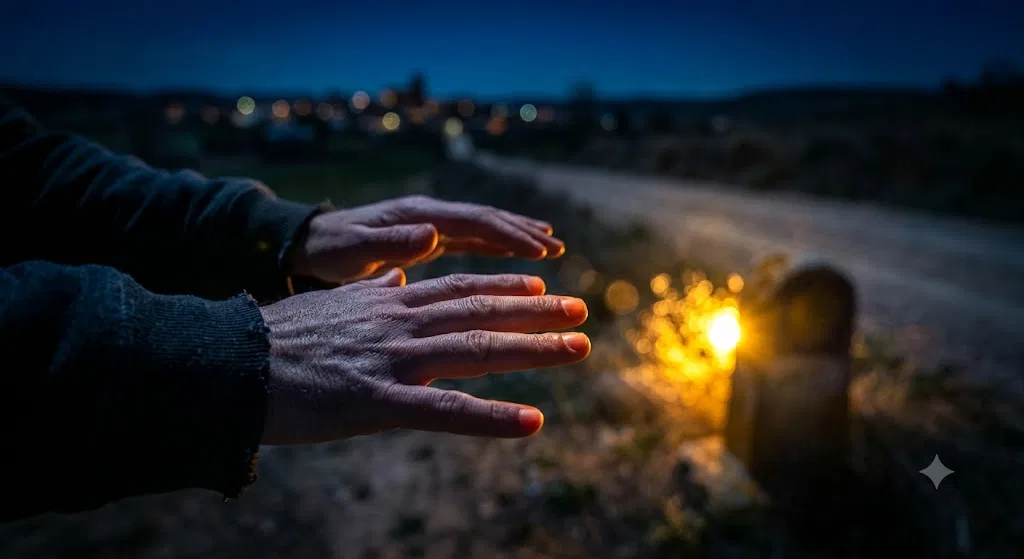
The Landete account is the more intimate of the two. According to the Cadena SER retelling, two siblings, Pepe and Susana, were returning from village festivities with a friend at around four in the morning. They were walking along a road or path when they saw a powerful yellow-orange light to the left of their route. The description is simple but vivid: the light was intense, almost dazzling, and close enough to tempt the group to approach it rather than simply watch from a distance.[Cadena SER]cadenaser.comOpen source on cadenaser.com.
The first sceptical question is obvious, and the radio feature itself raises it: after festivities, at an awkward hour, a bright light near a rural route could have been a vehicle, a caravan, a stall, a generator lamp or some other temporary human source. That does not debunk the account, but it immediately places it in the category of a potentially ordinary light seen under unusual conditions. The most useful detail is not the colour alone, but the reported sequence: the witnesses approached, began to suspect the source was not a normal vehicle, and then the light diminished until it disappeared, leaving the area dark.[Cadena SER]cadenaser.comOpen source on cadenaser.com.
This is why the Landete case lingers. It is not a distant light moving across the sky; it is a near-ground light that seems to behave in response to the witnesses’ approach. In UFO classification terms, it resembles a close-range encounter narrative because the witnesses are not merely looking upward at an unknown point. They are moving towards an apparently nearby source and expecting to reach it. The story’s dramatic force comes from the failed arrival: when they get to where the object should have been, there is nothing to inspect.[Cadena SER]cadenaser.comOpen source on cadenaser.com.
The weakness is just as important. The available public version does not establish whether the witnesses searched the exact spot, whether there were tracks, heat marks, damaged vegetation, other witnesses, a date precise enough to check, or any contemporary written record. Cadena SER’s own account notes that there is no recording, no reported physical trace and little beyond the testimony as collected by the author who transmitted it. That makes the story interesting as memory, but weak as evidence.[Cadena SER]cadenaser.comOpen source on cadenaser.com.

The Campillo comparison and the Manises link
The Campillo de Altobuey story has a different character. It is linked in later retelling to the Manises incident, Spain’s most famous aviation UFO case, because J. J. Benítez reportedly encountered it while investigating Manises. In the Cadena SER version, Ángel Díaz Cuellar, described as an airport traffic officer connected with the Manises context, recalled an earlier July sighting near Campillo, in the area known as Corral del Bolo. He was out hunting wild boar with several companions at about 10:30 at night.[Cadena SER]cadenaser.comOpen source on cadenaser.com.
The detail that gives this account more specificity than many village sightings is the naming of two companions, Pedro García Sillas and Pedro Martínez, both described as residents of Campillo. The setting is also concrete: a hunting party spread across different positions, waiting silently with shotguns, in clear night conditions. According to the account, something appeared at an estimated height of about 300 metres: an elongated, cucumber-like or cigar-like craft, with one end more swollen, moving without sound.[Cadena SER]cadenaser.comOpen source on cadenaser.com.
This is not the same type of claim as Landete. Landete is a light apparently at rest near a path; Campillo is a silent aerial object crossing the sky at low apparent altitude. Landete’s puzzle is disappearance at close range. Campillo’s puzzle is the claimed combination of shape, low height and silence. Those features make it more dramatic, but they also increase the burden of proof. An object large and close enough to show shape should, in principle, have left more checkable detail: direction of travel, duration, angular size, exact date, weather, astronomical conditions and independent witness statements.
The Manises link should therefore be handled carefully. Manises itself was a major aviation incident: in November 1979 a TAE Super Caravelle diverted to Valencia after the crew reported unexplained lights, and a Mirage F1 was later sent to investigate. The case became politically and culturally important in Spain and was later associated with declassified military material and parliamentary questions.[Congreso de los Diputados]congreso.esE 378 IE 378 I
But that does not make the Campillo story stronger by association. The Campillo account appears as a side story emerging during the Manises investigation, not as part of the same event. Its value is contextual: it shows how a celebrated national UFO case could pull older, rural testimonies into wider circulation. It does not show that the Campillo object and the Manises lights had a common cause.
What the two stories have in common
The Landete and Campillo accounts are different in setting and shape, but they share several features that explain why they remain attractive to UFO readers.
First, both are close-range stories rather than vague points of light. In Landete, the witnesses try to approach the source. In Campillo, the object is described as low enough to estimate height and shape. Close-range accounts feel more persuasive to readers because they seem to reduce the chance of mistaking a planet, aircraft or distant light. That is the intuition behind the “close encounter” idea in UFO literature: proximity is supposed to make misidentification less likely.[Wikipedia]WikipediaClose encounterClose encounter
Second, both involve silence. The Landete light is not accompanied, in the public retelling, by engine noise or obvious human activity. The Campillo object is explicitly described as completely silent. Silence is one of the most common features that makes rural light stories feel strange, especially in places where an engine, generator or aircraft would normally carry across open ground at night.[Cadena SER]cadenaser.comOpen source on cadenaser.com.
Third, neither story leaves a trace. This is crucial. The Landete light disappears before inspection. The Campillo object passes through without recorded physical effect. Cadena SER’s summary makes the point plainly: the two cases involve large or striking objects, but no marks from a landing and no trace from a flight path.[Cadena SER]cadenaser.comOpen source on cadenaser.com.
That combination is exactly why the stories remain suspended between fascination and doubt. They are too detailed to dismiss as empty folklore, but too thinly documented to rank beside cases with aviation logs, radar data, photographs or official investigation files.
Why testimony alone is difficult to verify
The central problem is not that the witnesses must have been dishonest. Most UFO reports begin with sincere witnesses trying to describe something they found unusual. The problem is that memory and perception are not recording devices. Research on eyewitness evidence has repeatedly shown that visual perception and later recall have limits, especially when lighting, distance, stress, expectation and time delay are involved. The National Academies’ review of eyewitness identification stresses that accurate recall depends on sensing, perceiving and remembering events within the limits of human vision and memory.[National Academies]nationalacademies.orgOpen source on nationalacademies.org.
That matters directly for Landete. A bright light at night can overwhelm depth judgement. A witness may be sure something is nearby, yet still misjudge distance, size or source. In a rural setting after festivities at four in the morning, fatigue, excitement and darkness all make interpretation harder. The key question is not simply “did they see a light?” They almost certainly believed they did. The harder question is whether the later story preserves enough information to identify what the light was.
It also matters for Campillo. A silent object at night may be described with apparent precision, but estimates such as “300 metres high” are difficult without known reference points. If the size is unknown, height is hard to judge; if the height is unknown, size is hard to judge. A small object nearby and a large object farther away can produce similar impressions. This does not explain the case away, but it shows why investigators need more than a vivid description.
Retelling adds another layer. The public versions available now are not raw witness statements written at the time of the events. They are mediated accounts: collected by investigators, published or discussed later, then revived in local radio and online summaries. Each stage can preserve useful detail, but it can also smooth uncertainty into a more coherent story. That is a normal feature of oral history, not a special flaw in these witnesses.
What would strengthen or weaken the cases now?
The Landete and Campillo stories are unlikely to be solved conclusively unless new archival material appears. Still, readers can judge what would change the assessment.
Stronger evidence would include contemporary notes, local press reports from the time, dated witness statements, independent testimony from people not in the same social group, police or municipal records, photographs, maps showing the route and sightline, or later interviews that preserve uncertainty rather than simply repeat the most dramatic version. For Campillo, the most valuable addition would be separate statements from the named companions, with consistent details about direction, duration, apparent size and the exact date.
Weaker evidence would include contradictions between later versions, a date that coincides with a known local event involving lights, a plausible vehicle or hunting-related explanation, or signs that details entered the story only after the Manises case became famous. The strongest caution is already visible: the cases have been memorable enough to retell, but not documented enough to verify independently.
This is why the Manises comparison is useful but dangerous. Manises had aviation communications, official attention and political follow-up, yet even that case remains disputed, with later sceptical explanations focusing on lights, atmospheric conditions, industrial flares and interpretation under stress. Reports on the parliamentary and official handling also show that the issue was discussed as unexplained lights rather than proven physical craft. Congreso de los Diputados+2www.noroeste.com.mx[congreso.es]congreso.esE 378 IE 378 I
If a nationally prominent aviation case can remain contested despite a larger paper trail, then a village light story with no hard trace deserves even more caution. The comparison should make readers more careful, not more credulous.

A fair classification for Landete and Campillo
The fairest label for these accounts is “locally significant but weakly evidenced”. They belong in Cuenca’s UFO history because they are specific to named villages, have memorable witness scenarios, and show how the province’s UFO record extends beyond the official 1968 file into rural testimony and local media memory. They should not be presented as confirmed landings, confirmed craft or proof of a shared phenomenon with Manises.
Landete is best understood as a close-range light encounter with an unresolved source. It is vivid because the witnesses approached the light and found nothing, but the absence of date, trace, corroboration and contemporary documentation keeps it in the realm of anecdotal testimony. Campillo is best understood as a low-altitude silent-object report transmitted through the Manises-era UFO literature. It has more named context, but still lacks the independent records needed to move from striking account to strong case.
Their lasting value is therefore interpretive. They show why Cuenca’s village UFO stories linger: not because they settle the question of what was seen, but because they preserve the human moment when ordinary people in quiet places encountered something that did not fit their expectations. The responsible conclusion is neither ridicule nor belief. It is a careful middle position: these are important local stories, honestly worth recording, but they remain unverified close-range light accounts rather than established evidence of extraordinary visitors.
Amazon book picks
Further Reading
Books and field guides related to Why Do Cuenca's Village Lights Still Linger?. Use these as the next step if you want deeper reading beyond the article.
UFOs: Generals, Pilots, and Government Officials Go on the Re...
Gives readers stronger documented cases to compare with fragile local testimony.
The UFO Experience: A Scientific Inquiry
Provides tools for weighing close-encounter claims when hard records are missing.

Passport to Magonia: from folklore to flying saucers
Directly helps frame how rural close-range light stories become part of UFO tradition.
The UFO Book: Encyclopedia of the Extraterrestrial
Offers wider context for comparing Landete and Campillo with better-known cases.
eBay marketplace picks
Marketplace Samples
Live-tested eBay searches with available results related to this page.




Endnotes
1.
Source: cadenaser.com
Link:https://cadenaser.com/emisora/2020/01/21/ser_cuenca/1579612922_133760.html
2.
Source: cadenaser.com
Link:https://cadenaser.com/audio/1579610868_060543/
3.
Source: ine.es
Link:https://www.ine.es/jaxiT3/Tabla.htm?L=0&t=2869
4.
Source: Wikipedia
Title: Close encounter
Link:https://en.wikipedia.org/wiki/Close_encounter
5.
Source: congreso.es
Title: E 378 I
Link:https://www.congreso.es/public_oficiales/L1/CONG/BOCG/E/E_378-I.PDF
6.
Source: cadenaser.com
Link:https://cadenaser.com/ser/2017/11/16/cultura/1510826756_651730.html
7.
Source: noroeste.com.mx
Title: el caso manises 3 LG6558287
Link:https://www.noroeste.com.mx/colaboraciones/el-caso-manises-3-LG6558287
8.
Source: Wikipedia
Title: Incidente OVNI de Manises
Link:https://es.wikipedia.org/wiki/Incidente_OVNI_de_Manises
9.
Source: Wikipedia
Link:https://en.wikipedia.org/wiki/Landete
10.
Source: Wikipedia
Title: Campillo de Altobuey
Link:https://en.wikipedia.org/wiki/Campillo_de_Altobuey
11.
Source: Wikipedia
Title: Campillo de Altobuey
Link:https://es.wikipedia.org/wiki/Campillo_de_Altobuey
12.
Source: Wikipedia
Title: Incident de Manises
Link:https://fr.wikipedia.org/wiki/Incident_de_Manises
13.
Source: Wikipedia
Title: Ala 14
Link:https://es.wikipedia.org/wiki/Ala_14
14.
Source: Wikipedia
Title: Manisesko OHEren gertakaria
Link:https://eu.wikipedia.org/wiki/Manisesko_OHEren_gertakaria
15.
Source: ine.es
Link:https://www.ine.es/jaxiT3/Tabla.htm?L=1&t=2869
16.
Source: ine.es
Link:https://www.ine.es/jaxi/Tabla.htm?L=0&file=1mun16.px&path=%2Ft20%2Fe244%2Favance%2Fp02%2Fl0%2F
17.
Source: manises.es
Title: conferencia ufologia fonomeno ovni
Link:https://www.manises.es/es/evento/conferencia-ufologia-fonomeno-ovni
18.
Source: nationalacademies.org
Link:https://www.nationalacademies.org/read/18891/chapter/2
19.
Source: nationalacademies.org
Link:https://www.nationalacademies.org/read/18891/chapter/6
20.
Source: cadenaser.com
Link:https://cadenaser.com/castillalamancha/2026/06/10/un-ovni-en-las-pinturas-rupestres-y-otros-avistamientos-en-los-pueblos-de-cuenca-ser-cuenca/
21.
Source: cadenaser.com
Title: Últimos audios de Extraterrestres
Link:https://cadenaser.com/tag/extraterrestres/a/audios/p5/
22.
Source: cadenaser.com
Title: Últimos audios de Ovnis
Link:https://cadenaser.com/tag/ovnis/a/audios/p3/
23.
Source: nationalacademies.org
Link:https://www.nationalacademies.org/projects/PGA-STL-13-02/publication/18891
24.
Source: viviendade.com
Title: campillo de altobuey
Link:https://viviendade.com/municipio/campillo-de-altobuey
Additional References
25.
Source: youtube.com
Title: The UFO that Shocked an Entire Continent
Link:https://www.youtube.com/watch?v=V10Q9AWsOfY
Source snippet
In 1979, a Spanish plane was chased by a UFO over the Mediterranean Sea and nearly crashed!!!?...
26.
Source: youtube.com
Title: The Jesus We Were Never Taught About w/ Juan José Benítez (Ep. 71)
Link:https://www.youtube.com/watch?v=ztaa-NEf1gc
Source snippet
72 UFO reports declassified with no evidence of extraterrestrial life...
27.
Source: facebook.com
Link:https://www.facebook.com/ADeBuenaFuente/videos/atenci%C3%B3n-cuenca-este-objeto-que-parece-ser-un-ovni-fue-grabado-esta-noche-desde-/1578371215930020/
28.
Source: facebook.com
Link:https://www.facebook.com/rio.romang/posts/alguien-fue-testigo-de-lo-que-pas%C3%B3-en-el-cielo-de-la-regi%C3%B3n-los-escuchamos/2689448828116113/
29.
Source: campillodealtobuey.com
Link:https://www.campillodealtobuey.com/
30.
Source: instagram.com
Link:https://www.instagram.com/p/DLnQsIqgrhc/?hl=en
31.
Source: ceicdata.com
Link:https://www.ceicdata.com/en/ecuador/enemdu-population-urban/population-urban-cuenca
32.
Source: facebook.com
Link:https://www.facebook.com/DMAXes/posts/el-caso-manises-es-probablemente-el-avistamiento-ovni-m%C3%A1s-medi%C3%A1tico-en-la-histor/2121926651171277/
33.
Source: facebook.com
Link:https://www.facebook.com/DMAXes/videos/caso-manises/2121921797838429/
34.
Source: elhorizonte.mx
Link:https://www.elhorizonte.mx/opinion/el-caso-manises-parte-3/2111522210
Topic Tree