Within Lleida UFOs
When a Lleida UFO Became Space Debris
The 1993 Lleida-linked entry shows how a dramatic sighting can enter UFO records and still be explained later by space debris.
On this page
- Why the 1993 event entered the archive
- What a rocket re entry can look like
- How an explanation changes the case's value
Page outline Jump by section
Introduction
The 31 March 1993 Lleida-linked UFO report is valuable precisely because it is not a strong mystery. It shows how a dramatic night-time sky event could be reported as an unidentified aerial phenomenon, entered into Spain’s official UFO paperwork, and later lose its mystery when investigators matched it to the atmospheric re-entry of a Russian rocket stage. Local reporting in Lleida identified the case as the province’s third Defence archive entry, alongside the better-known 1968 and 1971 files, and stated that the 1993 sightings also involved Barcelona and Girona.[Segre.com]segre.comtercer informe con avistamiento un ovni lleidatercer informe con avistamiento un ovni lleida
For Lleida’s UFO history, the case matters as a cautionary example. A UFO file is not the same as evidence of an extraordinary craft; it is a record of something unidentified at the time. The Spanish Defence archive’s own structure, as summarised by El País, includes reports, witness material and official conclusions, and many entries point towards ordinary causes such as weather, balloons, inconsistent testimony or other conventional explanations.[Verne]verne.elpais.comOpen source on elpais.com. The 1993 event belongs in that explained category.
Why the 1993 Event Entered the Archive
The basic event was a multi-region night sighting on 31 March 1993. In the Lleida press, Segre reported that Spain’s Defence virtual library included a third Lleida UFO report dated that day, with related sightings in Barcelona and Girona, and that the explanation was the re-entry into the atmosphere of a Russian rocket.[Segre.com]segre.comtercer informe con avistamiento un ovni lleidatercer informe con avistamiento un ovni lleida El País’s province-by-province list also places the same 31 March 1993 file under Barcelona, Girona and Lleida, which is important: this was not a single isolated witness story tied only to one town, but a wider sky event that was filed across several provinces.[Verne]verne.elpais.comOpen source on elpais.com.
The Defence PDF itself is brief but decisive. It identifies the case as file number 930331, dated 31 March 1993, and its index says the key document is a note from SEPRA, the French space-re-entry expertise service at CNES, concerning the atmospheric re-entry of the third stage of the Russian rocket that had carried the observation satellite Cosmos 2238.[Biblioteca Virtual de Defensa]bibliotecavirtual.defensa.gob.esBiblioteca Virtual de Defensa That makes the evidential character of the file different from a purely anecdotal UFO report: the explanation rests on a technical correlation between witness reports and orbital data.
There is one useful caveat. The PDF cover page gives the place as Madrid, while contemporary Spanish media lists the same file under Catalan provinces, including Lleida.[Biblioteca Virtual de Defensa]bibliotecavirtual.defensa.gob.esBiblioteca Virtual de Defensa The best reading is not that the case “happened only in Madrid”, but that the file was catalogued in a national archive while the observed phenomenon was reported across several regions. The Lleida connection therefore comes from its inclusion in the province listing and local reporting, not from a large, detailed Lleida-only narrative.
The most specific Lleida-area anchor found in re-entry cataloguing is Torres de Segre, a municipality in the province. A 2025 catalogue of visually observed satellite re-entries lists the 31 March 1993 Cosmos 2238 rocket re-entry at 00:10 UTC and includes sightings from Ireland, the United Kingdom, France and Catalonia, naming Portbou, Girona, Torres de Segre, Barcelona and Tarragona among the Spanish locations.[Satellites.org]satobs.orgSatellites.org Observed re-entries #22.xlsxSatellites.org Observed re-entries #22.xlsx That helps explain why the case could feel local in Lleida while still being part of a much larger European observation.
What a Rocket Re-entry Can Look Like
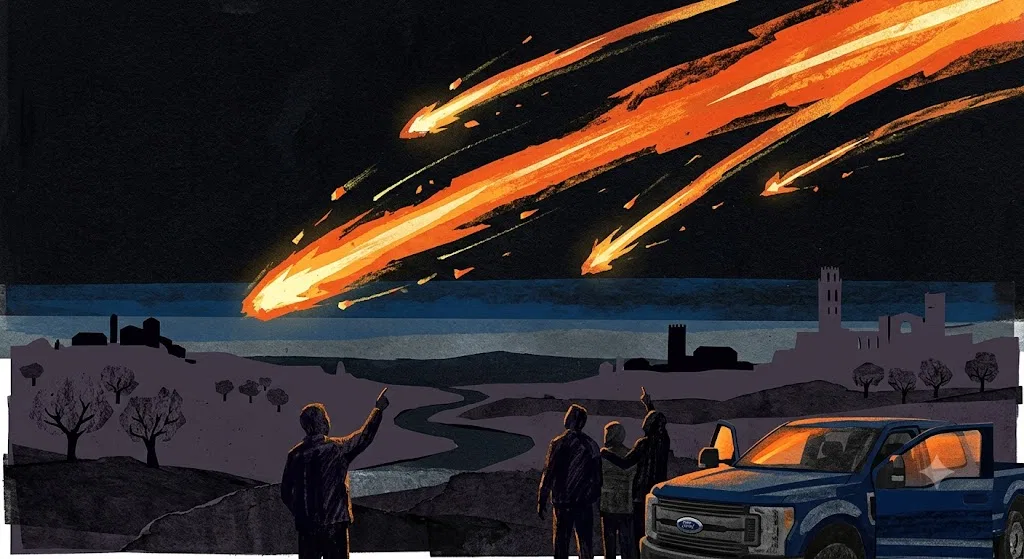
A rocket re-entry can look stranger than many people expect. It is not usually a neat point of light like a distant aircraft. Human-made debris enters the upper atmosphere at orbital speed, often travelling roughly parallel to the ground, producing a bright central glow, a long tail and sometimes several fragments as the object breaks apart. The Aerospace Corporation explains that re-entries can resemble shooting stars, but often show a bright body, a long luminous tail and multiple fragments.[aerospace.org]aerospace.orgOpen source on aerospace.org.
That description fits why re-entries often become UFO reports. A slow, silent, multi-fragment trail crossing a large part of the sky can look like a formation, a structured object, or several lights moving together. NASA’s Orbital Debris Program Office notes that re-entering spacecraft normally break up between about 84 and 72 kilometres altitude, with a nominal break-up altitude around 78 kilometres.[orbitaldebris.jsc.nasa.gov]orbitaldebris.jsc.nasa.govOpen source on nasa.gov. At those heights, the same event can be visible over a very wide area, which is exactly the kind of geography seen in the 1993 case.
The CNES/SEPRA note in the Spanish Defence file describes the French side of the same event. It says SEPRA was contacted on the morning of 31 March 1993 by dozens of witnesses, including members of the public, police, civil aviation and observatories, after an unidentified aerospace phenomenon was seen in numerous French regions. The note records a common pattern in the testimony: an observation around 02:10 to 02:14 French local time, crossing the sky from north-west to south-east, with a duration of roughly 30 to 50 seconds.[Biblioteca Virtual de Defensa]bibliotecavirtual.defensa.gob.esBiblioteca Virtual de Defensa
The same note says SEPRA, with support from CNES orbitography services, correlated the collected observations with the atmospheric re-entry of the third stage of the Russian rocket that had placed Cosmos 2238 in orbit. It also states that the launch occurred on 30 March at 18:00 UTC, and that NORAD data transmitted to CNES via NASA allowed investigators to reconstruct the third stage’s path over France between 00:10 and 00:12 UTC on 31 March.[Biblioteca Virtual de Defensa]bibliotecavirtual.defensa.gob.esBiblioteca Virtual de Defensa
That is the key mechanism behind the Lleida-linked explanation. The case was not solved by simply saying “probably a meteor” or “probably aircraft”. It was matched to a known space object, a launch date, an orbital path and a re-entry time.
Why Cosmos 2238 Was the Likely Source
The object at the centre of the explanation was associated with Cosmos 2238, a Russian satellite launched on 30 March 1993. Satellite tracking data identify Cosmos 2238 as NORAD ID 22585, international designator 1993-018A, launched from the Tyuratam launch complex in the former Soviet space programme.[N2YO]n2yo.comOpen source on n2yo.com. The satellite itself remained in orbit until a later decay date, but the UFO-relevant object was the rocket stage, not the satellite payload.
This distinction matters. Casual retellings often say “a satellite re-entered”, but the Defence and CNES material points specifically to the third stage of the rocket that had carried Cosmos 2238.[Biblioteca Virtual de Defensa]bibliotecavirtual.defensa.gob.esBiblioteca Virtual de Defensa Re-entry catalogues make the same distinction by listing 1993-018B, NORAD 22586, as the Cosmos 2238 rocket, with a re-entry on 31 March 1993 at 00:10 UTC.[Satellites.org]satobs.orgSatellites.org Observed re-entries #22.xlsxSatellites.org Observed re-entries #22.xlsx
The geography also supports the explanation. The same re-entry catalogue lists reports from Ireland, Wales, England, several regions of France and Catalonia, including Torres de Segre.[Satellites.org]satobs.orgSatellites.org Observed re-entries #22.xlsxSatellites.org Observed re-entries #22.xlsx A single high-altitude re-entry is exactly the sort of event that can generate widely separated reports within minutes. A low-flying craft over one town would not naturally explain such a broad observation chain.
A separate OVNI Archive summary of the Spanish Defence file gives the same core interpretation: SEPRA found that the observed phenomenon coincided with the atmospheric re-entry of the third stage of a Russian rocket launched the previous day to place Cosmos 2238 into orbit, and that the trajectory and timing matched the testimonies.[OVNI Archive]ovniarchive.comOVNI Archive Sighting of luminous objects in Madrid · OVNI ArchiveOVNI Archive Sighting of luminous objects in Madrid · OVNI Archive As a secondary summary, it should not outrank the Defence PDF, but it confirms that the conventional reading of the file is stable.

How the Lleida Case Fits a Wider 1993 European Sky Event
The Lleida-linked report is best understood as the Spanish edge of a larger European event. In Britain, the same night became associated with the well-known Cosford UFO reports. The National Archives’ 2009 highlights guide says more than 30 sightings were recorded during a six-hour period, radar tapes were replayed without finding anything unusual, and it later emerged that the majority of sightings were caused by the Russian rocket that launched Cosmos 2238 re-entering the atmosphere.[National Archives]cdn.nationalarchives.gov.ukNational Archives Highlights GuideNational Archives Highlights Guide
This British comparison is useful, but it should not take over the Lleida story. The UK case included additional reports and debate about whether every sighting from that night could be explained by the rocket re-entry.[Gizmodo]gizmodo.comDeclassified Government Docs Reveal Secret British UFODeclassified Government Docs Reveal Secret British UFO For Lleida, the narrower question is whether the Catalan sighting file has a strong conventional explanation. On the available evidence, it does: the Spanish file’s own technical note points to the Cosmos 2238 rocket stage, and later local reporting presents the case as explained.[Biblioteca Virtual de Defensa]bibliotecavirtual.defensa.gob.esBiblioteca Virtual de Defensa
The wider European footprint also helps readers avoid a common mistake. A sighting seen from Lleida or near Lleida need not have been physically “over” Lleida in the ordinary aircraft sense. A bright re-entry tens of kilometres high can be visible from far away, and its apparent path can be hard for ground witnesses to judge. That does not make the witnesses unreliable; it means the geometry of the event is non-intuitive.
How an Explanation Changes the Case’s Value
The 1993 case becomes less valuable as a mystery once the rocket-stage explanation is accepted, but it becomes more valuable as a lesson in how UFO records should be read. It shows that official filing does not mean official endorsement of an extraordinary object. Spain’s Defence UFO collection covers reports of strange aerial phenomena, not confirmed alien craft, and El País explicitly warned that “UFO” in this context means an object not identified at the time of observation.[Verne]verne.elpais.comOpen source on elpais.com.
For Lleida, this gives the province’s small official UFO record a useful contrast. The 1968 file remains the more substantial local case because it involved military pilots, radar and an attempted photographic check. The 1993 file is important for the opposite reason: it shows the archive working as an investigative record where an initially puzzling event can be explained later by technical evidence.[Verne]verne.elpais.comOpen source on elpais.com.
The case also demonstrates why multi-witness sightings are not automatically unexplained. In fact, many witnesses across a wide area can strengthen a conventional explanation if their reports align with a known astronomical or spaceflight event. In the 1993 case, the spread of reports across France, the UK and Catalonia is not a problem for the re-entry explanation; it is one of the things that makes it plausible.[Biblioteca Virtual de Defensa]bibliotecavirtual.defensa.gob.esBiblioteca Virtual de Defensa
The remaining uncertainty is not whether a rocket re-entry is a credible explanation. It is how much local detail survives for the Lleida side of the event. Publicly accessible summaries give the date, province links, rocket explanation and a specific Catalan location at Torres de Segre, but they do not preserve a rich Lleida-only witness narrative comparable to some better-known UFO cases.[Segre.com]segre.comtercer informe con avistamiento un ovni lleidatercer informe con avistamiento un ovni lleida That limits the case as folklore, but strengthens its role as a clear example of an explained UFO entry.
What Readers Should Take From the 1993 File
The 1993 Lleida-linked UFO report is best classified as explained rather than unresolved. It entered the record because people saw something unusual in the night sky. It matters because the sighting was recorded in Spain’s official UFO material and later tied to a specific spaceflight event: the re-entry of the third stage of the Russian rocket associated with Cosmos 2238.[Biblioteca Virtual de Defensa]bibliotecavirtual.defensa.gob.esBiblioteca Virtual de Defensa
Its most useful takeaway is methodological. A convincing UFO history of Lleida should not treat all archived entries equally. Some cases are stronger because they involve trained witnesses or radar; some are weaker because the surviving evidence is thin; and some, like 31 March 1993, are valuable because they show how an impressive report can be explained without dismissing the witnesses. The people who reported the lights may well have seen something dramatic. The best-supported explanation is that they were watching space debris burn through the upper atmosphere.
eBay marketplace picks
Marketplace Samples
Live-tested eBay searches with available results related to this page.



Endnotes
1.
Source: segre.com
Title: tercer informe con avistamiento un ovni lleida 1993 5016
Link:https://www.segre.com/es/sociedad/161026/tercer-informe-con-avistamiento-un-ovni-lleida-1993_5016.html
2.
Source: bibliotecavirtual.defensa.gob.es
Title: Biblioteca Virtual de Defensa
Link:https://bibliotecavirtual.defensa.gob.es/BVMDefensa/exp_ovni/i18n/catalogo_imagenes/imagen.do?path=102265&posicion=1®istrardownload=1
3.
Source: aerospace.org
Link:https://aerospace.org/article/what-does-reentry-look-like
4.
Source: orbitaldebris.jsc.nasa.gov
Link:https://orbitaldebris.jsc.nasa.gov/reentry/
5.
Source: n2yo.com
Link:https://www.n2yo.com/satellite/?s=22585
6.
Source: cdn.nationalarchives.gov.uk
Title: National Archives Highlights Guide
Link:https://cdn.nationalarchives.gov.uk/documents/aug-2009-highlights-guide.pdf
7.
Source: gizmodo.com
Title: Declassified Government Docs Reveal Secret British UFO
Link:https://gizmodo.com/declassified-government-docs-reveal-secret-british-ufo-5180066
8.
Source: ntrs.nasa.gov
Link:https://ntrs.nasa.gov/citations/19930045455
9.
Source: ntrs.nasa.gov
Link:https://ntrs.nasa.gov/api/citations/20080022435/downloads/20080022435.pdf
10.
Source: orbitaldebris.jsc.nasa.gov
Title: hoosf 16e
Link:https://orbitaldebris.jsc.nasa.gov/library/hoosf_16e.pdf
11.
Source: orbitaldebris.jsc.nasa.gov
Title: quarterly news
Link:https://orbitaldebris.jsc.nasa.gov/quarterly-news/
12.
Source: orbitaldebris.jsc.nasa.gov
Link:https://orbitaldebris.jsc.nasa.gov/quarterly-news/pdfs/ODQNv8i1.pdf
13.
Source: aerospace.org
Link:https://aerospace.org/article/space-debris-101
14.
Source: cdn.nationalarchives.gov.uk
Title: nationalarchives.gov.uk UF O files
Link:https://cdn.nationalarchives.gov.uk/documents/ufo-transcript-aug-09.pdf
15.
Source: cdn.nationalarchives.gov.uk
Title: cas 147142 relevant records.xlsx
Link:https://cdn.nationalarchives.gov.uk/documents/cas-147142-relevant-records.xlsx
16.
Source: verne.elpais.com
Link:https://verne.elpais.com/verne/2016/10/25/articulo/1477394008_803441.html
17.
Source: satobs.org
Title: Satellites.org Observed re-entries #22.xlsx
Link:https://www.satobs.org/reentry/Visually_Observed_Natural_Re-entries_latest_draft.pdf
18.
Source: ovniarchive.com
Title: OVNI Archive Sighting of luminous objects in Madrid · OVNI Archive
Link:https://ovniarchive.com/doc/10071?lang=en
19.
Source: satobs.org
Title: Visually Observed Natural Re entries DRAFT 1
Link:https://satobs.org/seesat_ref/misc/Visually_Observed_Natural_Re-entries_DRAFT_1.pdf
20.
Source: Wikipedia
Title: Space debris
Link:https://en.wikipedia.org/wiki/Space_debris
21.
Source: eoportal.org
Title: orbital debris
Link:https://www.eoportal.org/other-space-activities/orbital-debris
Additional References
22.
Source: youtube.com
Title: Mystery Fireballs Spotted From Space Explained | WION Podcast
Link:https://www.youtube.com/watch?v=KKhPgJLeDjo
Source snippet
SpaceX rocket debris likely the reason for strange lights seen in skies over Pacific Northwest...
23.
Source: state.gov
Link:https://www.state.gov/report/custom/f8b213d300
24.
Source: youtube.com
Title: Ross Coulthart investigates UK’s UFO Phenomenon
Link:https://www.youtube.com/watch?v=_I-xlxV2OsY
Source snippet
Mystery Fireballs Spotted From Space Explained | WION Podcast...
25.
Source: aol.com
Link:https://www.aol.com/80-times-people-found-odd-092914136.html
26.
Source: huggingface.co
Link:https://huggingface.co/helboukkouri/character-bert-medical/resolve/30397d827839963ebdd7260716f2e92308bdf1f5/mlm_vocab.txt?download=true
27.
Source: facebook.com
Link:https://www.facebook.com/groups/sciencesquadgroup/posts/1591147808174090/
28.
Source: github.com
Link:https://github.com/IvanLazarevsky/AIML_1sem/blob/master/nltk_feature_names4_wm.json
29.
Source: eucass.eu
Link:https://www.eucass.eu/component/docindexer/?id=7435&task=download
30.
Source: instagram.com
Link:https://www.instagram.com/reel/DUWHlTgDbUU/
31.
Source: spaceacademy.net.au
Link:https://www.spaceacademy.net.au/watch/debris/reentryhaz.htm
Topic Tree