Within Biscay UFOs
How Gallarta Became a UFO Legend
Gallarta survived because press coverage and UFO culture kept retelling it, while later investigators weakened its strongest claims.
On this page
- Local press and UFO writers
- Contradictions found by investigators
- From close encounter to cautionary tale
Page outline Jump by section
Introduction
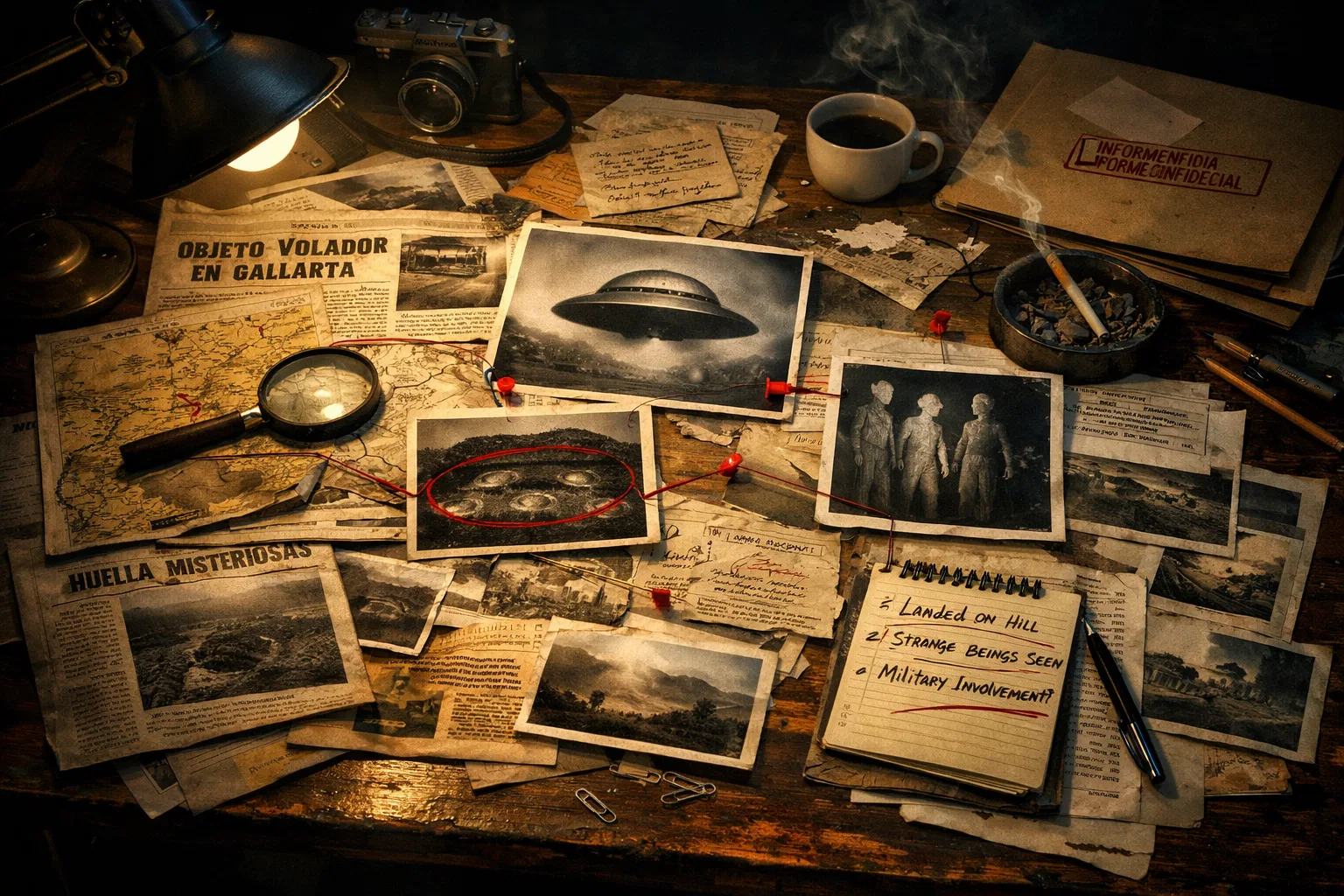
Gallarta became a Biscay UFO legend less because its strongest claims survived scrutiny than because they were repeatedly retold: first through local and national UFO journalism, then through specialist arguments, archive releases and later television treatment. The 1977 story had everything a memorable case needed: a mining spoil heap, alleged landing marks, a named technical witness, a second witness describing beings and repeated landings, and hints of military interest. But the same afterlife that kept it alive also weakened it. Air Force investigators doubted the central testimony, later field researchers traced the supposed landing holes to ordinary excavation work, and sceptical writers turned the case into a warning about how dramatic reporting can outrun evidence. Spain’s Defence archive still lists Gallarta as a 1977–1979 Air Operational Command file of 93 pages, declassified in January 1995, which makes it important in Biscay’s UFO history even though its evidential value is poor.[Biblioteca Virtual Defensa]bibliotecavirtual.defensa.gob.esOpen source on gob.es.
Why the story survived the first news cycle
Gallarta’s media afterlife began with the way the case entered public view. The first hook was concrete and local: reported “landing traces” on a spoil heap in Gallarta, alongside José Luis Lozón’s claim that he had seen a large, shiny, mushroom-like object lift off silently from the area. A story like that was easy to visualise. It did not ask readers to follow a vague light in the night sky; it offered an alleged physical site, marks on the ground and a witness presented as technically credible.[Magonia]magonia.comEncuentros en la tercera fase en Gallarta – MagoniaEncuentros en la tercera fase en Gallarta – Magonia
That local hook then expanded into a far richer close-encounter tale through Juan Sillero, Lozón’s father-in-law. Sillero’s reported account moved the case from “possible landing” to repeated encounters with occupants, telepathic communication, entry into the craft, warnings about the Earth, a small exploratory vehicle and even a mysterious stone. For UFO writers, this turned Gallarta into a narrative rather than a single observation. It had scenes, characters, dialogue, recurring visits and a landscape that could be made to feel uncanny.[Magonia]magonia.comEncuentros en la tercera fase en Gallarta – MagoniaEncuentros en la tercera fase en Gallarta – Magonia
The timing also helped. Spanish UFO culture in the 1970s was not a marginal online subculture; it was fed by newspapers, magazines, radio and popular authors. Ignacio Cabria, a historian of Spanish UFO culture, has described a “second generation” of Spanish UFO investigators who tried to apply more scientific methods, creating tensions with older, more belief-led or sensational approaches. That tension is exactly what Gallarta came to embody: one side retold it as a startling contact case, while another treated it as a test of method, corroboration and witness reliability.[valenciaplaza.com]valenciaplaza.comValencia PlazaIgnacio Cabria: "El periodismo ufológico ha preferido el sensacionalismo al enfoque científico |…
The case also gained durability because it was not merely a press item. The Spanish Air Force opened file 770213, and the Defence Ministry’s later online catalogue placed Gallarta among the national UFO file set. That archival status did not validate the extraordinary claims, but it gave the story a second life. A case listed in an official catalogue can be marketed and remembered as an “official UFO file” even when the file’s contents are sceptical or inconclusive.[Biblioteca Virtual Defensa]bibliotecavirtual.defensa.gob.esOpen source on gob.es.

Local press and UFO writers made Gallarta memorable
The strongest force behind Gallarta’s legend was not one piece of evidence but a chain of retellings. According to later summaries of the case, La Gaceta del Norte reported the Gallarta traces in March 1977, and Juan José Benítez then became one of the key popularisers of the story. Benítez’s style mattered: he did not simply note an odd report; he shaped it into a dramatic close-encounter narrative, highlighting the silence of the alleged craft, the strange marks and the spectacular claims of contact.[Magonia]magonia.comEncuentros en la tercera fase en Gallarta – MagoniaEncuentros en la tercera fase en Gallarta – Magonia
The press framing gave Gallarta several advantages over weaker provincial sightings. It had named protagonists. It had a recognisable place in Biscay’s industrial landscape. It had photographs or descriptions of marks that could be reproduced. It had the suggestion of official attention. And it had a storyline that escalated from a puzzling object to repeated meetings with beings. Each layer made the story easier to repeat, even as it became harder to verify.
The later afterlife shows the same pattern. In 2016, Cuarto Milenio revisited “the lights of Gallarta”, presenting the case around Sillero’s claim that something landed beside his home on two consecutive nights and left more than 80 large holes in the spoil heap. The programme page also framed the story as one of silences, hoaxes and alleged pressure from important people, which shows how the case remained useful as mystery television even after major sceptical objections had been available for decades.[Cuatro]cuatro.comArchivo Cámara: las luces de GallartaArchivo Cámara: las luces de Gallarta
Gallarta therefore survived because it was adaptable. Believers could emphasise the emotional force of Sillero’s story and the alleged military radar context. Sceptics could emphasise the contradictions, the weak physical evidence and the later admission about the holes. Broadcasters could use the atmosphere of a mining village, dogs barking, blinding lights and family silence. The same case could be a wonder story, a media story or a debunking story depending on which details were foregrounded.
What investigators found that weakened the legend
The key sceptical dismantling of Gallarta did not rest on a single objection. It came from several converging problems: the tone and reliability of the central testimony, the status of the supposed landing marks, and the difficulty of linking the close-encounter story to independent radar events.
The Air Force investigation reportedly became sceptical early. In Magonia’s account of the file, the military investigators found Sillero’s story strikingly fantastic and interrupted by claims that “they” were stopping him from speaking. The file’s later assessment, as summarised by Luis Alfonso Gámez, treated the information from Lozón and Sillero as not credible and raised doubts about Sillero’s mental balance. This does not prove that every element of the story was knowingly invented, but it does show that the official inquiry did not treat the close-encounter narrative as reliable evidence of a landed craft.[Magonia]magonia.comEncuentros en la tercera fase en Gallarta – MagoniaEncuentros en la tercera fase en Gallarta – Magonia
The landing marks were even more damaging. Félix Ares and the Colectivo Iván investigated the site and concluded that the supposed traces were not coherent landing marks. According to the later sceptical account, many holes were irregular and lay beside stones whose shapes matched them. The group then found a mundane explanation: a retroexcavator operator, Adrián Tramón, said he had made the holes while extracting mineral stones. Sillero later admitted in writing that the photographed holes published by Benítez were Tramón’s work, though he maintained that the “real” marks had been erased.[Magonia]magonia.comEncuentros en la tercera fase en Gallarta – MagoniaEncuentros en la tercera fase en Gallarta – Magonia
That admission is central to the case’s collapse. Gallarta’s press power depended heavily on the alleged physical traces. Once the published marks were explained as the by-product of mining or excavation activity, the case lost its most reader-friendly support. What remained was a dramatic testimony, but without solid physical backing and with official investigators already doubting the witness’s reliability.
The later cataloguing of the Spanish Air Force UFO archive by El Ojo Crítico likewise classifies several Gallarta entries from February, March and April 1977 as fraud, while one 13 February entry is described as containing suspicious elements in the testimony and low reliability. This is a secondary compilation rather than the original military file, but it is useful because it shows how Gallarta was absorbed into later sceptical and archival taxonomies: not as a classic unresolved case, but as a weak or fraudulent one.[elojocritico.info]elojocritico.infoOpen source on elojocritico.info.
The radar argument kept the dispute alive
The most resilient pro-Gallarta argument was not the beings or the landing holes. It was the claim that radar echoes over Biscay and fighter interceptions occurred on some of the same general nights, giving the story a military-aviation shadow. Benítez used a letter from the head of the 3rd Air Region to argue that unidentified radar echoes had been detected over Biscay and that aircraft had been sent up on two interception missions.[Magonia]magonia.comEncuentros en la tercera fase en Gallarta – MagoniaEncuentros en la tercera fase en Gallarta – Magonia
This mattered because radar evidence sounds independent. A strange witness account can be challenged as memory, invention or misinterpretation; radar echoes imply machines, records and air-defence procedures. In UFO culture, that kind of detail often acts as a credibility multiplier. It allows a case to be retold as “not just a witness story” even when the connection between the witness story and the radar events is weak.
The sceptical reply was that coincidence is not corroboration. Juan Carlos Victorio’s Misterios del Aire summary argues that later believers continued trying to connect the allegedly fraudulent landings, whose dates were imprecise, with unidentified echoes detected on specific nights by the Calatayud radar station. In other words, even if unusual radar returns occurred, that did not prove Sillero’s close encounters or the origin of the holes. The link needed to be demonstrated, not assumed.[misteriosdelaire.blogspot.com]misteriosdelaire.blogspot.comOpen source on blogspot.com.
That distinction is the heart of the Gallarta debate. A reader does not have to choose between “nothing happened anywhere” and “alien landings occurred in Gallarta”. The more careful assessment is that several strands were bundled together: a claimed visual sighting, a much more elaborate contact narrative, ground marks later explained by excavation, and radar material whose relationship to the close encounters remained contested. The bundle made the legend stronger in media terms, but not necessarily stronger in evidential terms.
From close encounter to cautionary tale
Gallarta’s later reputation changed because sceptical investigators reframed the case from “what landed?” to “how was this story built?” That shift is important for Biscay’s UFO history. The case is no longer interesting only as a possible close encounter; it is interesting as a local example of how dramatic claims can harden into folklore before the basic checks are complete.
The first caution is about physical evidence. The holes were persuasive because they looked like something a reader could inspect. Yet the later explanation was local, practical and unromantic: a machine working in a mining landscape could make marks that outsiders reinterpreted as landing traces. The lesson is not that every UFO trace case has the same explanation, but that local terrain, industry and ordinary labour matter. In Gallarta, the mining setting was not just atmospheric background; it was part of the explanation.
The second caution is about witness escalation. Lozón’s alleged observation of a silent object was already unusual, but Sillero’s account carried the case into highly elaborate contact territory. Once a case depends on telepathic messages, repeated private encounters and gifts from beings, independent corroboration becomes crucial. Without it, the story may remain culturally fascinating while becoming evidentially fragile.
The third caution is about official files. Spain’s Defence archive gives Gallarta a real documentary footprint: title, file number, Air Force authorship, dates, page count and declassification note. But an official file is not the same as official confirmation. El País made this point more broadly when reporting the Defence UFO files: an unidentified object is simply something not identified at the time, and many files point towards weather phenomena, balloons, non-matching testimony or other ordinary causes.[Biblioteca Virtual Defensa]bibliotecavirtual.defensa.gob.esOpen source on gob.es.
The fourth caution is about media recycling. When the case returned decades later in mystery television and online discussion, the strongest sceptical findings did not always carry the same emotional weight as the original images: lights, holes, dogs, silence and alleged pressure. That imbalance is common in UFO afterlives. The memorable story travels faster than the correction.
Why Gallarta still matters for Biscay
Gallarta is not Biscay’s strongest UFO case in the sense of being well supported. It matters because it is Biscay’s most documented and most argued-about UFO case. The Defence catalogue lists it as the province’s clear official-file anchor, while later press, television, sceptical blogs, specialist catalogues and archive records show that the argument did not end in 1977.[Biblioteca Virtual Defensa]bibliotecavirtual.defensa.gob.es› Title list…
Its value now is interpretive rather than evidential. Gallarta helps readers understand how a provincial UFO legend can form through the interaction of local press, charismatic UFO writers, official curiosity, vivid witnesses and later debunking. It also shows why “declassified” should not be read as “validated”. The file’s public availability makes the case easier to study, but the publicly traceable afterlife points towards weakening, not strengthening, the original extraordinary claim.
The case also sits at a turning point in Spanish UFO culture. Cabria’s account of a more scientifically minded generation clashing with sensational UFO journalism fits the Gallarta dispute closely. The argument between Benítez and the investigators around Ares was not just a disagreement over one spoil heap in Biscay. It was part of a wider fight over what UFO investigation should be: dramatic testimony and mystery-led storytelling, or fieldwork, contradiction-checking and willingness to discard a famous case when the evidence fails.[valenciaplaza.com]valenciaplaza.comValencia PlazaIgnacio Cabria: "El periodismo ufológico ha preferido el sensacionalismo al enfoque científico |…
For a modern reader, the fairest conclusion is that Gallarta should be treated as a cautionary legend. Something was reported; a file was opened; a story grew; the strongest physical claim was later undermined; and the remaining extraordinary narrative depends on testimony that investigators did not find reliable. That does not make Gallarta irrelevant. It makes it one of the clearest Biscay examples of how UFO history is often shaped as much by media afterlife and sceptical dismantling as by the original night of the sighting.
Amazon book picks
Further Reading
Books and field guides related to How Gallarta Became a UFO Legend. Use these as the next step if you want deeper reading beyond the article.
UFOs: Generals, Pilots, and Government Officials Go on the Re...
Balances skeptical and official perspectives.
eBay marketplace picks
Marketplace Samples
Live-tested eBay searches with available results related to this page.


Endnotes
1.
Source: magonia.com
Title: Encuentros en la tercera fase en Gallarta – Magonia
Link:https://magonia.com/2016/11/07/encuentros-en-la-tercera-fase-en-gallarta/
2.
Source: valenciaplaza.com
Title: Valencia Plaza
Link:https://valenciaplaza.com/noticas-cultura-valencia-comunitat-valenciana/noticia1953
Source snippet
Ignacio Cabria: "El periodismo ufológico ha preferido el sensacionalismo al enfoque científico |...
3.
Source: cuatro.com
Title: Archivo Cámara: las luces de Gallarta
Link:https://www.cuatro.com/cuarto-milenio/programas/archivo-camara-luces-gallarta_18_2286405072.html
4.
Source: elojocritico.info
Link:https://elojocritico.info/los-archivos-ovni-del-ejercito-del-aire-desglosados-quien-que-como/
5.
Source: misteriosdelaire.blogspot.com
Link:https://misteriosdelaire.blogspot.com/2016/
6.
Source: magonia.com
Title: Juan Sillero
Link:https://magonia.com/tag/juan-sillero/
7.
Source: labloga.blogspot.com
Title: chicanonautica j j benitez and his
Link:https://labloga.blogspot.com/2018/06/chicanonautica-j-j-benitez-and-his.html
8.
Source: elojocritico.info
Link:https://elojocritico.info/ufoleaks-6-los-jueces-instructores-de-los-expedientes-ovni-identificados-por-primera-vez/
9.
Source: mudancasnaterra.blogspot.com
Title: documentos ufologicos do governo
Link:https://mudancasnaterra.blogspot.com/2012/06/documentos-ufologicos-do-governo.html
10.
Source: misteriosdelaire.blogspot.com
Link:https://misteriosdelaire.blogspot.com/2016/10/
11.
Source: misteriosdelaire.blogspot.com
Title: los mejores expedientes vascos sobre
Link:https://misteriosdelaire.blogspot.com/2016/10/los-mejores-expedientes-vascos-sobre.html
12.
Source: misteriosdelaire.blogspot.com
Title: un robot extraterrestre en burgos
Link:https://misteriosdelaire.blogspot.com/2011/04/un-robot-extraterrestre-en-burgos.html
13.
Source: inexplicata.blogspot.com
Link:https://inexplicata.blogspot.com/2016/10/
14.
Source: bibliotecavirtual.defensa.gob.es
Link:https://bibliotecavirtual.defensa.gob.es/BVMDefensa/exp_ovni/en/consulta/busqueda_referencia.do?campo=idtitulo&idValor=395886
15.
Source: bibliotecavirtual.defensa.gob.es
Link:https://bibliotecavirtual.defensa.gob.es/BVMDefensa/exp_ovni/en/consulta/indice_campo.do?campo=idtitulo
Source snippet
› Title list...
16.
Source: bibliotecavirtual.defensa.gob.es
Title: defensa.gob.es Listado de títulos
Link:https://bibliotecavirtual.defensa.gob.es/BVMDefensa/exp_ovni/es/consulta/indice_campo.do?campo=idtitulo
17.
Source: exociencias.wordpress.com
Link:https://exociencias.wordpress.com/page/9/?app-download=blackberry
Additional References
18.
Source: youtube.com
Link:https://www.youtube.com/watch?v=D_lHYXXmg_A
Source snippet
A fondo - Conversamos con Luis Alfonso Gámez sobre el mundo del misterio y el peligro de la mentira...
19.
Source: youtube.com
Title: A fondo
Link:https://www.youtube.com/watch?v=WbKNsjx_e1Q
Source snippet
OVNIS ¿Desmontamos el mito? #HomoCuriosusFestival...
20.
Source: youtube.com
Title: Entrevista a Luis Alfonso Gámez
Link:https://www.youtube.com/watch?v=cezWIgYCl_w
Source snippet
«El despertar de los ovnis. Globos, secretos y extraterrestres», con Luis Alfonso Gámez...
21.
Source: youtube.com
Title: OVNIS ¿Desmontamos el mito? #Homo Curiosus Festival
Link:https://www.youtube.com/watch?v=eTC9Q-2w7po
Source snippet
Ancient Aliens: el mito más burdo (y más racista). Con Luis Alfonso Gámez...
22.
Source: skepticalinquirer.org
Link:https://skepticalinquirer.org/wp-content/uploads/sites/29/2009/01/p47.pdf?ref=thegalacticmind.com
23.
Source: calameo.com
Link:https://www.calameo.com/books/0038244240258da77d4ca
24.
Source: cineciutat.org
Link:https://www.cineciutat.org/es/pelicula/encuentros-en-la-tercera-fase
25.
Source: abebooks.co.uk
Link:https://www.abebooks.co.uk/9788460470779/ufologos-creyentes-contactados-historia-social-8460470776/plp
26.
Source: academia.edu
Link:https://www.academia.edu/116893052/Entre_uf%C3%B3logos_creyentes_y_contactados_Una_historia_social_de_los_ovnis_en_Espa%C3%B1a
27.
Source: amazon.com
Link:https://www.amazon.com/-/es/Entre-ufo%CC%81logos-creyentes-contactados-historia/dp/8460470776?tag=searcht-20
Topic Tree