Within Zaragoza UFOs
When Radar Made a Light Look Serious
The March 1980 sightings combine military witnesses, radar echoes, and later doubts about Venus and false returns.
On this page
- The Academy and air base reports
- What the radar echo added to the story
- Why later assessments stayed cautious
Page outline Jump by section
Introduction
The March 1980 radar-visual reports at Zaragoza Base are important because they look, at first glance, like a stronger-than-usual UFO case: military witnesses, a bright object seen near the Academy, and radar echoes reported by the base’s Ground Controlled Approach unit. The Spanish Air Force file, later declassified, covers 29, 30 and 31 March 1980 and runs to 32 pages in the surviving public copy.[J.J. Benítez]planetabenitez.comzaragoza 29 30 y 31 de marzo de 1980zaragoza 29 30 y 31 de marzo de 1980
The case matters within Zaragoza’s UFO history because it sits exactly where local folklore becomes official paperwork. A senior officer and family members reportedly watched a brilliant, oddly shaped light for about half an hour; a controller then reported a small primary radar echo in roughly the same area. Yet the later assessment was cautious rather than dramatic: the visual report could have involved a very bright astronomical body, while the radar returns could have been false echoes or, in one interpretation, a light aircraft not under control.[heraldo.es]heraldo.esDefensa publica cuatro informes sobre ovnis vistos enDefensa publica cuatro informes sobre ovnis vistos en
Why this Zaragoza case sounds stronger than a normal light-in-the-sky report
Most UFO reports weaken quickly because they depend on one person’s memory of a distant light. The Zaragoza case is more interesting because it combines three features that usually raise the evidential temperature: a military setting, multiple human observers, and a radar element. The main visual sighting was linked to the General Military Academy area in Zaragoza, while the radar checks involved the air base’s control environment. Heraldo de Aragón’s account of the declassified files says the first sighting was reported on 29 March 1980 by the Colonel Head of Studies at the Academy and eight members of his family, who watched a very bright object for about thirty minutes between 21:45 and 22:15.[heraldo.es]heraldo.esDefensa publica cuatro informes sobre ovnis vistos enDefensa publica cuatro informes sobre ovnis vistos en
The location also matters. Zaragoza was not just any city sky. Zaragoza Airport and the air base shared a Cold War aviation landscape shaped by the 1953 Spain-US agreement, under which Valenzuela air station was selected for joint military use and major runway and facility upgrades followed.[Aena]aena.esOpen source on aena.es. That background does not make the object extraordinary, but it explains why a bright light near the Academy and base would be treated as an airspace question rather than as a purely private curiosity.
The official file’s public catalogue entry places the report inside Spain’s broader declassified Air Force UFO archive. Spain’s Ministry of Defence describes that archive as 80 files and about 1,900 pages on unusual aerial phenomena in Spanish airspace involving, in some way, Air Force personnel or material.[Biblioteca Virtual Defensa]bibliotecavirtual.defensa.gob.esBiblioteca Virtual Defensa Expedientes OVNIBiblioteca Virtual Defensa Expedientes OVNI Zaragoza’s March 1980 report is one of the Aragonese entries in that national set, and one of the few in the province with an explicit radar-visual character.[Biblioteca Virtual Defensa]bibliotecavirtual.defensa.gob.esBiblioteca Virtual Defensa Title listBiblioteca Virtual Defensa Title list
The Academy and air-base reports
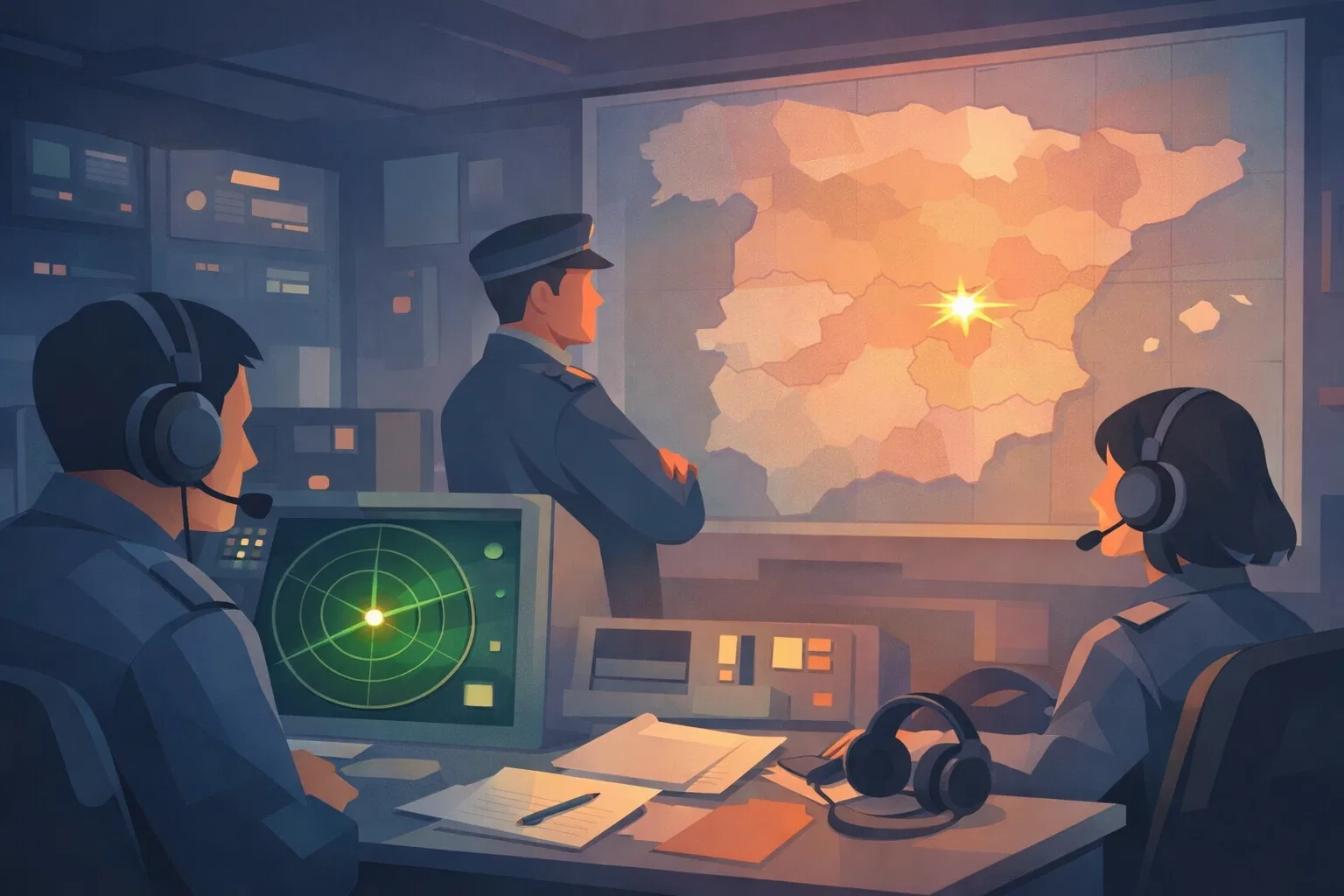
The core visual claim is simple but memorable. Witnesses at the General Military Academy described a very bright object, later reported in local summaries as having a shape compared to a lemon squeezer. The object was said to remain visible for about half an hour and then disappear abruptly.[heraldo.es]heraldo.esDefensa publica cuatro informes sobre ovnis vistos enDefensa publica cuatro informes sobre ovnis vistos en
That description is vivid, but it is also exactly the kind of description that needs caution. A bright planet or star seen through atmospheric haze, binoculars, thin cloud, or expectation can appear to pulse, flare, blur, or acquire a halo. Shape descriptions are especially fragile when the object is a bright point source rather than a clearly resolved body. In this case, the later classification lists the Academy observation as a nocturnal light and gives the assessment as the planet Venus.[El Ojo Critico]elojocritico.infoOpen source on elojocritico.info.
The air-base side of the story came through radar checks. According to the Heraldo summary, a Zaragoza base air controller detected a primary radar echo at the height or direction of the General Military Academy.[heraldo.es]heraldo.esDefensa publica cuatro informes sobre ovnis vistos enDefensa publica cuatro informes sobre ovnis vistos en Primary radar means the system is receiving a reflected signal from something, rather than relying on a transponder reply from a co-operative aircraft. That is useful because it can detect non-transponding targets, but it is also more exposed to ambiguity: clutter, reflections, atmospheric bending, terrain effects, small aircraft, and other unwanted returns can all complicate interpretation.
The declassified-file index compiled by El Ojo Crítico lists the 29 March entry as a radar-visual case at Zaragoza Air Base, with the assessment “Venus and false radar echoes”; it also lists a 30 March Academy entry assessed as Venus.[El Ojo Critico]elojocritico.infoOpen source on elojocritico.info. This is the key tension in the case. The file did not simply ignore the radar element. It treated the radar element as real enough to discuss, but not strong enough to prove that the visual object and the radar echo were the same thing.
What the radar echo added to the story
Radar made the Zaragoza report more serious because it appeared to give the sighting an independent technical trace. A person can misidentify Venus; a radar screen seems, at first, less subjective. That is why radar-visual cases often become durable in UFO history. They create the impression of two separate lines of evidence pointing to the same unknown object.
The difficulty is that “radar echo” is not the same as “confirmed aircraft” or “confirmed physical craft”. Aviation radar is a powerful but imperfect surveillance tool. SKYbrary, an aviation safety resource, defines radar clutter as unwanted signals on a display and notes that clutter can cause false alarms, including objects being recognised as aircraft or duplicated targets with wrong range or bearing.[Skybrary]skybrary.aeroOpen source on skybrary.aero. The FAA’s Aeronautical Information Manual also warns that anomalous propagation, or ducting, can bend radar pulses and cause extraneous blips to appear on a radar display.[Federal Aviation Administration]faa.govOpen source on faa.gov.
That technical background fits the caution in the Zaragoza file. The radar contact was described as small, slow and primary, reportedly comparable in size to a light aircraft echo. Heraldo’s summary of the file says the radar echoes “could” have been those of a light aircraft without contact with air-traffic agencies.[heraldo.es]heraldo.esDefensa publica cuatro informes sobre ovnis vistos enDefensa publica cuatro informes sobre ovnis vistos en The El Ojo Crítico index gives the final assessment even more sceptically: Venus plus false radar echoes.[El Ojo Critico]elojocritico.infoOpen source on elojocritico.info.
There is also a timing problem. A radar return lasting only a few minutes does not automatically validate a visual light reportedly watched for about half an hour. For the radar to strengthen the case decisively, investigators would need a clean match between the visual object’s direction, time, movement, elevation, and disappearance, and the radar target’s bearing, range, speed, and track. The published summaries instead point to ambiguity: the file notes inconsistencies between testimony and the investigating officer’s account, and does not treat the visual and radar elements as proven to be one object.[heraldo.es]heraldo.esDefensa publica cuatro informes sobre ovnis vistos enDefensa publica cuatro informes sobre ovnis vistos en

Why Venus became the leading explanation
Venus is a recurring explanation in Spanish Air Force UFO files because it can be exceptionally bright and is often seen low in the sky around dusk or after sunset. In the Zaragoza archive sequence, the December 1979 Barcelona-Zaragoza flight case is also listed with a Venus-related assessment, showing that investigators were already applying astronomical checks to aviation-linked reports in the province.[El Ojo Critico]elojocritico.infoOpen source on elojocritico.info.
The March 1980 Academy sighting fits the pattern of a bright, largely stationary light. The official and later secondary summaries do not say that the witnesses were careless. They say the evidential record is not strong enough to support the presence of an extraordinary aerial object. Heraldo quotes the file’s conclusion that there were no reliable proofs to admit the presence of UFOs and that the first witness’s observation could have been a very luminous celestial body.[heraldo.es]heraldo.esDefensa publica cuatro informes sobre ovnis vistos enDefensa publica cuatro informes sobre ovnis vistos en
That matters because witness quality and object identity are separate questions. A senior military observer may give a careful account and still misinterpret a bright astronomical object under unusual viewing conditions. The credibility of the witness can improve the quality of the report, but it cannot by itself turn a point of light into a structured craft.
The “lemon squeezer” shape is the most colourful detail, but also the most vulnerable. When a brilliant point of light is seen through binoculars or through disturbed air, the apparent shape can come from glare, optical distortion, focus, atmospheric shimmer, or the observer’s attempt to describe a non-sharp image. The later Venus assessment does not prove that every reported detail was caused by Venus; it means the file’s reviewers found an ordinary bright-object explanation more plausible than an unknown craft.
Why later assessments stayed cautious
The cautious reading of the Zaragoza case rests on three main points.
First, the dates and sequence are not perfectly clean. The public summaries describe the file as covering 29, 30 and 31 March 1980, while the strongest visual account is usually tied to the evening of 29 March and later references suggest possible repeat observations.[J.J. Benítez]planetabenitez.comzaragoza 29 30 y 31 de marzo de 1980zaragoza 29 30 y 31 de marzo de 1980 Multi-night reports can be important when they show a pattern, but they can also increase confusion if times, witnesses and exact directions are not separated clearly.
Second, the radar and visual data do not lock together. The radar contact sounds important because it was reported from an air-base environment, but the available summaries do not establish a firm one-to-one match with the bright light seen from the Academy. A small, slow primary echo near the base could be a light aircraft, a false return, or another radar artefact. Primary radar can detect non-cooperative targets, but it can also display unwanted or misleading returns, especially close to the radar or under propagation conditions.[Skybrary]skybrary.aeroOpen source on skybrary.aero.
Third, the official conclusion itself was restrained. The case was declassified in 1995, and the catalogue-style summaries place it not among the strongest unresolved Spanish cases but among reports assessed as Venus and false radar echoes, or Venus for the Academy entry.[J.J. Benítez]planetabenitez.comzaragoza 29 30 y 31 de marzo de 1980zaragoza 29 30 y 31 de marzo de 1980 That does not erase the event from Zaragoza’s UFO history. It changes what the event is useful for.
The most balanced assessment is that the March 1980 Zaragoza reports are not a confirmed close encounter, nor a cleanly solved case in every detail. They are a good example of how a striking visual report can become more impressive when radar is mentioned, and then less decisive once investigators ask whether the two forms of evidence truly correspond.
What the case contributes to Zaragoza’s UFO history
The March 1980 reports deserve a place in Zaragoza’s UFO record because they show the province’s distinctive pattern: air-base proximity, military witnesses, official investigation, and later sceptical reinterpretation. Zaragoza’s UFO history is not built mainly on spectacular rural folklore. It is built on aviation-linked episodes in which ordinary explanations had to be tested against disciplined witness reports and formal paperwork.
This case also helps readers understand why “radar-visual” should not be treated as a magic phrase. Radar can strengthen a sighting when the track is clear, persistent, correlated with visual observation, and checked against known traffic and technical faults. In Zaragoza, the radar element raises the case above a casual skywatching story, but the uncertainties keep it below the level of a robust unexplained incident.
The result is a case that is more valuable as a lesson than as a mystery trophy. It shows how a bright light near a sensitive military environment can generate alarm, how radar can add apparent weight, and how later review can pull the claim back towards Venus, false returns, or an uncoordinated light aircraft. In the wider Zaragoza branch, it pairs naturally with the December 1979 Barcelona-Zaragoza flight report: both are aviation-linked, both involve serious witnesses, and both became less extraordinary under later assessment.
Amazon book picks
Further Reading
Books and field guides related to When Radar Made a Light Look Serious. Use these as the next step if you want deeper reading beyond the article.

eBay marketplace picks
Marketplace Samples
Live-tested eBay searches with available results related to this page.
Endnotes
1.
Source: heraldo.es
Title: Defensa publica cuatro informes sobre ovnis vistos en
Link:https://www.heraldo.es/noticias/aragon/2016/10/23/defensa-publica-informes-sobre-ovnis-vistos-aragon-1124384-300.html
2.
Source: aena.es
Link:https://www.aena.es/en/zaragoza/get-to-know-us/history.html
3.
Source: skybrary.aero
Link:https://skybrary.aero/articles/radar-clutter
4.
Source: faa.gov
Link:https://www.faa.gov/air_traffic/publications/atpubs/AIM/aim0405.html
5.
Source: skybrary.aero
Link:https://skybrary.aero/articles/primary-surveillance-radar-psr
6.
Source: war.gov
Link:https://www.war.gov/ufo/
7.
Source: ia601405.us.archive.org
Link:https://ia601405.us.archive.org/28/items/B-001-014-055/B-001-014-055.pdf
8.
Source: aena.es
Link:https://www.aena.es/en/sabadell/get-to-know-us/history.html
9.
Source: aena.es
Link:https://www.aena.es/en/zaragoza/get-to-know-us/presentation.html
10.
Source: aena.es
Title: Historia de los aeropuertos de Zaragoza
Link:https://www.aena.es/sites/Satellite?Language=en_GB&c=VentaPub_C&cid=1575083464703&pagename=VentaPublicaciones
11.
Source: heraldo.es
Link:https://www.heraldo.es/especiales/reportajes/base-americana-zaragoza/
12.
Source: heraldo.es
Title: defensa publica los expedientes ovni desclasificados 1123727 305
Link:https://www.heraldo.es/noticias/nacional/2016/10/23/defensa-publica-los-expedientes-ovni-desclasificados-1123727-305.html
13.
Source: skybrary.aero
Title: Bookshelf Hind Sight 20
Link:https://skybrary.aero/bookshelf-items
14.
Source: skybrary.aero
Link:https://skybrary.aero/articles/secondary-surveillance-radar-ssr
15.
Source: skybrary.aero
Link:https://skybrary.aero/articles/weather-radar-storm-avoidance
16.
Source: skybrary.aero
Link:https://skybrary.aero/sites/default/files/bookshelf/5391.pdf
17.
Source: zaragoza.es
Link:https://www.zaragoza.es/contenidos/cultura/publicaciones/11703.pdf
18.
Source: faa.gov
Link:https://www.faa.gov/air_traffic/publications/atpubs/aim_html/chap4_section_5.html
19.
Source: planetabenitez.com
Title: zaragoza 29 30 y 31 de marzo de 1980
Link:https://planetabenitez.com/zaragoza-29-30-y-31-de-marzo-de-1980/
20.
Source: elojocritico.info
Link:https://elojocritico.info/los-archivos-ovni-del-ejercito-del-aire-desglosados-quien-que-como/
21.
Source: bibliotecavirtual.defensa.gob.es
Title: Biblioteca Virtual Defensa Expedientes OVNI
Link:https://bibliotecavirtual.defensa.gob.es/BVMDefensa/exp_ovni/es/micrositios/inicio.do
22.
Source: bibliotecavirtual.defensa.gob.es
Title: Biblioteca Virtual Defensa Title list
Link:https://bibliotecavirtual.defensa.gob.es/BVMDefensa/exp_ovni/en/consulta/indice_campo.do?campo=idtitulo
23.
Source: bibliotecavirtual.defensa.gob.es
Title: Biblioteca Virtual Defensa Listado de títulos
Link:https://bibliotecavirtual.defensa.gob.es/BVMDefensa/exp_ovni/es/consulta/indice_campo.do?campo=idtitulo
24.
Source: publicaciones.defensa.gob.es
Title: raa 590
Link:https://publicaciones.defensa.gob.es/media/downloadable/files/links/r/a/raa_590.pdf
25.
Source: defensa.gob.es
Link:https://www.defensa.gob.es/Galerias/documentacion/revistas/2010/10-259.pdf
26.
Source: bibliotecavirtual.defensa.gob.es
Link:https://bibliotecavirtual.defensa.gob.es/
27.
Source: bibliotecavirtual.defensa.gob.es
Title: defensa.gob.es Consulta › Búsqueda
Link:https://bibliotecavirtual.defensa.gob.es/BVMDefensa/es/consulta/busqueda.do
28.
Source: Wikipedia
Title: Zaragoza Airport
Link:https://en.wikipedia.org/wiki/Zaragoza_Airport
29.
Source: nationalarchives.gov.uk
Link:https://www.nationalarchives.gov.uk/explore-the-collection/explore-by-time-period/postwar/ufo-reports/
30.
Source: kids.kiddle.co
Title: Zaragoza Airport
Link:https://kids.kiddle.co/Zaragoza_Airport
31.
Source: planetabenitez.com
Title: avistamiento de fenomenos extranos en zaragoza 29 30 y 31 de marzo de 1980
Link:https://planetabenitez.com/wp-content/uploads/2023/11/avistamiento-de-fenomenos-extranos-en-zaragoza-29-30-y-31-de-marzo-de-1980.pdf
32.
Source: biblioteca.sicyt.gob.ar
Link:https://biblioteca.sicyt.gob.ar/recursos/BVMDEF
33.
Source: 1991-new-world-order.fandom.com
Title: Zaragoza Air Base
Link:https://1991-new-world-order.fandom.com/wiki/Zaragoza_Air_Base
34.
Source: cobdcv.es
Title: biblioteca virtual defensa puerta acceso patrimonio cultural defensa
Link:https://cobdcv.es/simile/biblioteca-virtual-defensa-puerta-acceso-patrimonio-cultural-defensa/
Additional References
35.
Source: youtube.com
Title: Night Flying
Link:http://www.youtube.com/watch?v=nqqMj_tLBzI
Source snippet
This selection includes expert overviews from aviation educators on how night illusions impact vision during operations, alongside analyt...
36.
Source: youtube.com
Title: How Military Sensors Proved UFO Craft Were Physically Real | WION Podcast
Link:http://www.youtube.com/watch?v=H6eK1VbrHPY
Source snippet
Military UFO Footage Shows Objects With No Heat Signature | WION Podcast...
37.
Source: archives.gov
Link:https://www.archives.gov/research/topics/uaps
38.
Source: cia.gov
Link:https://www.cia.gov/readingroom/document/cia-rdp81r00560r000100010001-0
39.
Source: researchgate.net
Link:https://www.researchgate.net/publication/3205910_Classification_of_Ground_Clutter_and_Anomalous_Propagation_Using_Dual-Polarization_Weather_Radar
40.
Source: academia.edu
Link:https://www.academia.edu/35429868/Los_expedientes_OVNI_desclasificados_Online
41.
Source: faraim.org
Link:https://faraim.org/faa/aim/chapter-4/section-4-5-1.html
42.
Source: reddit.com
Link:https://www.reddit.com/r/sailing/comments/1gctdeq/alubat_ovni_370_ballast_and_centerboard_for_ocean/
43.
Source: reddit.com
Link:https://www.reddit.com/r/aviation/comments/179udv8/anyone_know_why_wx_radar_was_picking_up_a_return/
44.
Source: quizlet.com
Link:https://quizlet.com/419475825/block-1-section-7-radar-flash-cards/
Topic Tree