Within Cuenca UFOs
How Do Repeated Lights Become Local Lore?
Solera de Gabaldon's repeated lights show how local UFO traditions can grow from shared sightings, uncertainty and retelling.
On this page
- What residents reportedly saw
- Possible ordinary explanations
- How repetition shapes a village mystery
Page outline Jump by section
Introduction
Solera de Gabaldón matters in Cuenca’s UFO history because it is not a single well-documented official case, but a small village example of how repeated lights can become local lore. The central claim is simple: residents reportedly saw unusual coloured lights over or near the village in summer, more than once, with some accounts describing a large silent light near the Fuente de la Arena area and later sightings of red, yellow or orange lights appearing in the same direction. The evidence is thin: mainly a local blog testimony, later radio treatment by Cadena SER Cuenca, and retellings that preserve the mystery rather than resolve it. That does not make the story worthless. It makes Solera de Gabaldón useful as a case family: a way to understand how shared sightings, rural darkness, memory, place names and repeated retelling turn uncertain lights into a remembered village mystery.[solera-de-gabaldon.blogspot.com]solera-de-gabaldon.blogspot.comOpen source on blogspot.com.
What Residents Reportedly Saw
The most detailed public account comes from a local Solera de Gabaldón blog entry published in December 2007. The writer says there had been several UFO sightings in the village, including one he personally witnessed with many other people, but he also admits a major weakness: he did not record the exact date. The first described case is placed roughly 20 years earlier and in August. According to the account, people had gathered behind a house and were looking towards Fuente de la Arena, where they saw a strange light. The writer says he alerted his family, more people joined, and around 20 witnesses eventually watched it.[solera-de-gabaldon.blogspot.com]solera-de-gabaldon.blogspot.comOpen source on blogspot.com.
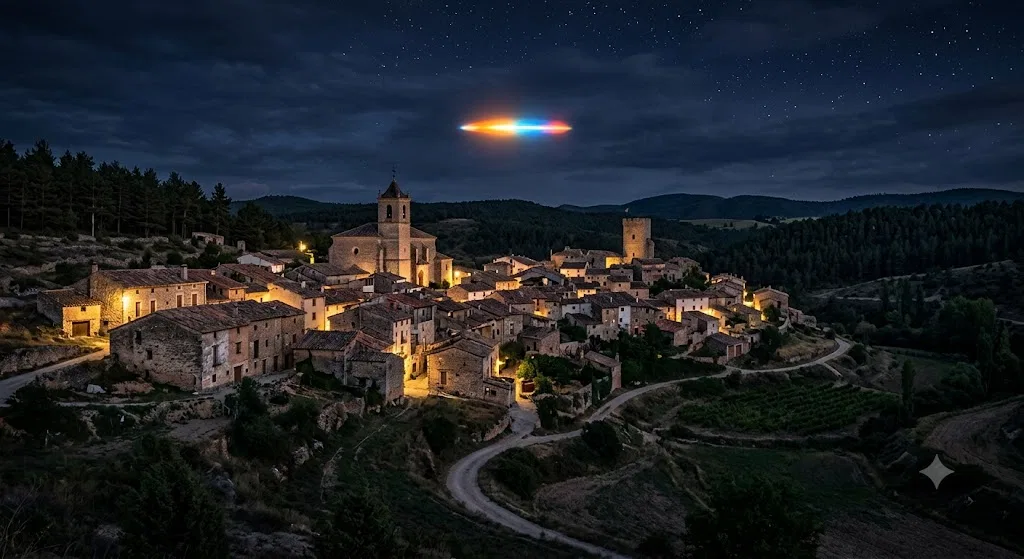
The reported light had several features that explain why it stayed in local memory. It was said to be static, silent, elongated, and visibly large from the village. The witness described changing colours — red, yellow, bluish and orange — and said binoculars did not reveal a solid craft, windows, landing gear or metallic structure, only an immense light. That last detail is important. Even in the believer-friendly account, the object is not described as a clearly seen machine; it is described as light.[solera-de-gabaldon.blogspot.com]solera-de-gabaldon.blogspot.comOpen source on blogspot.com.
The dramatic part of the story comes when several people reportedly drove towards the area. The witness says that as they approached, the light rose, made a zig-zag movement and disappeared rapidly across the sky. This is the strongest narrative hook in the Solera story, but also the point at which evidential caution matters most. There is no photograph, no official report, no trace inspection, no recorded weather data tied to a precise date, and no independent contemporary press item attached to the original event in the source itself. The story is vivid, but not verifiable in the way Cuenca’s 1968 aviation sighting is, because the 1968 case has an Air Force file in Spain’s Defence virtual library.[solera-de-gabaldon.blogspot.com]solera-de-gabaldon.blogspot.comOpen source on blogspot.com.
The same blog records a second pattern rather than a single incident: later summer lights in the same general direction, but higher in the sky. These were described as red balls changing to yellow or orange, appearing at the same time of night over about a week, sometimes dividing into smaller lights, moving around, and merging again. That repetition is what turns Solera de Gabaldón from a one-night claim into a local “recurring lights” tradition. It also makes ordinary explanations more, not less, important, because repeated timings and repeated directions are often exactly what investigators need to test against planets, aircraft routes, balloons, distant vehicles, atmospheric effects or local activity.[solera-de-gabaldon.blogspot.com]solera-de-gabaldon.blogspot.comOpen source on blogspot.com.
A third, older-sounding strand in the same source is not a modern UFO claim at all. It tells of a shepherd lost during a storm who was reportedly guided back towards the village by lights that appeared near or beyond his donkey’s ears, then vanished. The blog itself records a possible explanation suggested within the family tradition: St Elmo’s fire, an electrical glow associated with strong atmospheric electric fields. NOAA describes St Elmo’s Fire as a colourful discharge of atmospheric electricity, typically during thunderstorms, when a sharp object in a high electrical field can produce a glow. That does not prove the shepherd story was St Elmo’s fire, but it shows how an older rural light story can sit halfway between weather, fear, religion, memory and later paranormal interpretation.[solera-de-gabaldon.blogspot.com]solera-de-gabaldon.blogspot.comOpen source on blogspot.com.
Why Solera Became a Village Mystery
Solera de Gabaldón is a small Cuenca municipality in the Serranía Baja area, surrounded by rural tracks, pine woods, farmland and open views. Regional tourism material presents it as a quiet rural place with immediate access to paths, forested areas and small hills, while local descriptions place it around 55 kilometres from Cuenca and at roughly 1,047 metres above sea level. Those details matter because light traditions are shaped by landscape. In a quiet village, a distant light can appear more dominant than it would in a town full of traffic, street lighting and visual noise.[Turismo Castilla-La Mancha]turismocastillalamancha.esOpen source on turismocastillalamancha.es.
The village’s local identity also gives the story somewhere to attach. Cadena SER Cuenca’s 2018 report framed Solera de Gabaldón as a place where history and mystery mix, mentioning the remains linked to earlier settlement, the Torre Vigía and the church, before turning to the summer lights. That framing is not neutral evidence for the sightings, but it helps explain how the lights are remembered: they are folded into a broader sense that the village has old layers, ruins, buried history and unresolved stories.[Cadena SER]cadenaser.comOpen source on cadenaser.com.
This is how a local UFO tradition often grows. A puzzling observation is first shared among neighbours. It becomes tied to a named location, such as Fuente de la Arena. A few memorable details survive: the silence, the colours, the size, the cars driving closer, the sudden departure. Later sightings are interpreted through the earlier one. A radio feature then gives the story a public form, and a village anecdote becomes part of Cuenca’s wider catalogue of strange lights. Cadena SER’s article explicitly says the summer lights were still talked about in the village and that the events were not isolated, but repeated more than once.[Cadena SER]cadenaser.comOpen source on cadenaser.com.
The mechanism is not unique to UFO stories. Folklore and memory studies treat local narratives as things that are preserved, reshaped and transmitted through social settings, not simply stored like recordings. A 2023 article on folkloric memory describes the close relationship between folklore, memory and cultural narratives, including the way inherited stories are received, reconfigured and carried in communities. For Solera, that means the key question is not only “what was the light?” but also “how did the village keep the light meaningful?”[Sage Journals]journals.sagepub.comSage Journals Folkloric memory: (Re)connecting the dots for broader perspectivesSage Journals Folkloric memory: (Re)connecting the dots for broader perspectives
Possible Ordinary Explanations
The Solera reports are too imprecise to debunk cleanly. There is no exact date for the main August sighting, no fixed duration, no recorded azimuth or elevation, and no documented check against aviation, weather or astronomy. The responsible conclusion is therefore not “explained”, but “weakly evidenced and open to several ordinary explanations”.
One possibility is misidentified astronomical objects. NASA’s Night Sky Network notes that Venus, Sirius, Jupiter and Mercury are commonly reported as UFOs, especially when bright and low near the horizon; bright planets near the horizon can even appear as formations of strange lights. This does not fit every detail in the Solera account, especially the alleged rapid departure, but it is relevant to repeated lights seen at similar times and in similar directions over several evenings.[Night Sky Network]nightsky.jpl.nasa.govNews & Resources | Night Sky Network…
A second possibility is atmospheric distortion. Distant lights near the horizon can change colour, flicker, appear to wobble, and seem larger or stranger than they are, especially over uneven terrain and in temperature layers. The Solera account’s emphasis on changing colours and the inability to resolve structure through binoculars is compatible with a light source distorted by distance or atmosphere, though not enough to identify it. NASA’s general UFO-identification guidance also lists weather balloons, satellites, meteors, fireballs, aircraft, rockets and unusual clouds among common sources of mistaken UFO reports.[Night Sky Network]nightsky.jpl.nasa.govNews & Resources | Night Sky Network…
A third possibility is a balloon or illuminated object. Cuenca’s best official UFO case, the 5–6 September 1968 file covering Madrid, Toledo, Cuenca and Pamplona, shows why this explanation should not be dismissed. That Defence record is an 18-page declassified Air Force file, and the broader case has often been discussed in relation to balloon-like observations. It is not evidence for Solera, but it is a useful provincial comparison: even trained observers can report striking aerial lights that later sit close to a conventional explanation.[Biblioteca Virtual Defensa]bibliotecavirtual.defensa.gob.esOpen source on gob.es.
A fourth possibility concerns storm electricity in the older shepherd tradition. The blog itself preserves the suggestion of St Elmo’s fire, and NOAA’s description of the phenomenon fits the broad category of a coloured electrical glow during storm conditions. Yet the match is imperfect. St Elmo’s fire is usually associated with sharp or elevated objects in a strong electrical field, not free-floating guide lights moving along a path. It is best treated as a plausible natural analogy, not a solved identification.[solera-de-gabaldon.blogspot.com]solera-de-gabaldon.blogspot.comOpen source on blogspot.com.
There are also human factors. In a group sighting, people influence one another’s attention and interpretation. When several neighbours are already looking at a strange light, later arrivals may inherit the mood before they form a fully independent judgement. That does not mean they are lying. It means collective sightings can be socially powerful while still being observationally fragile, especially when no one records the time, direction, photographs, weather conditions or follow-up checks.
How Repetition Shapes a Village Mystery
The most interesting feature of the Solera de Gabaldón material is repetition. A one-off light may be forgotten; a light that appears in the same direction, at the same time, over several nights starts to look patterned. Pattern is what turns uncertainty into lore. It gives the community a reason to ask whether the village has a special sky, a special place, or a recurring presence.
But repetition cuts two ways. For a mystery-minded reader, repetition feels stronger because multiple observations seem to confirm one another. For an investigator, repetition can make a case more testable. If lights appeared at the same hour and in the same direction over a week, the first checks would be astronomical visibility, aircraft schedules, satellite passes, local road alignments, agricultural activity, military or civil aviation notices, and weather conditions. Without the exact date, those tests cannot be run properly. The very detail that makes the story memorable — “it happened over about a week” — remains too loose to verify.[solera-de-gabaldon.blogspot.com]solera-de-gabaldon.blogspot.comOpen source on blogspot.com.
Retelling also compresses uncertainty. The blog account is careful in one respect: it says the witness could not speak of a spacecraft, only of a large unsettling light. Later summaries often headline the strangeness, because that is the part readers remember. Cadena SER’s 2018 article likewise presents the lights as unexplained and still discussed, while placing them in a radio slot devoted to Cuenca mysteries. That media setting helps preserve the story, but it also nudges the reader towards mystery before evidence.[solera-de-gabaldon.blogspot.com]solera-de-gabaldon.blogspot.comOpen source on blogspot.com.
The Solera tradition therefore sits between UFO history and local oral history. It is part of Cuenca’s UFO map because it has been publicly reported as repeated unusual lights, associated with named witnesses and a named village. Yet its evidential status is very different from an official case file. The Ministry of Defence file for the 1968 Cuenca-related sighting has a title, date, institutional author, page count and declassification note. Solera’s light tradition has remembered testimony, local identity and later media interest. Both belong to UFO culture, but they should not be weighed the same way.[Biblioteca Virtual Defensa]bibliotecavirtual.defensa.gob.esOpen source on gob.es.
What the Solera Lights Add to Cuenca’s UFO History
Solera de Gabaldón adds a human-scale example to a province whose UFO history is otherwise scattered across official paperwork, aviation sightings, local press and village narratives. It shows how a UFO tradition can form without radar returns, photographs or military files. A group of residents see something odd; the sighting is linked to a familiar place; similar lights are remembered later; an older storm-light tale is pulled into the same atmosphere; and eventually local media turns the cluster into a public-facing mystery.[Cadena SER]cadenaser.comOpen source on cadenaser.com.
Its value is not that it proves an extraordinary craft visited Solera. The sources do not support that. Its value is that it shows the mechanics of provincial UFO memory more clearly than a famous, over-polished case might. The first report even contains a useful restraint: the witness says he cannot call it a spacecraft, only a huge coloured light he cannot explain. That distinction is exactly what balanced UFO history needs.[solera-de-gabaldon.blogspot.com]solera-de-gabaldon.blogspot.comOpen source on blogspot.com.
Within Cuenca, Solera also provides a contrast with the 1968 Iberia-related case. The 1968 sighting belongs to the official archive and can be examined as an aviation and Defence-file episode. Solera belongs to village testimony and recurring light tradition. One asks how institutions handled an aerial report; the other asks how communities remember lights when formal investigation is absent. Together, they show why Cuenca’s UFO record is less a single dramatic story than a layered provincial pattern of sightings, explanations, retellings and unresolved gaps.[Biblioteca Virtual Defensa+2Cadena SER]bibliotecavirtual.defensa.gob.esOpen source on gob.es.
The fairest classification is therefore: locally significant, culturally interesting, but weak as evidence for anything beyond repeated reports of unusual lights. Later reporting kept the story alive, but did not substantially strengthen the original claim. No public source found so far adds a dated official investigation, photographs, police notes, aviation data, astronomical reconstruction or physical traces. That leaves Solera de Gabaldón as one of Cuenca’s clearest examples of how repeated lights become lore: not because certainty grows, but because uncertainty is shared, named, revisited and remembered.
Amazon book picks
Further Reading
Books and field guides related to How Do Repeated Lights Become Local Lore?. Use these as the next step if you want deeper reading beyond the article.
UFOs: Generals, Pilots, and Government Officials Go on the Re...
Gives broader documented UFO context for readers moving beyond Solera's weak evidence.
The Demon-Haunted World: Science as a Candle in the Dark
Supports the page's careful handling of perception, memory and ordinary explanations.
UFOs Explained
Pairs with the page's discussion of how repeated lights may have ordinary causes.
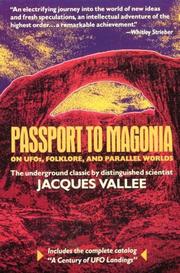
Passport to Magonia: from folklore to flying saucers
Matches the page's focus on how unusual lights become remembered village mystery.
eBay marketplace picks
Marketplace Samples
Live-tested eBay searches with available results related to this page.




Endnotes
1.
Source: solera-de-gabaldon.blogspot.com
Link:https://solera-de-gabaldon.blogspot.com/2007/12/
2.
Source: cadenaser.com
Link:https://cadenaser.com/emisora/2018/11/27/ser_cuenca/1543323478_800572.html
3.
Source: nightsky.jpl.nasa.gov
Title: Night Sky Network
Link:https://nightsky.jpl.nasa.gov/news/39/
Source snippet
News & Resources | Night Sky Network...
4.
Source: oceanservice.noaa.gov
Link:https://oceanservice.noaa.gov/ocean/weird-ocean-weather.html
5.
Source: cadenaser.com
Link:https://cadenaser.com/emisora/2019/01/15/ser_cuenca/1547556298_743888.html
6.
Source: cuencaculturaynaturaleza.blogspot.com
Title: solera de gabaldon
Link:https://cuencaculturaynaturaleza.blogspot.com/2020/03/solera-de-gabaldon.html
7.
Source: science.nasa.gov
Title: identifying ufos and uaps
Link:https://science.nasa.gov/solar-system/skywatching/night-sky-network/identifying-ufos-and-uaps/
8.
Source: weather.gov
Link:https://www.weather.gov/media/zhu/ZHU_Training_Page/lightning_stuff/lightning/lightning_facts2.pdf
9.
Source: bibliotecavirtual.defensa.gob.es
Link:https://bibliotecavirtual.defensa.gob.es/BVMDefensa/exp_ovni/es/consulta/busqueda_referencia.do?campo=idlugar&idValor=659567
10.
Source: turismocastillalamancha.es
Link:https://www.turismocastillalamancha.es/es/destinos/encanto-rural/cuenca/solera-de-gabaldon
11.
Source: journals.sagepub.com
Title: Sage Journals Folkloric memory: (Re)connecting the dots for broader perspectives
Link:https://journals.sagepub.com/doi/10.1177/17506980231204175
12.
Source: cadenaser.com
Title: Últimos audios de Ovnis
Link:https://cadenaser.com/tag/ovnis/a/audios/p4/
13.
Source: cadenaser.com
Title: Últimos audios de Extraterrestres
Link:https://cadenaser.com/tag/extraterrestres/a/audios/p7/
14.
Source: cadenaser.com
Title: Últimos audios de Ufología
Link:https://cadenaser.com/tag/ufologia/a/audios/p5/
15.
Source: cadenaser.com
Title: Últimas noticias de Extraterrestres
Link:https://cadenaser.com/tag/extraterrestres/a/p1/
16.
Source: cadenaser.com
Title: Últimas noticias de Misterios
Link:https://cadenaser.com/tag/misterios_sin_resolver/a/p7/
17.
Source: cadenaser.com
Link:https://cadenaser.com/audio/1547556298_743888
18.
Source: cadenaser.com
Link:https://cadenaser.com/castillalamancha/2026/06/10/un-ovni-en-las-pinturas-rupestres-y-otros-avistamientos-en-los-pueblos-de-cuenca-ser-cuenca/
19.
Source: cadenaser.com
Link:https://cadenaser.com/ser/2012/06/25/videos/1340575202_870215.html
20.
Source: Wikipedia
Title: Solera de Gabaldón
Link:https://en.wikipedia.org/wiki/Solera_de_Gabald%C3%B3n
21.
Source: Wikipedia
Title: Solera de Gabaldón
Link:https://es.wikipedia.org/wiki/Solera_de_Gabald%C3%B3n
22.
Source: bibliotecavirtual.defensa.gob.es
Title: defensa.gob.es Listado de títulos
Link:https://bibliotecavirtual.defensa.gob.es/BVMDefensa/exp_ovni/es/consulta/indice_campo.do?campo=idtitulo
23.
Source: mptmd.gob.es
Title: 20100129 5 RESOLUCION GENERAL
Link:https://mptmd.gob.es/content/dam/mpt/politica-territorial/local/coop_econom_local_estado_fondos_europeos/CEL_y_otras-ayudas/planes-e/fondo_sostenibilidad/resoluciones_aprobacion_proyectos_feesl/enero/29-enero/20100129-5-RESOLUCION-GENERAL.pdf
24.
Source: geoportaligm.gob.ec
Link:https://www.geoportaligm.gob.ec/portal/index.php/descargas/cartografia-de-libre-acceso/registro/
25.
Source: wral.com
Link:https://www.wral.com/archive/20716858/
26.
Source: ign.gob.do
Link:https://ign.gob.do/
27.
Source: cuenca.gob.ec
Link:https://www.cuenca.gob.ec/content/cuenca
28.
Source: ecuadorencifras.gob.ec
Link:https://www.ecuadorencifras.gob.ec/documentos/web-inec/Geografia_Estadistica/Micrositio_geoportal/index.html
Additional References
29.
Source: youtube.com
Title: Tenerife’s Strangest Valley – UFOs, Lost Time & The Girl with the Pears
Link:https://www.youtube.com/watch?v=i1H7GTu2RXI
Source snippet
In 1979, a Spanish plane was chased by a UFO over the Mediterranean Sea and nearly crashed!!!?...
30.
Source: youtube.com
Link:https://www.youtube.com/watch?v=aOttfrSi0Is
Source snippet
Javier Sierra: The secret report on UFOs in Franco's Spain...
31.
Source: youtube.com
Title: Javier Sierra: The secret report on UFOs in Franco’s Spain
Link:https://www.youtube.com/watch?v=_lSEWzNb2rc
Source snippet
Strange lights. Unexplained encounters. Shocking truths | TOP 20 UFO ENCOUNTERS IN EUROPE...
32.
Source: youtube.com
Link:https://www.youtube.com/watch?v=p-VKLHMcMZY
Source snippet
Tenerife's Strangest Valley – UFOs, Lost Time & The Girl with the Pears...
33.
Source: academia.edu
Link:https://www.academia.edu/36634914/ARQUEOLOG%C3%8DA_DE_LAS_CUENCAS_ALTO_Y_MEDIO_ANDINAS_DEL_DEPARTAMENTO_DE_LIMA
34.
Source: researchgate.net
Link:https://www.researchgate.net/publication/399314546_Narrative_Patterns_and_Cultural_Transmission_in_Masbatenos_Urban_Legends_A_Framework_for_Controlled_Shift_Narration_for_Oral_Tradition_Preservation
35.
Source: instagram.com
Link:https://www.instagram.com/reel/DWhW3mAiQF7/?__d=1%2F
36.
Source: facebook.com
Link:https://www.facebook.com/ametsoc/posts/word-of-the-weekst-elmos-firealso-called-elmos-fire-corposant-corona-or-point-di/10158128033911772/
37.
Source: reddit.com
Link:https://www.reddit.com/r/Columbus/comments/1u7wf37/anyone_know_what_this_stationary_object_in_the/
38.
Source: nuevodiario.es
Link:https://nuevodiario.es/noticia/3894/galicia/aquellas-extranas-luces-en-solera-de-gabaldon.html
Topic Tree