Within Albacete UFOs
Why Los Llanos Became Part of Manises
Los Llanos gives Albacete its strongest documented UFO link because a Mirage F1 was launched from the base during the Manises incident.
On this page
- How Ala 14 and the Mirage F1 fit the story
- Captain Fernando Camara's pursuit account
- What the scramble adds to the evidence
Page outline Jump by section
Introduction
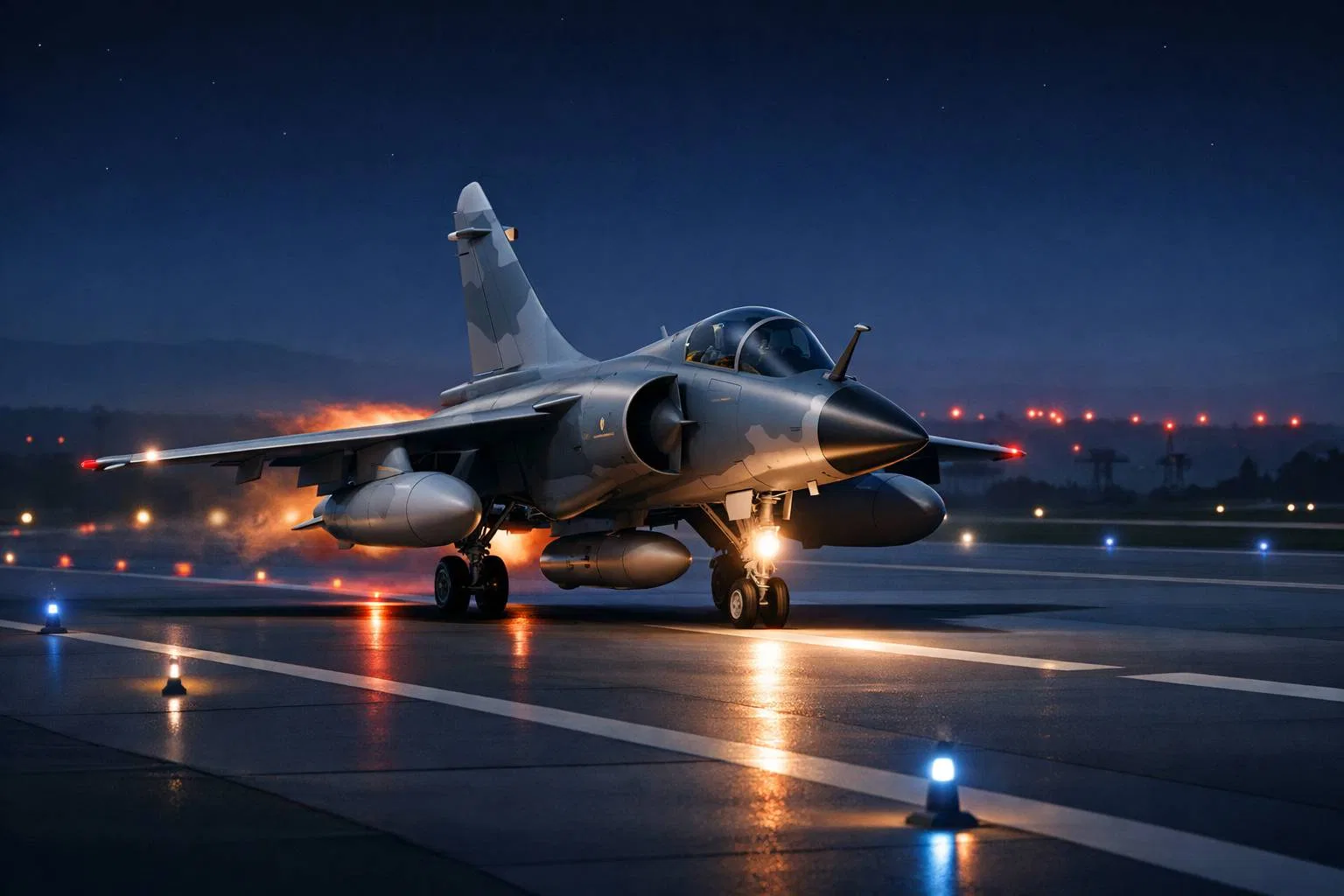
Los Llanos Air Base became part of Spanish UFO history for one specific reason: in the early hours after the 1979 Manises emergency landing, a Mirage F1 from Albacete’s combat wing was ordered into the air to identify unexplained lights reported near Valencia. The wider Manises incident belongs mainly to Valencia and the western Mediterranean, but Albacete enters the story through the military response. That response matters because it moved the case beyond a civilian airliner’s alarming sighting and into the realm of air defence, fighter interception, radar reports, radio interference claims and later official scrutiny.[Cadena SER]cadenaser.comCadena SEREl piloto que persiguió un OVNI | Actualidad | Cadena SERCadena SEREl piloto que persiguió un OVNI | Actualidad | Cadena SER
For Albacete, the key point is not that the province was the location of the original sighting. It was not. Its role was operational. Los Llanos was the base from which Captain Fernando Cámara, then flying a Mirage F1 of Wing 14, was scrambled at about 00:40 to investigate. That gives Albacete one of its strongest documented links to Spain’s UFO record: not folklore, not a distant rumour, but an airbase, a named pilot, a modern fighter aircraft and a case later examined through military and sceptical research.[Ejercito Del Aire]ejercitodelaireydelespacio.defensa.gob.esUnidades - Unidad…
Why Los Llanos mattered that night
Los Llanos was not a random airfield drawn into the Manises case by chance. By 1979, it had recently been reshaped into one of Spain’s important combat aviation sites. The Spanish Air and Space Force’s own unit history says that in June 1974 the former Los Llanos Air Base shifted from transport and earlier roles to combat aviation because of its geostrategic position within the Iberian Peninsula. The same official account records the creation of Wing 14 there, replacing the former transport wing, and the assignment of Mirage F1 aircraft to the new fighter unit.[Ejercito Del Aire]ejercitodelaireydelespacio.defensa.gob.esUnidades - Unidad…
That timing is central to the Albacete angle. The first Mirage F1 aircraft reached the unit on 18 June 1975, only a little over four years before Manises. The Air Force describes the Mirage F1 as the most modern combat aircraft then serving in the Spanish Air Force and one of the more advanced fighters among Western air forces of the period. Los Llanos therefore entered the Manises incident as a newly modernised fighter base, not merely as the nearest convenient runway.[Ejercito Del Aire]ejercitodelaireydelespacio.defensa.gob.esUnidades - Unidad…
This is why the Manises scramble has become more important to Albacete’s UFO history than many local sighting stories. It connects the province to an incident with contemporary press coverage, named aviation witnesses, later interviews and post-event investigation. A provincial UFO case can be interesting because something was allegedly seen over the province. Los Llanos is different: its importance lies in how the state responded when an unidentified aerial report was treated as a possible air-safety and air-defence problem.

How Wing 14 and the Mirage F1 fit the story
The basic chain of events began with TAE flight JK-297, a Super Caravelle carrying 109 passengers. Early reporting by El País said the aircraft had left Palma de Mallorca on a charter route to the Canary Islands when its crew reported unusual red lights while over or near Ibiza. According to the account attributed to the commander, the lights appeared to approach the aircraft, leading him to divert to Valencia’s Manises airport as a safety measure.[El País]elpais.comOpen source on elpais.com.
Once the aircraft had landed, the case did not stop at a civilian report. Airport and military personnel at or near Manises also became involved in observing lights in the sky. Later sceptical reconstruction by Juan Antonio Fernández Peris, summarising a long investigation, states that after the airliner reached Manises at 23:45, airport personnel and military staff at the adjoining air base took part in the sighting of bright points in the night sky. In response, the Air Combat Command ordered a Mirage F1 scrambled from Los Llanos at 00:40 on 12 November.[Academia]academia.eduDOC) THE MANISES UFO FILEDOC) THE MANISES UFO FILE
That is the point at which Albacete enters the case decisively. The Mirage was not launched to prove that an extraordinary craft existed. It was launched to search for and identify lights that had been reported by aviation professionals and airport personnel. In air-defence terms, the word “scramble” simply means a rapid launch of an interceptor, usually because an aircraft or object needs to be identified quickly. In UFO history, however, that step is significant because it shows that the report had crossed a threshold from curious sighting to operational response.
The aircraft itself also matters. The Mirage F1 was the signature combat platform of Wing 14 for decades. The official unit history says the type became the “workhorse” of the Albacete wing for almost forty years, and that the base had to adapt its infrastructure to the aircraft’s new capabilities, including runway extension to 2,700 metres.[Ejercito Del Aire]ejercitodelaireydelespacio.defensa.gob.esUnidades - Unidad… This means the Manises scramble sits at the beginning of Los Llanos’ Mirage era, when the fighter was still a new symbol of the base’s modern combat role.
Captain Fernando Cámara’s pursuit account
Captain Fernando Cámara’s account is the element that gives the Los Llanos part of Manises its lasting force. In later reporting by Cadena SER, Cámara described reaching the Valencia area quickly after take-off from Los Llanos and seeing a large red light while his radar did not detect a corresponding target. The same interview account says he believed the object reacted to his approach, while his aircraft’s threat systems were triggered.[Cadena SER]cadenaser.comCadena SEREl piloto que persiguió un OVNI | Actualidad | Cadena SERCadena SEREl piloto que persiguió un OVNI | Actualidad | Cadena SER
The pursuit story then becomes more complicated. Cadena SER’s summary says the fighter requested permission to go supersonic, that the light appeared to match speed as he approached, and that Cámara followed it towards Zaragoza before abandoning that pursuit. He was then reportedly directed back towards the Valencia area and on towards Sagunto, where he described encountering a different white disc-like light, again associated in his telling with interference affecting the aircraft.[Cadena SER]cadenaser.comCadena SEREl piloto que persiguió un OVNI | Actualidad | Cadena SERCadena SEREl piloto que persiguió un OVNI | Actualidad | Cadena SER
The strongest version of the case, from a UFO-believer’s perspective, rests on this sequence: a trained military pilot, flying a modern fighter, says he saw lights that did not behave like ordinary aircraft; radar or onboard systems did not neatly settle the matter; and the mission ended without a clear interception. That is why the Los Llanos scramble is often treated as more compelling than a simple ground sighting.
But a careful reading has to separate the firm facts from the disputed interpretation. The firmest points are that a Mirage F1 was launched from Los Llanos, that Cámara flew the mission, that he pursued or investigated lights, and that he returned because the mission could not continue indefinitely, including because of fuel. The more contested points are what the lights were, whether their apparent movement was real or perceptual, and how much weight to place on reported electronic interference.
What the scramble adds to the evidence
The Los Llanos scramble adds three things to the Manises evidence. First, it adds an official air-defence action. The incident was not simply a passenger-plane anecdote retold later by UFO writers. It involved an emergency diversion, reports from aviation personnel, and a military response. Early El País coverage already framed the matter as an incident communicated to military authority, while later accounts identify the interceptor mission from Albacete as a central feature of the case.[El País]elpais.comOpen source on elpais.com.
Second, it adds a named professional witness whose testimony can be compared with later explanations. Cámara was not an anonymous observer watching lights from a road. He was a fighter pilot operating under instructions, and later media coverage preserved his own rejection of the Escombreras refinery explanation. He told Cadena SER that he knew the refinery flames from the air and did not believe they matched what he saw during the pursuit.[Cadena SER]cadenaser.comCadena SEREl piloto que persiguió un OVNI | Actualidad | Cadena SERCadena SEREl piloto que persiguió un OVNI | Actualidad | Cadena SER
Third, it adds a useful test of the case’s limits. A fighter launch sounds dramatic, but it does not by itself prove that the target was a structured unknown object. Interception missions can be prompted by incomplete information, visual misperception, radar ambiguity, military caution or a mix of factors. The Manises scramble is therefore valuable not because it confirms an extraordinary craft, but because it provides a richer record against which ordinary and extraordinary explanations can be weighed.
This is especially important for Albacete’s provincial UFO history. Los Llanos gives the province a documented place in a national case, but not ownership of the whole incident. The original airliner encounter, the emergency landing, the airport observations and many of the proposed explanations sit outside Albacete. What belongs to Albacete is the readiness of Wing 14, the Mirage F1 launch, the pilot’s pursuit account and the way that pursuit has shaped later interpretations of the case.
The main doubts and rival explanations
The main sceptical interpretation associated with Fernández Peris and the Anomaly Foundation does not deny that the night was eventful. It argues instead that several ordinary stimuli became linked into one extraordinary narrative. In the English summary of his research, Fernández Peris says the case was best explained by a chain of unusual but natural or human circumstances: the airliner crew probably misidentified flare lights from the Escombreras refinery near Cartagena; airport observers later mistook bright stars or planets for related objects; and the Mirage pilot then pursued distant ambiguous lights under pressure during a night of exceptional visibility.[Academia]academia.eduDOC) THE MANISES UFO FILEDOC) THE MANISES UFO FILE
That explanation is important because it directly weakens the idea that all witnesses were seeing the same object. If the airliner, airport staff and Mirage pilot were actually responding to different lights at different stages, the case becomes less like a single coherent chase and more like a cascade of linked misidentifications. Fernández Peris also argued that some of the lights pursued by the Mirage were probably stellar, while one early light seen by the pilot may have been connected to a refinery in northern Algeria.[Academia]academia.eduDOC) THE MANISES UFO FILEDOC) THE MANISES UFO FILE
The alternative explanations were not all the same. Contemporary reporting in El País noted a hypothesis from Valencian UFO investigators that the original object might have been a US Sixth Fleet aircraft connected with military movements after exercises near Almería. That interpretation tried to explain the radar echo and the way the object appeared to accompany the airliner, but it was still speculative and did not become a settled official answer.[El País]elpais.comEl País El ovni de Manises pudo ser un caza norteamericano | España | EL PAÍSEl País El ovni de Manises pudo ser un caza norteamericano | España | EL PAÍS
The case is therefore best treated as unresolved in popular memory but substantially contested in analysis. Cámara’s account remains difficult for many readers to dismiss because it comes from a military pilot in an interceptor. Yet the sceptical reconstruction has a different strength: it tries to break the night into separate episodes, each with a possible mundane source, rather than treating every report as part of one object’s behaviour.
Why later reporting both strengthened and weakened the claim
Later reporting strengthened the Manises story by keeping named witnesses and operational details in public view. Cadena SER’s 2015 interview summary gave readers a direct modern account from Cámara and reaffirmed the key Albacete detail: a Mirage took off from Los Llanos at about 00:40 and reached the Valencia area within minutes. It also preserved Cámara’s continuing disagreement with the refinery-flare explanation.[Cadena SER]cadenaser.comCadena SEREl piloto que persiguió un OVNI | Actualidad | Cadena SERCadena SEREl piloto que persiguió un OVNI | Actualidad | Cadena SER
At the same time, later investigation weakened the simplest UFO version of the story. Fernández Peris’s long study, aided by the 1994 declassification of the military file, argued that the case became famous because several unusual circumstances overlapped: exceptional visibility, atmospheric effects, bright lights on the ground, stars and planets, media climate and stress among aviation personnel. His account is not a casual dismissal; it is a detailed attempt to explain why competent witnesses could have been sincerely mistaken.[Academia]academia.eduDOC) THE MANISES UFO FILEDOC) THE MANISES UFO FILE
This tension is exactly why the Los Llanos scramble remains valuable to an evidence-led Albacete UFO history. It is neither a clean debunking nor a clean confirmation. The scramble is well enough documented to matter, but the interpretation of what Cámara pursued remains disputed. The case shows how a real military action can become attached to a larger UFO legend, and how later research can preserve the seriousness of the incident while challenging the assumption that a single unknown craft caused every observation.
How to read the Los Llanos role today
The fairest reading is that Los Llanos became part of Manises because it was the right kind of base at the right moment: a modern fighter unit, recently equipped with Mirage F1 aircraft, able to respond when air-defence authorities wanted unidentified lights checked. That makes the Albacete connection concrete and historically meaningful.[Ejercito Del Aire]ejercitodelaireydelespacio.defensa.gob.esUnidades - Unidad…
It does not mean that Albacete was the scene of Spain’s most famous UFO encounter in the ordinary geographic sense. The airliner report was over the western Mediterranean, the diversion was to Valencia, and many later explanations involve Cartagena, the night sky or wider military activity. Albacete’s role is narrower but stronger: it supplied the interceptor, the pilot and the operational action that made Manises more than a civilian sighting.
For readers following UFO history province by province, that distinction matters. Los Llanos is not a local legend inflated by repetition. It is a military node in a national case. The scramble does not prove an extraterrestrial craft, and it should not be presented as if it does. But it does show why Albacete deserves a place in the Manises story: when the lights were treated as a possible airspace problem, the aircraft sent to investigate came from Los Llanos.
Amazon book picks
Further Reading
Books and field guides related to Why Los Llanos Became Part of Manises. Use these as the next step if you want deeper reading beyond the article.

eBay marketplace picks
Marketplace Samples
Live-tested eBay searches with available results related to this page.




Endnotes
1.
Source: cadenaser.com
Title: Cadena SEREl piloto que persiguió un OVNI | Actualidad | Cadena SER
Link:https://cadenaser.com/emisora/2015/10/01/radio_valencia/1443721856_943060.html
2.
Source: ejercitodelaireydelespacio.defensa.gob.es
Title: Ejercito Del Aire
Link:https://ejercitodelaireydelespacio.defensa.gob.es/EA/ejercitodelaire/es/Unidades/Unidad/16103382-9f29-11ee-b1b1-005056bf91c5/
Source snippet
Unidades - Unidad...
3.
Source: academia.edu
Title: (DOC) THE MANISES UFO FILE
Link:https://www.academia.edu/27920724/THE_MANISES_UFO_FILE
4.
Source: elpais.com
Link:https://elpais.com/diario/1979/11/13/espana/311295627_850215.html
5.
Source: elpais.com
Title: El País El ovni de Manises pudo ser un caza norteamericano | España | EL PAÍS
Link:https://elpais.com/diario/1980/01/25/espana/317602833_850215.html
6.
Source: publicaciones.defensa.gob.es
Link:https://publicaciones.defensa.gob.es/media/downloadable/files/links/r/a/raa_800_2011.pdf
7.
Source: elpais.com
Link:https://elpais.com/diario/1979/11/16/ultima/311554806_850215.html
8.
Source: elpais.com
Link:https://elpais.com/noticias/extraterrestres/8
Additional References
9.
Source: youtube.com
Title: The Manises UFO Incident: Mirage F-1 Scramble | Rain Sounds for Sleep
Link:https://www.youtube.com/watch?v=6OG_SORJZE4
Source snippet
Manises Airport UFO Incident 1979 Spanish Plane Emergency & UFO Encounter...
10.
Source: youtube.com
Title: Mirage F1 Spain Air Force
Link:https://www.youtube.com/watch?v=Dqh9qCU3-94
Source snippet
Manises UFO incident fighter scramble The Manises UFO Incident: Mirage F-1 Scramble | Rain Sounds for Sleep The Folklore Case Files...
11.
Source: instagram.com
Link:https://www.instagram.com/p/DQ7jVAoESKu/
12.
Source: facebook.com
Link:https://www.facebook.com/elcentineladelmisterio2016/posts/expediente-ovni-caso-manises-con-fernando-c%C3%A1mara-esta-noche-en-el-centinela-del-/1277405592651797/
13.
Source: facebook.com
Link:https://www.facebook.com/DMAXes/posts/el-caso-del-aeropuerto-de-manises-es-el-m%C3%A1s-relevante-de-la-ufolog%C3%ADa-espa%C3%B1ola-lo/871185761712323/
14.
Source: reddit.com
Link:https://www.reddit.com/r/UFOB/comments/160tzuu/fernando_c%C3%A1mara_was_scrambled_to_intercept_a_ufo/
15.
Source: ars.electronica.art
Link:https://ars.electronica.art/planetb/en/chemical-ecosystem/
16.
Source: eldigitaldealbacete.com
Link:https://www.eldigitaldealbacete.com/2026/06/22/el-avion-de-esta-rotonda-de-albacete-y-el-caso-ovni-mas-famoso-de-espana-la-historia-real-que-aun-desconcierta-al-piloto-protagonista/
17.
Source: elojocritico.info
Link:https://elojocritico.info/ufoleaks-6-los-jueces-instructores-de-los-expedientes-ovni-identificados-por-primera-vez/
18.
Source: youtube.com
Title: Spanish Mirage F1M in-flight footage
Link:https://www.youtube.com/watch?v=Hdjzr8Tb-Gs
Source snippet
Spain Air Force Mirage F-1EDA (14-55) At Albacete LEAB...
Topic Tree