Within Gipuzkoa UFOs
How Did One Light Become a Public Drama?
The province's UFO history shows how newspapers, radio, emergency crews and official checks can turn reports into public events.
On this page
- The role of newspapers and radio
- Why emergency involvement changes public perception
- How airport and observatory checks shaped the story
Page outline Jump by section
Introduction
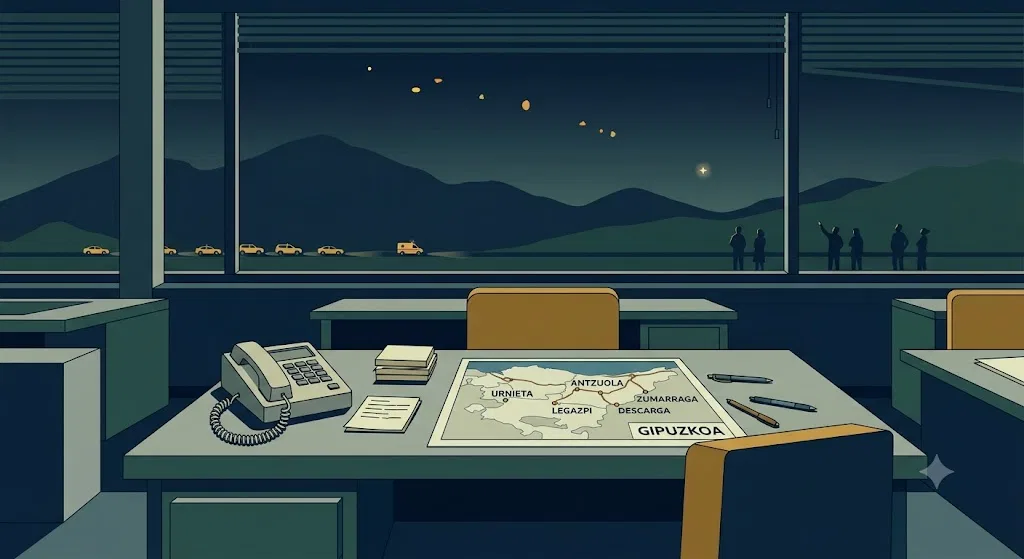
In Gipuzkoa’s UFO history, the most revealing question is not only “what was seen?”, but “how did one reported light become a public drama?” The province’s best-known example, the night of 10–11 July 1985, began with a reader’s call to a local newspaper about a strange light near Urnieta. It then moved through emergency radio networks, ambulance crews, police involvement, private cars and later press retellings. By the time observatories and airports were checked, the event had already become a shared local story. Later sceptical analysis argued that the pursued “object” was probably Jupiter, low and bright in the sky, made stranger by movement, terrain, expectation and repeated messages between observers.[Misterios del Aire]misteriosdelaire.blogspot.comel ovni que sobrevolo gipuzkoa en 1985Misterios del AireMisterios del Aire: El OVNI que sobrevoló Gipúzkoa en 1985…
That makes Gipuzkoa a useful province-level case study. Its UFO record is not dominated by a single military mystery. It is dominated by the way reports were amplified, tested, doubted and remembered. Local media gave sightings visibility; emergency crews gave them seriousness; official checks gave them a reality test; and later archive work showed how fragile the original interpretation could be. Spain’s wider declassified UFO collection contains 80 files and 1,900 pages, but Gipuzkoa’s clearest lessons come from these communication chains rather than from a large body of unresolved official cases.[Biblioteca Virtual Defensa]bibliotecavirtual.defensa.gob.esOpen source on gob.es.
How a Newspaper Call Became a Moving Story
The 1985 episode shows the basic mechanism clearly. According to a later sceptical reconstruction drawing on the local press account, the first trigger was not a radar alert or a pilot report, but a call to El Diario Vasco from someone saying they had seen a UFO near Urnieta. The newspaper then contacted DYA, Gipuzkoa’s road-assistance and emergency organisation, which alerted its mobile units. Around midnight, a DYA ambulance crew at Antzuola reported seeing a strange light that appeared to grow and shrink.[Misterios del Aire]misteriosdelaire.blogspot.comel ovni que sobrevolo gipuzkoa en 1985Misterios del AireMisterios del Aire: El OVNI que sobrevoló Gipúzkoa en 1985…
That sequence matters because it changed the social status of the sighting. A private observation became a newsroom item; the newsroom passed it to an emergency network; the emergency network produced more observers. From that point, each new report did not arrive in a vacuum. Crews and listeners were already primed to look for something unusual. The later reconstruction is bluntly sceptical about this: when people are told to search the sky for something extraordinary, ordinary lights can be reclassified very quickly as extraordinary ones.[Misterios del Aire]misteriosdelaire.blogspot.comel ovni que sobrevolo gipuzkoa en 1985Misterios del AireMisterios del Aire: El OVNI que sobrevoló Gipúzkoa en 1985…
The local geography helped the drama. The chase was said to involve roads and places such as the Descarga pass, Urretxu, Zumarraga, Legazpi and the Barrendiola reservoir near Brinkola. These are not open desert sightlines. Drivers would have been moving through valleys, curves, changing elevations and intermittent views of the horizon. A bright fixed object can appear to shift, hover, retreat or “lead” a convoy when the observer is moving and the foreground keeps changing. That does not make the witnesses dishonest. It makes the chain of perception more complicated than a simple “many people saw it, therefore it moved” argument.[Misterios del Aire]misteriosdelaire.blogspot.comel ovni que sobrevolo gipuzkoa en 1985Misterios del AireMisterios del Aire: El OVNI que sobrevoló Gipúzkoa en 1985…
Newspapers Did More Than Report the Sighting
Local newspapers were not passive mirrors in this kind of case. They could receive the first claim, decide whether it was worth checking, contact institutions, publish witness language and later revive the story as a piece of regional memory. Gipuzkoa’s press infrastructure is especially important because old issues of El Diario Vasco are part of the province’s digitised press archive, with holdings listed across the twentieth century and into the twenty-first. That archive context matters: it helps explain why a dramatic local episode could be revisited decades later rather than disappearing as a one-night rumour.[Gipuzkoa]w390w.gipuzkoa.netAtzoko Prentsa DigitalaAtzoko Prentsa Digitala…
In the 1985 case, the press account appears to have given the event a narrative shape: a mysterious light, alarmed witnesses, emergency crews, roads, towns and official checks. That shape is memorable. It turns a point of light into a route through Gipuzkoa. It gives readers a geography they recognise and a cast of local institutions they trust. This is why local media can make a sighting more durable than the raw observation itself. Once the report has named the places and agencies involved, later readers remember the “Gipuzkoa chase” rather than a vague light in the sky.[Misterios del Aire]misteriosdelaire.blogspot.comel ovni que sobrevolo gipuzkoa en 1985Misterios del AireMisterios del Aire: El OVNI que sobrevoló Gipúzkoa en 1985…
But the same mechanism also creates a risk. Early reports often preserve the most dramatic witness impressions before slower checks have caught up. A phrase about a light changing size or racing away can travel further than a later explanation involving a planet, haze, road movement and changing angles. In Gipuzkoa’s 1985 case, the later sceptical account criticises the continued presentation of the story as mysterious even after the Jupiter explanation had been set out. That tension between a good story and a better explanation is central to how sightings spread.[Misterios del Aire]misteriosdelaire.blogspot.comel ovni que sobrevolo gipuzkoa en 1985Misterios del AireMisterios del Aire: El OVNI que sobrevoló Gipúzkoa en 1985…
Why Emergency Involvement Changes Public Perception
Emergency services alter how ordinary readers judge a sighting. If a passer-by sees a light, the story may sound like a curiosity. If an ambulance crew, road-assistance network, Red Cross vehicle, municipal police and regional police are mentioned, the same story feels more official, more urgent and harder to dismiss. The 1985 chase gained much of its public force from exactly that escalation: DYA units were alerted, other vehicles joined, and police were reportedly involved at Legazpi as the convoy debated what to do.[Misterios del Aire]misteriosdelaire.blogspot.comel ovni que sobrevolo gipuzkoa en 1985Misterios del AireMisterios del Aire: El OVNI que sobrevoló Gipúzkoa en 1985…
DYA’s local standing helps explain why that mattered. By the 1980s, DYA Gipuzkoa had expanded its emergency activity across the province, with rescue units, special coordination vehicles, a control centre and a repeater network for communications. Its public telephone number and yellow vehicles had become strongly associated with assistance and emergency response. In other words, when DYA appeared in a UFO story, it did not read like a fringe witness group; it read like a trusted local service drawn into an unusual event.[DYA Gipuzkoa]dyagipuzkoa.comDYA Gipuzkoa HistoriaDYA Gipuzkoa Historia
That credibility cuts both ways. On one hand, emergency crews are trained to respond, communicate and observe under pressure. Their involvement is a reason to take the historical report seriously as a real public incident. On the other hand, emergency involvement does not guarantee correct identification of a distant light. Ambulance crews are not automatically equipped to judge astronomical azimuth, altitude, apparent motion or the effect of driving towards a low planet. Their role confirms that people reacted to something; it does not by itself confirm that the thing was an unknown craft.
The most important public lesson is that institutional involvement can validate the seriousness of the response without validating the extraordinary interpretation. A police or ambulance presence means the report became operationally important. It does not mean the object was physically unusual.
The Radio Effect: Shared Witnessing in Real Time
The 1985 chase also illustrates a communication pattern that predates social media but works in a similar way. The sceptical reconstruction says the pursuit was fed by testimony from listeners broadcast by a local radio station. That would have created a live feedback loop: people heard that others were seeing something, looked up, interpreted their own view in that frame, and added further testimony.[Misterios del Aire]misteriosdelaire.blogspot.comel ovni que sobrevolo gipuzkoa en 1985Misterios del AireMisterios del Aire: El OVNI que sobrevoló Gipúzkoa en 1985…
This is one of the reasons UFO “flaps” can grow quickly. A sighting is not simply copied from one person to another; it becomes synchronised. People in different places may be looking at the same astronomical object, aircraft, cloud-lit horizon or atmospheric effect, but once the public frame is “strange object over Gipuzkoa”, reports start to converge around that idea. The more local the communication network, the more persuasive it can feel. A voice from a nearby town carries a different emotional weight from a distant national broadcast.
The same process can also harden weak details. If one witness says the light changed size, another says it moved fast, and a third says emergency crews are following it, the combined story can sound stronger than any individual observation. Yet each piece may still be vulnerable to ordinary causes: motion from the observer’s vehicle, clouds passing across a planet, foreground objects changing the sightline, or the simple difficulty of judging distance at night.
Airport and Observatory Checks Put the Story Under Stress
The strongest part of the Gipuzkoa media-and-police story is that the newspaper did not stop at witness excitement. It reportedly contacted observatories at Igueldo and Arantzazu, the airports at San Sebastián and Sondika, and the control centre at Paracuellos del Jarama near Madrid. None was said to have recorded an unusual aerial phenomenon over Gipuzkoa that night.[Misterios del Aire]misteriosdelaire.blogspot.comel ovni que sobrevolo gipuzkoa en 1985Misterios del AireMisterios del Aire: El OVNI que sobrevoló Gipúzkoa en 1985…
That kind of checking is crucial. Airports and air-traffic centres can test whether an aircraft, flight path or controlled aviation event fits the report. Observatories can help assess bright planets, stars, meteors or other astronomical explanations. Weather information can test claims affected by cloud, haze or visibility. Spain’s declassified UFO files show that official investigations often used this wider pattern: summaries, witness interviews, incident reports and meteorological information could all form part of a file, depending on the case.[Biblioteca Virtual Defensa]bibliotecavirtual.defensa.gob.esOpen source on gob.es.
In the 1985 Gipuzkoa case, the absence of corroboration from those checks weakens the extraordinary version. It does not erase the witnesses’ experience, but it changes the evidential balance. A light reported by many people is one kind of evidence; a light that also appears on radar, matches no known aircraft, and resists astronomical explanation would be another. The Gipuzkoa event appears to belong in the first category, not the second.
The later Jupiter explanation is persuasive because it fits the negative checks as well as the positive reports. A bright planet low in the south-eastern sky would not generate an aircraft record. It would not require airport confirmation. It could remain apparently ahead of a moving convoy. It could also fade in importance towards dawn. The same features that seemed strange during the chase become less strange once the object is treated as astronomical rather than local.[Misterios del Aire]misteriosdelaire.blogspot.comel ovni que sobrevolo gipuzkoa en 1985Misterios del AireMisterios del Aire: El OVNI que sobrevoló Gipúzkoa en 1985…
The 1971 File Shows a Different Route Into the Record
Gipuzkoa’s UFO history also touches Spain’s official archive through a broader 23 February 1971 case covering Barcelona, Huesca, Lleida and the Cantabrian Sea. The Biblioteca Virtual de Defensa lists the file as a 71-page Air Operational Command intelligence document, later declassified in 1993, under the series of UFO-related “strange phenomena” reports. Its subject areas include the Cantabrian Sea as well as several north-eastern Spanish provinces.[Biblioteca Virtual Defensa]bibliotecavirtual.defensa.gob.esOpen source on gob.es.
This is not the same kind of local drama as the 1985 chase. It matters here because it shows another way a sighting can spread: not through a local convoy and radio excitement, but through multiple reports across a wide area that become grouped into one official file. A later El País guide to the released Defence files lists the 23 February 1971 Cantabrian fishing-boat sighting among aviation and maritime reports, separate from the Basque Country’s Gallarta file in Biscay.[Verne]verne.elpais.comOpen source on elpais.com.
For Gipuzkoa readers, the contrast is useful. The 1971 case shows how a report near the Cantabrian maritime setting could enter the national military archive. The 1985 case shows how a provincial sighting could become famous locally without becoming a major unresolved Defence case. Both routes involve communication and verification, but they produce different kinds of historical footprint: one archival and bureaucratic, the other journalistic and communal.
What Later Reporting Strengthened—and What It Weakened
Later reporting strengthened the historical reality of the 1985 episode as a public event. There really was a remembered local story involving a reported light, emergency crews, police references, a moving convoy and institutional checks. The story is still recognisable decades later because it had vivid local anchors: Urnieta, Antzuola, Descarga, Legazpi, Zumarraga and Barrendiola.[Misterios del Aire]misteriosdelaire.blogspot.comel ovni que sobrevolo gipuzkoa en 1985Misterios del AireMisterios del Aire: El OVNI que sobrevoló Gipúzkoa en 1985…
What later analysis weakened is the claim that the sighting required an exotic object. The Jupiter reconstruction gives a coherent account of the time, direction and behaviour of the light, while the reported airport and observatory checks failed to support unusual aerial traffic. The sceptical explanation also accounts for why a stationary astronomical body could seem to move during a road chase through varied terrain.[Misterios del Aire]misteriosdelaire.blogspot.comel ovni que sobrevolo gipuzkoa en 1985Misterios del AireMisterios del Aire: El OVNI que sobrevoló Gipúzkoa en 1985…
This does not make the case worthless. It makes it more useful. A weakly explained “mystery light” would be just another anecdote. A well-documented public escalation, followed by plausible debunking, teaches more about how UFO stories work in Gipuzkoa: a report becomes a rumour; the rumour becomes an emergency response; the response becomes a media event; and the media event becomes local memory.
How to Read Gipuzkoa Sightings More Carefully
The Gipuzkoa pattern suggests a practical way to assess similar cases without either mocking witnesses or accepting every claim at face value.
First, separate the sighting from the spread. The fact that many people were talking about a light may prove that communication was intense, not that the object was extraordinary. Secondly, check whether observers were stationary or moving. The 1985 chase is especially vulnerable to misread motion because key witnesses were travelling by road. Thirdly, ask what independent systems recorded: airport logs, radar, observatories, weather records or official reports. In the Gipuzkoa case, the reported institutional checks did not support an unusual aerial event.[Misterios del Aire]misteriosdelaire.blogspot.comel ovni que sobrevolo gipuzkoa en 1985Misterios del AireMisterios del Aire: El OVNI que sobrevoló Gipúzkoa en 1985…
Fourthly, give weight to local institutions without treating them as infallible. DYA’s role made the 1985 story socially credible because the organisation was a recognised emergency presence in the province, but emergency credibility is not the same as astronomical identification.[DYA Gipuzkoa]dyagipuzkoa.comDYA Gipuzkoa HistoriaDYA Gipuzkoa Historia
Finally, look at how the story changed after the first night. Did later reporting add independent evidence, or did it mainly repeat the original drama? In Gipuzkoa’s best-known case, the later sceptical reading did not deny the chase; it changed what the chase meant. The public drama was real. The “unknown craft” interpretation was much weaker.
Amazon book picks
Further Reading
Books and field guides related to How Did One Light Become a Public Drama?. Use these as the next step if you want deeper reading beyond the article.
The Demon-Haunted World
Useful for understanding media amplification and critical thinking.
Why People Believe Weird Things
Explores belief formation around extraordinary claims.
eBay marketplace picks
Marketplace Samples
Live-tested eBay searches with available results related to this page.

Endnotes
1.
Source: w390w.gipuzkoa.net
Title: Atzoko Prentsa Digitala
Link:https://w390w.gipuzkoa.net/WAS/CORP/DKPAtzokoPrentsaWEB/argitalpen/178866
Source snippet
Atzoko Prentsa Digitala...
2.
Source: lleida.com
Title: 1971 02 23 avistamiento en barcelona huesca lerida mar cantabrico compressed
Link:https://www.lleida.com/sites/default/files/u4626/1971-02-23_avistamiento_en_barcelona-huesca-lerida-mar_cantabrico_compressed.pdf
3.
Source: dya.eus
Title: historia ano a ano
Link:https://dya.eus/historia-ano-a-ano/
4.
Source: misteriosdelaire.blogspot.com
Title: el ovni que sobrevolo gipuzkoa en 1985
Link:https://misteriosdelaire.blogspot.com/2015/07/el-ovni-que-sobrevolo-gipuzkoa-en-1985.html
Source snippet
Misterios del AireMisterios del Aire: El OVNI que sobrevoló Gipúzkoa en 1985...
5.
Source: bibliotecavirtual.defensa.gob.es
Link:https://bibliotecavirtual.defensa.gob.es/BVMDefensa/exp_ovni/es/micrositios/inicio.do
6.
Source: dyagipuzkoa.com
Title: DYA Gipuzkoa Historia
Link:https://dyagipuzkoa.com/historia/
7.
Source: bibliotecavirtual.defensa.gob.es
Link:https://bibliotecavirtual.defensa.gob.es/BVMDefensa/es/consulta/registro.do?id=38121
8.
Source: verne.elpais.com
Link:https://verne.elpais.com/verne/2016/10/25/articulo/1477394008_803441.html
9.
Source: bibliotecavirtual.defensa.gob.es
Title: defensa.gob.es Listado de títulos
Link:https://bibliotecavirtual.defensa.gob.es/BVMDefensa/exp_ovni/es/consulta/indice_campo.do?campo=idtitulo
10.
Source: despiertaalfuturo.blogspot.com
Title: el ovni que sobrevolo gipuzkoa en 1985
Link:https://despiertaalfuturo.blogspot.com/2015/07/el-ovni-que-sobrevolo-gipuzkoa-en-1985.html
Additional References
11.
Source: youtube.com
Title: DECLASSIFIED UFO FILES: Why does science ignore them and governments don’t?
Link:https://www.youtube.com/watch?v=wunCPG7EBXs
Source snippet
The Pentagon's secret documents on UFOs: what do they really reveal? | Luis Burgos...
12.
Source: youtube.com
Title: Javier Sierra: The secret report on UFOs in Franco’s Spain
Link:https://www.youtube.com/watch?v=_lSEWzNb2rc
Source snippet
DECLASSIFIED UFO FILES: Why does science ignore them and governments don't?...
13.
Source: youtube.com
Title: Why This UFO Sighting Was Different | Monstrum
Link:https://www.youtube.com/watch?v=dHGn_yPSgg0
Source snippet
Javier Sierra: The secret report on UFOs in Franco's Spain...
14.
Source: cobdcv.es
Link:https://cobdcv.es/simile/biblioteca-virtual-defensa-puerta-acceso-patrimonio-cultural-defensa/
15.
Source: facebook.com
Link:https://www.facebook.com/groups/2393127970/posts/10164634177077971/
16.
Source: facebook.com
Link:https://www.facebook.com/groups/scientificcosmology/posts/10174976489890268/
17.
Source: memoriaylibertad.org
Link:https://memoriaylibertad.org/data/documents/Guia_de_los_archivos_militares_espanoles.pdf
18.
Source: instagram.com
Link:https://www.instagram.com/reel/C4my_THhOH-/
19.
Source: instagram.com
Link:https://www.instagram.com/reel/DZPmb_WlQul/
20.
Source: ovniarchive.com
Link:https://ovniarchive.com/pais/espana?lang=en&offset=50
Topic Tree