Within Cadiz UFOs
Why Sea Lights Look Stranger in Cadiz
Cadiz sea sightings matter because distance, darkness, ships and aircraft can make lights over water unusually hard to judge.
On this page
- Ships, aircraft and horizon effects
- The 1980 Atlantic ship file reference
- How water changes witness perception
Page outline Jump by section
Introduction
Sea lights are one of the easiest kinds of Cádiz UFO report to misunderstand. The province faces the Atlantic, the Bay of Cádiz and the approaches to the Strait of Gibraltar, so witnesses often watch lights against dark water, a flat horizon and heavy ship and aircraft traffic. That does not mean every report is trivial, or that every witness was careless. It means that distance, darkness, reflections, changing weather and moving vessels can make ordinary lights look detached from any obvious source.
For Cádiz UFO history, the point is not to dismiss sea sightings but to read them with the right geography in mind. A light over the water may be a ship, aircraft, flare, satellite, atmospheric effect or genuinely unidentified observation. The most useful question is therefore: what would the witness have been able to judge from that shore, at that time, with that horizon?
Why Cádiz sea lights are unusually hard to judge
Cádiz is not just a coastal province with scenic views. It sits beside one of Europe’s important maritime corridors. The Port of the Bay of Cádiz describes the bay as a strategic point for Europe-Africa and America-Mediterranean traffic, close to the Strait of Gibraltar, where around 110,000 ships pass each year. That matters because many strange-light reports begin with a witness looking out from land and seeing lights apparently hovering, moving sideways, appearing from the sea, or disappearing into it. In a place with intense marine traffic, those impressions need careful testing before they become an unexplained case. Puerto de la Bahía de Cádiz[puertocadiz.com]puertocadiz.comPuerto de la Bahía de Cádiz Access and locationPuerto de la Bahía de Cádiz Access and location
The Strait adds another layer. Studies and maritime summaries repeatedly describe it as one of the world’s major navigation areas, with dense shipping, fishing vessels, recreational craft and difficult local weather and oceanographic conditions. A legal and maritime analysis of traffic control in the Strait notes not only heavy ship density, but also fishing fleets, leisure vessels and the “peculiar” meteorological and oceanographic character of the area.[sybil.es]sybil.esOpen source on sybil.es.
For a person watching from Cádiz, San Fernando, Rota, Chiclana, Conil, Barbate or Tarifa, that means the night sea is rarely empty. Lights may belong to merchant ships, tankers, ferries, fishing boats, naval traffic, harbour equipment, aircraft, helicopters, coastal beacons or vehicles on distant land. The difficulty is that the observer often sees only the light, not the object carrying it.
This is why sea-light cases should not be judged by the phrase “over the water” alone. Over water can mean above the sea, on the sea, beyond the sea, reflected in the sea, or simply seen in a direction where the nearest familiar landmark is the sea.

Ships, aircraft and horizon effects
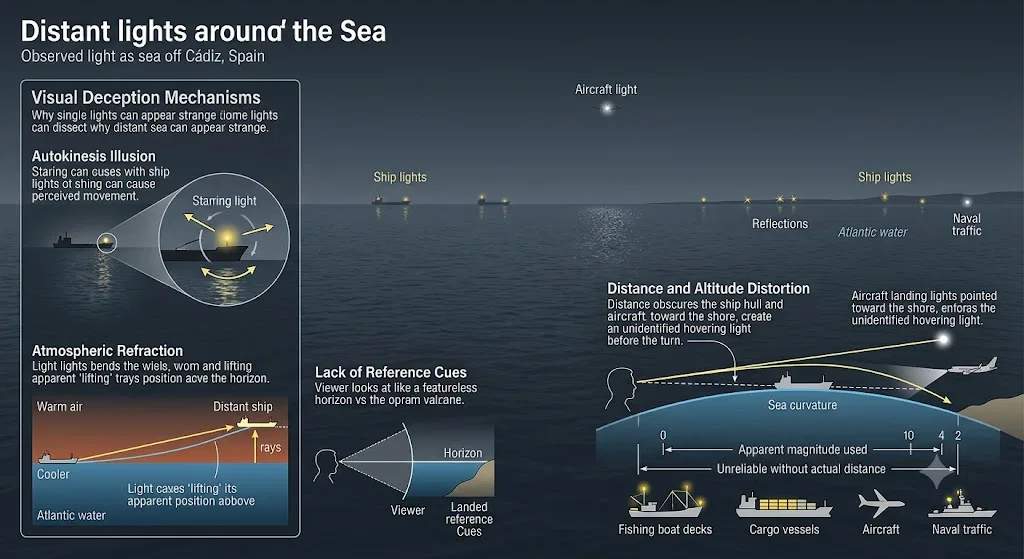
A ship at night can look far stranger than a ship by day. At distance, the hull disappears first into darkness, haze or the curvature of the horizon, while upper lights remain visible. If the vessel is approaching or receding, its motion can be hard to detect. If it turns, different lights may appear, merge or vanish. If it is partly hidden by swell, haze or low cloud, it may seem to blink, pulse or rise from the water.
The same applies to aircraft. Cádiz has a long aviation setting as well as a maritime one. AENA’s history of Jerez Airport notes that the airspace over the port and bay of Cádiz was opened to official and private air traffic in March 1929, and the modern province is served by Jerez Airport as well as nearby Seville and Gibraltar routes.[Aena]aena.esOpen source on aena.es. Naval Station Rota also has a major air and port role: the US Navy says the base supports US and NATO ships, US Navy and US Air Force aircraft, a 670-acre airfield and active piers within a shared Spanish-American facility.[cnreurafcent.cnic.navy.mil]cnreurafcent.cnic.navy.milOpen source on navy.mil.
None of this proves that a given light was an aircraft. It does mean that any Cádiz report involving fast lights, triangular light patterns, silent movement, apparent hovering or disappearance towards the Atlantic should be checked against air and sea traffic before stronger claims are made.
Several ordinary patterns are especially relevant:
- Distant ship lights: A vessel on the horizon may appear stationary for a long time, then seem to move suddenly when it turns or when the viewer’s reference point changes.
- Aircraft on approach or departure: A landing light pointed towards the witness can look like a bright object hanging in the sky, then seem to fade or shoot sideways as the aircraft changes angle.
- Fishing and working lights: Bright deck lights can look low, clustered and erratic, especially when reflected by water.
- Military and naval activity: Around Rota and the Strait, some flights and vessels may not be obvious to a casual observer, even when their presence is entirely conventional.
- Haze and refraction: Low lights near the horizon can be displaced, distorted or made to shimmer by atmospheric layers.
The key weakness in many over-water UFO stories is not the honesty of the witness. It is the absence of range. Without knowing whether a light is one kilometre away, ten kilometres away or far beyond the bay, estimates of speed, size and altitude become unreliable.
The 1980 Atlantic file and what it really adds
One reason Cádiz sea sightings deserve a cautious but serious place in provincial UFO history is that Spain’s official UFO archive does include maritime and Atlantic material. The Spanish Defence Virtual Library lists a declassified Air Force file titled “Avistamiento de fenómenos extraños en el Océano Atlántico-RIF: 08 de Diciembre de 1980”, produced by the Air Operational Command, Air Staff, Intelligence Section. The catalogue describes it as a four-page online manuscript file, published in 1980 and declassified by the Air Force Chief of Staff in November 1995.[Biblioteca Virtual Defensa]bibliotecavirtual.defensa.gob.esOpen source on gob.es.
That file is not a Cádiz Bay case in the narrow local sense. Its value for a Cádiz page is different: it shows that Spanish official UFO documentation did not stop at land witnesses, town rumours or newspaper oddities. The archive contains cases framed around Atlantic observation, and the Defence catalogue places them within the same national body of “strange phenomenon” files as better-known air, radar and pilot reports.[Biblioteca Virtual Defensa]bibliotecavirtual.defensa.gob.es› Listado de títulos…
For Cádiz, that matters because the province’s sea-facing claims often sit between local folklore and official aviation geography. The bay and Atlantic approaches are exactly the kind of setting where a report may cross categories: a civilian sees a light from a beach; a vessel reports an object; a radar station has no corresponding trace; an aircraft route might explain it; or the report remains too thin to classify.
The 1980 Atlantic reference should therefore be used carefully. It does not confirm that the Bay of Cádiz had underwater craft, alien bases or repeated anomalous departures from the sea. It does confirm that Spanish military cataloguing treated some Atlantic sightings as records worth filing, even when the later public file may be brief. That is a modest but important distinction.
How water changes witness perception
Water makes night sightings harder because it removes ordinary scale cues. On land, a witness can compare a light with buildings, hills, roads or trees. Over the sea, there may be nothing but darkness, a faint horizon and reflected points of light. Aviation safety material is useful here because pilots face the same perceptual problem in a higher-stakes form.
The US Federal Aviation Administration defines autokinesis as a night-time visual illusion in which a stationary light appears to move after a person stares at it for several seconds. That is directly relevant to single-light sea sightings, especially when the witness has few surrounding reference points.[Federal Aviation Administration]faa.govFederal Aviation Administration PHAK GlossaryFederal Aviation Administration PHAK Glossary The FAA also warns that darkness, haze and flight over water can remove reliable surface references; lack of a natural horizon is common on over-water flights at night, and sloping clouds, stars or ground lights can provide misleading orientation cues.[Federal Aviation Administration]faa.govFederal Aviation Administration FAA AC60-4A, Pilots Spatial DisorientationFederal Aviation Administration FAA AC60-4A, Pilots Spatial Disorientation
A shore witness is not flying an aircraft, but the visual problem is similar. A small bright point against a dark, featureless background can seem to drift, wobble or accelerate. A row of lights can be mentally joined into a “craft”. A reflection can look like a second object. A light close to the horizon can seem to be on the water, above the water or coming out of the water depending on the observer’s angle.
Atmospheric optics add another complication. Mirages and related refraction effects occur when light bends through layers of air at different temperatures. Physics teaching material commonly uses ships over water as an example, because a distant vessel can appear displaced or oddly lifted by refraction over cooler water.[hyperphysics.phy-astr.gsu.edu]hyperphysics.phy-astr.gsu.eduOpen source on gsu.edu. The British Astronomical Association also notes that atmospheric refraction shifts and distorts objects close to the horizon, including the Sun and Moon.[britastro.org]britastro.orgatmospheric refractionatmospheric refraction
These effects do not explain every Cádiz report. They do explain why “it looked as if it came out of the sea” is weaker evidence than it first sounds. At night, a light can brighten as a ship turns, appear as it clears a headland, vanish behind swell or haze, or seem to detach from the horizon because the viewer has no fixed reference.

The bay “crater” story shows how sea folklore grows
Recent local reporting gives a useful example of how Cádiz sea-light stories can expand beyond the original evidence. In 2025, Diario de Cádiz reported on a televised and social-media claim about a circular-looking feature under the Carranza bridge in the Bay of Cádiz, promoted by a UFO enthusiast as a possible underwater UFO-related site. The same article made clear that other explanations had been suggested, including a natural formation, an old human-made feature or a meteorite impact, and that there was no official study determining what the structure was or how it originated.[diariodecadiz.es]diariodecadiz.esEl misterioso "cráter que podría ser un aparcamiento deEl misterioso "cráter que podría ser un aparcamiento de
That story belongs on this page not because it proves anything about UFOs, but because it shows a familiar mechanism in Cádiz sea lore. A real visual feature, an ambiguous aerial or satellite view, a dramatic interpretation and local humour can combine into a memorable story. Once that happens, later sea-light reports may be folded into the same narrative: lights are said to “enter” or “leave” the bay, and the bay itself becomes part of the explanation.
The careful approach is to separate three things:
- A reported visual feature: something seen on imagery or from the air.
- A proposed explanation: natural, historical, industrial, military or speculative.
- A UFO interpretation: the claim that the feature is connected to anomalous craft or underwater objects.
Only the first is directly observed. The second needs evidence. The third needs much stronger evidence than anecdote, repetition or television framing.
What would make a Cádiz sea-light report stronger?
A strong over-water report is not one that sounds dramatic. It is one that gives investigators enough information to reduce ordinary explanations. Cádiz’s setting makes that especially important because the default environment is busy, reflective and visually deceptive.
The most useful details are practical rather than mysterious: exact time, location, compass direction, duration, weather, tide state, visibility, whether the Moon was up, whether the light was above or below a visible horizon, whether ships or aircraft were present, and whether independent witnesses saw the same thing from different positions. A video can help, but only if it includes context: horizon, landmarks, zoom level, original audio and unedited timing. A tight zoom on a bright point over the sea often removes the very clues needed to identify it.
Official or semi-official records also change the weight of a case. A report backed by harbour logs, AIS vessel data, airport movement data, military documentation, police notes or meteorological records is much more useful than a memory reported years later. The Gibraltar Port Authority’s vessel traffic services, for example, use radar, Automatic Identification System data and other sensors to monitor vessel movements in and outside British Gibraltar Territorial Waters. That kind of system illustrates the type of check that can turn a vague light into a vessel track, or show that no obvious vessel matched the observation.[Gibraltar Port Authority]gibraltarport.comOpen source on gibraltarport.com.
The reverse is also true. A story becomes weaker when it depends on anonymous witnesses, later retellings, cropped social-media clips, or claims that cannot be matched to a date and place. A light seen “somewhere off Cádiz” is not impossible to investigate, but it gives almost nothing to test.
A balanced reading of Cádiz sea lights
The best explanation for many Cádiz Bay and Atlantic sightings is not one single cause. It is a cluster of mechanisms: ships near a busy port, aircraft near Jerez, Rota and Strait routes, fishing lights, military and naval traffic, atmospheric refraction, reflections, and the human difficulty of judging isolated lights over dark water. This cluster is enough to explain why Cádiz produces persistent sea-light stories without requiring every report to share the same origin.
That does not make the province’s UFO history uninteresting. In fact, it makes it more useful. Cádiz is a good case study in how geography shapes UFO reporting. The same Atlantic openness that makes the province dramatic also makes sightings hard to interpret. The same strategic traffic that gives reports an aviation or military flavour also supplies many conventional candidates. The same sea horizon that makes a light look uncanny also strips away the visual clues that would normally help a witness judge distance and motion.
A fair conclusion is therefore cautious. Cádiz sea-light reports should be taken seriously as observations, but not automatically as unexplained events. The strongest cases are those with dates, multiple witnesses, official records or checkable traffic conditions. The weakest are those that turn a distant light, a reflection or an ambiguous bay feature into a fixed paranormal claim. Between those two poles lies most of the real Cádiz material: intriguing, locally distinctive and often sincere, but shaped at every stage by the Atlantic horizon.

Amazon book picks
Further Reading
Books and field guides related to Why Sea Lights Look Stranger in Cadiz. Use these as the next step if you want deeper reading beyond the article.

Passport to Magonia: from folklore to flying saucers
Explores recurring patterns in reports and folklore.
eBay marketplace picks
Marketplace Samples
Live-tested eBay searches with available results related to this page.




Endnotes
1.
Source: sybil.es
Link:https://www.sybil.es/sybil/article/download/1513/1519/2259
2.
Source: aena.es
Link:https://www.aena.es/en/jerez/get-to-know-us/history.html
3.
Source: cnreurafcent.cnic.navy.mil
Link:https://cnreurafcent.cnic.navy.mil/installations/navsta-rota/
4.
Source: faa.gov
Title: Federal Aviation Administration PHAK Glossary
Link:https://www.faa.gov/sites/faa.gov/files/21_phak_glossary.pdf
5.
Source: faa.gov
Title: Federal Aviation Administration FAA AC60-4A, Pilots Spatial Disorientation
Link:https://www.faa.gov/sites/faa.gov/files/2022-11/AC60-4A.pdf
6.
Source: hyperphysics.phy-astr.gsu.edu
Link:https://hyperphysics.phy-astr.gsu.edu/hbase/atmos/mirage.html
7.
Source: britastro.org
Title: atmospheric refraction
Link:https://britastro.org/2019/atmospheric-refraction
8.
Source: diariodecadiz.es
Title: El misterioso “cráter que podría ser un aparcamiento de
Link:https://www.diariodecadiz.es/vivir_en_[cadiz
9.
Source: faa.gov
Link:https://www.faa.gov/pilots/safety/pilotsafetybrochures/media/spatiald_visillus.pdf
10.
Source: sybil.es
Link:https://www.sybil.es/sybil/article/view/1513/1519
11.
Source: navsea.navy.mil
Title: mil Naval Station Rota Welcome Guide
Link:https://www.navsea.navy.mil/Portals/103/Images/FDRMC/Spain/Naval%20Station%20Rota%20Welcome%20Guide.pdf
12.
Source: puertocadiz.com
Title: Puerto de la Bahía de Cádiz Access and location
Link:https://www.puertocadiz.com/en/the-port/access-and-location/
13.
Source: bibliotecavirtual.defensa.gob.es
Link:https://bibliotecavirtual.defensa.gob.es/BVMDefensa/exp_ovni/es/consulta/busqueda_referencia.do?campo=idtitulo&idValor=395992
14.
Source: bibliotecavirtual.defensa.gob.es
Link:https://bibliotecavirtual.defensa.gob.es/BVMDefensa/exp_ovni/es/consulta/indice_campo.do?campo=idtitulo
Source snippet
› Listado de títulos...
15.
Source: gibraltarport.com
Link:https://www.gibraltarport.com/port-information/vessel-traffic-services
16.
Source: exociencias.wordpress.com
Link:https://exociencias.wordpress.com/page/9/?app-download=blackberry
17.
Source: youtube.com
Link:https://www.youtube.com/watch?v=uGhlY1PaRQc
18.
Source: youtube.com
Link:https://www.youtube.com/watch?v=y6Euxa6-ndk
19.
Source: publicaciones.defensa.gob.es
Title: red 420
Link:https://publicaciones.defensa.gob.es/media/downloadable/files/links/r/e/red_420.pdf
20.
Source: bibliotecavirtual.defensa.gob.es
Title: busqueda referencia.do
Link:https://bibliotecavirtual.defensa.gob.es/BVMDefensa/exp_ovni/es/consulta/busqueda_referencia.do?campo=idlugar&idValor=659567
21.
Source: bibliotecavirtual.defensa.gob.es
Link:https://bibliotecavirtual.defensa.gob.es/BVMDefensa/es/consulta/indice_campo.do?campo=idtitulo&forma=&letra=A&posicion=5721
22.
Source: Wikipedia
Title: Atmospheric refraction
Link:https://en.wikipedia.org/wiki/Atmospheric_refraction
23.
Source: Wikipedia
Title: Naval Station Rota
Link:https://en.wikipedia.org/wiki/Naval_Station_Rota
24.
Source: spacea.net
Title: naval station rota
Link:https://www.spacea.net/naval-station-rota
25.
Source: puertocadiz.com
Title: the port of cadiz bay celebrates today the world day of maritime aids
Link:https://www.puertocadiz.com/en/the-port-of-cadiz-bay-celebrates-today-the-world-day-of-maritime-aids/
26.
Source: shipmin.gov.in
Title: Annual Report 2024 25 English
Link:https://shipmin.gov.in/sites/default/files/Annual%20Report%202024-25%20-%20English.pdf
27.
Source: globalsecurity.org
Link:https://www.globalsecurity.org/military/facility/rota.htm
28.
Source: bencraven.org.uk
Title: Atmospheric refraction
Link:https://bencraven.org.uk/tag/atmospheric-refraction/
Additional References
29.
Source: youtube.com
Link:https://www.youtube.com/watch?v=Km6tgYaNcD0
Source snippet
The Floating Light No One Can Explain (S4) | The Proof Is Out There...
30.
Source: youtube.com
Title: The Floating Light No One Can Explain (S4) | The Proof Is Out There
Link:https://www.youtube.com/watch?v=7c_mCX5cNOA
Source snippet
The Mystery Of Norway's Hessdalen Lights Phenomenon | UFO: Trick Of The Light | Spark...
31.
Source: youtube.com
Title: Coast Guard has an answer for strange lights seen off San Diego coast
Link:https://www.youtube.com/watch?v=A6-58BJPVQY
Source snippet
Bizarre Light Disappears Over the Pacific (S5) | The Proof Is Out There | History...
32.
Source: youtube.com
Link:https://www.youtube.com/watch?v=_iZjJbIsVds
Source snippet
UFO Lights CONFOUND Investigators | History...
33.
Source: faasafety.gov
Link:https://www.faasafety.gov/files/notices/2014/Dec/SA17_Spatial_Disorientation.pdf
34.
Source: instagram.com
Link:https://www.instagram.com/reel/DVBDAsoDbS5/
35.
Source: academia.edu
Link:https://www.academia.edu/9237337/La_monografia_OVNI_del_Capitan_Gonzalez_de_Boado
36.
Source: academia.edu
Link:https://www.academia.edu/35429868/Los_expedientes_OVNI_desclasificados_Online
37.
Source: instagram.com
Link:https://www.instagram.com/reel/DSZo4JzkTL-/?hl=en
38.
Source: navymwrrota.com
Link:https://www.navymwrrota.com/about-us
Topic Tree