Within Salamanca UFOs
Why Are Salamanca's UFO Files So Thin?
Spain's declassified UFO archive is real, yet Salamanca's best-known stories mostly survive outside clear Air Force case files.
On this page
- What Spain's declassified archive covers
- Where Salamanca appears and disappears
- How folklore can outrun official records
Page outline Jump by section
Introduction
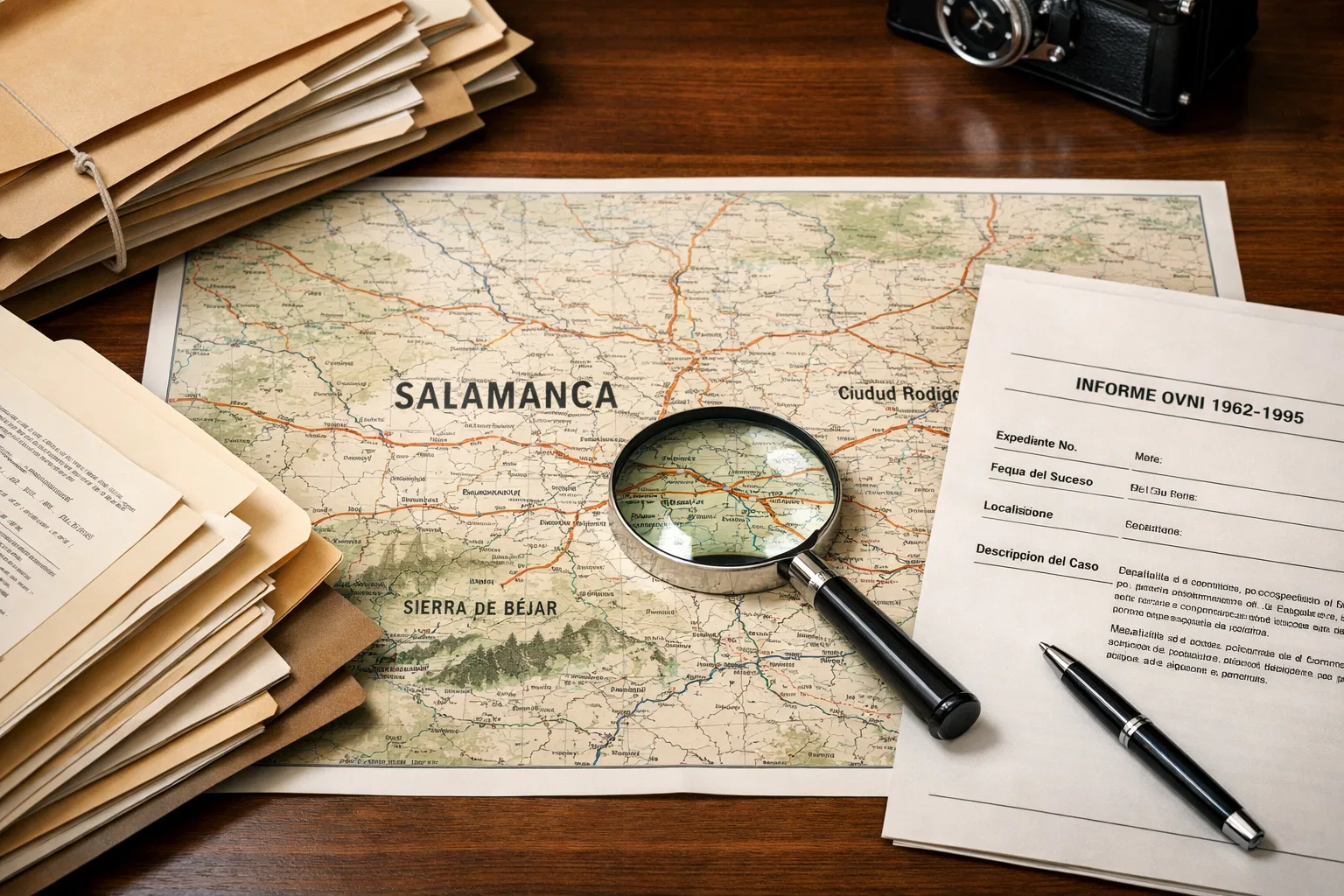
Salamanca’s UFO record has a simple but important puzzle at its centre: Spain’s declassified UFO archive is real, searchable and unusually useful, yet Salamanca’s best-known stories mostly live outside it. The Ministry of Defence says the Spanish Air Force archive covers 80 files and about 1,900 pages of strange aerial phenomena from 1962 to 1995, with summaries, witness material, reports and, where available, meteorological information. But the province’s most memorable accounts — especially the 1974 Lagunilla and Valdehijaderos encounter and the 2001 Gallegos de Argañán landing-and-trace claim — are preserved mainly through local press, specialist UFO writers, later retellings and alleged police or Guardia Civil references rather than neat Air Force dossiers. Biblioteca Virtual de Defensa+2Comunidad Ufológica[bibliotecavirtual.defensa.gob.es]bibliotecavirtual.defensa.gob.esOpen source on gob.es.
That does not make the Salamanca stories worthless. It does mean they have to be read differently. An official file is not proof that something extraordinary happened, and the absence of a file is not proof that nothing happened. For Salamanca, the most honest reading is that the province has a strong UFO folklore layer but a thin public Air Force file layer. The difference matters because it changes how much confidence a reader should place in each claim.
What Spain’s declassified archive actually covers
Spain’s declassified UFO archive was not a general collection of every strange story ever told in the country. It was an Air Force-centred set of records. The Ministry of Defence explains that declassification began in 1991 because the ministry decided to analyse documents on strange sightings and lower their classification so they could be made available to the public. A physical copy was deposited in the Air Force Central Library in Madrid in 1992, and digitisation later made the files available online through the Virtual Defence Library.[Biblioteca Virtual de Defensa]bibliotecavirtual.defensa.gob.esOpen source on gob.es.
The same official presentation defines the scope: sightings within Spanish airspace, from the first listed case at San Javier in Murcia in 1962 to the last dated case at Morón in Seville in 1995, in which Air Force personnel or material were involved in some way. It also notes that each file differs: some contain only a few pages, while others include witness interviews, incident reports and weather information.[Biblioteca Virtual de Defensa]bibliotecavirtual.defensa.gob.esOpen source on gob.es.
That scope is the first key to understanding Salamanca. A reported light over a village, a roadside encounter, a rumour of a landing mark, or even a local police visit would not automatically become an Air Force UFO file. The archive’s centre of gravity was aviation, airspace, military reporting channels and cases that reached the appropriate Air Force level. Specialist researcher Vicente-Juan Ballester Olmos, who was involved in the Spanish declassification process, described the released material as Air Force material: cases involving Air Force witnesses, Air Force inquiries, or civilian observations communicated to air authorities. He also stressed that many other alleged sightings never reached central Air Force files, may have remained in local units, or may never have been formally reported at all.[Academia]academia.eduPDF) Los expedientes OVNI desclasificados -OnlinePDF) Los expedientes OVNI desclasificados -Online
This distinction is especially useful for Salamanca because it prevents two opposite mistakes. The first is to treat every locally famous story as if it must have a hidden official dossier. The second is to dismiss a story simply because it is not easily visible in the public Air Force archive. The archive is a governance record, not a complete map of Spanish popular memory.

Where Salamanca appears, and where it disappears
Salamanca is not completely absent from the Spanish Defence UFO portal. The catalogue includes an authority entry for Ciudad Rodrigo, identifying it as a municipality in the province of Salamanca and linking it generically to Salamanca province.[Biblioteca Virtual de Defensa]bibliotecavirtual.defensa.gob.esOpen source on gob.es. That is a small but revealing detail: the geography of Salamanca exists in the catalogue structure, yet the province does not stand out as a major source of declassified Air Force case files.
Regional reporting makes the same point from another angle. A 2022 overview of UFO cases in Castilla y León noted that the Defence Ministry had published 80 declassified reports, including five in Castilla y León. The named regional examples in that article are concentrated in Valladolid, Burgos and León: Villalón de Campos and Villanubla in Valladolid, a Burgos sighting involving soldiers, and Puente Almuhey in León. Salamanca is not presented there as one of the region’s headline declassified-file provinces.[EL ESPAÑOL]elespanol.comEL ESPAÑOLOvnis en Castilla y León: los expedientes X que siguen sin explicaciónEL ESPAÑOLOvnis en Castilla y León: los expedientes X que siguen sin explicación
This matters because Salamanca’s public UFO identity is not weak. It has recognisable places, witnesses and recurring local claims: the Sierra de Béjar road story around Lagunilla, Valdehijaderos and Horcajo; the later Ciudad Rodrigo borderland story at Gallegos de Argañán; and modern “lights in the sky” reports that sit closer to ordinary skywatching than to close-encounter folklore. The oddity is not that Salamanca has no UFO tradition. The oddity is that its tradition is much stronger in local memory and ufological retelling than in easily searchable Air Force files.
There is also one intriguing late trace in Ballester Olmos’s discussion of post-declassification material: a table of brief additional records includes “26/2/2001 CAO Salamanca” as additional information found from control logs, not a full public case dossier in the same sense as the main historical files. The reference is thin, but it shows why absence is not always clean absence. Some official traces may exist only as brief logbook entries, fragments, or references that never became a developed public investigation.[Academia]academia.eduPDF) Los expedientes OVNI desclasificados -OnlinePDF) Los expedientes OVNI desclasificados -Online
Why the official layer is thin
The thinness of Salamanca’s official UFO files is best explained by how Spain’s system collected information. The Air Force archive favoured cases that came through military, aviation or airspace channels. It was not designed to preserve every dramatic rural claim, every local newspaper story, or every later television reconstruction. In other words, the archive reflects the path a report took through institutions, not the cultural impact it later achieved.
Several filters would have worked against Salamanca’s most famous folklore becoming thick official files:
- Reporting channel: A witness might speak to neighbours, journalists, local police or UFO investigators without the account becoming an Air Force case.
- Type of event: Close encounters on roads or alleged ground traces were not always aviation-safety incidents.
- Institutional priority: A puzzling light seen by air traffic controllers or near an air base was more likely to interest air authorities than a rural story with no radar, aircraft or defence implications.
- Survival of paperwork: Ballester Olmos notes that some material may have remained in units, never reached central files, or simply never been reported through formal channels.[Academia]academia.eduPDF) Los expedientes OVNI desclasificados -OnlinePDF) Los expedientes OVNI desclasificados -Online
- Later amplification: A case can become famous years later through books, radio, television and websites even if its official paper trail was modest or unclear.
The broader Castilla y León comparison reinforces the point. Valladolid’s Villanubla case involved a control tower and a reported scramble order, the kind of aviation-linked situation that naturally fits an Air Force archive. Salamanca’s best-known accounts are more rural, witness-led and folkloric. That does not automatically make them false, but it does make them less likely to appear as classic official airspace investigations.[EL ESPAÑOL]elespanol.comEL ESPAÑOLOvnis en Castilla y León: los expedientes X que siguen sin explicaciónEL ESPAÑOLOvnis en Castilla y León: los expedientes X que siguen sin explicación
The 1974 Lagunilla story shows how folklore can outrun files
The 1974 Maximiliano Iglesias Sánchez case is the clearest example of Salamanca folklore outpacing official documentation. In the common version, Iglesias was a young transport worker connected with Lagunilla who, in the early hours of 21 March 1974, left Pinedas in an Avia van and encountered intense lights on the road between Valdehijaderos and Horcajo. The story developed into a close-encounter account involving a vehicle stoppage, strange objects, alleged beings and a frightened witness.[Comunidad Ufológica]ovnispain.comOpen source on ovnispain.com.
As a story, it has all the elements that help a case survive in popular memory: a named witness, a lonely rural road, a precise provincial setting, a vehicle affected at the scene, and later retellings by UFO writers. It is also highly “localisable”. Readers can place it in the Sierra de Béjar area rather than in an abstract national UFO map. That local texture is one reason it has endured.
As evidence, however, it is harder to treat with the same confidence as an official aviation file. The material most easily available today comes through ufological retellings and secondary accounts rather than a clear, accessible Air Force dossier. The case may include claims about authorities being informed, but the public evidential trail is not the same as a file containing original statements, dated official summaries, weather checks, air-traffic information and conclusions. For a balanced Salamanca page, the correct conclusion is not “therefore nothing happened”. It is that the story’s cultural strength is greater than its official-document strength.
That difference changes how the reader should interpret it. The 1974 case is central to Salamanca’s UFO memory, but it should be classed as a folklore-led close encounter rather than as a strongly documented military file case. Its importance lies in what it reveals about the province’s UFO imagination: roads, small villages, night travel, sudden light, fear, and the way one witness account can become a landmark story.
The 2001 Gallegos de Argañán case sits between police record and public legend
The Gallegos de Argañán case is more complicated because it appears closer to an official local response, even though it still does not sit comfortably inside the main Air Force declassified archive. Local reporting places the incident in April 2001 at the Cuéllar estate, within the municipality of Gallegos de Argañán, in the Ciudad Rodrigo area. The owner, Luis González, and an ex-Ukrainian military witness, Yuri Andreyev, are associated with claims of bright platforms or lights over the estate and mysterious ground marks.[Noticias Ciudad Rodrigo]noticiasciudadrodrigo.comOpen source on noticiasciudadrodrigo.com.
A 2023 Noticias Ciudad Rodrigo article summarised the case as one that received national media attention after publication in local press, including images of the alleged marks. It also notes that journalist and local researcher Juan Tomás Muñoz had covered the matter while working for the now-defunct El Adelanto de Salamanca.[Noticias Ciudad Rodrigo]noticiasciudadrodrigo.comOpen source on noticiasciudadrodrigo.com.
The most important evidential feature is the reported involvement of the Guardia Civil. In the retold account, members of the judicial police unit inspected the site, collected witness declarations and photographic material, and forwarded a copy of the inspection report to government authorities.[Noticias Ciudad Rodrigo]noticiasciudadrodrigo.comOpen source on noticiasciudadrodrigo.com. That is stronger than a purely oral village legend, because it suggests that at least some official local paperwork existed.
But the case still has limits. The strongest public versions are mediated through later retellings, especially those connected to UFO journalism and television. The reported Guardia Civil material is described or reproduced in secondary contexts, not presented in the same public institutional format as the Defence Ministry’s Air Force files. The result is a halfway category: not merely pub folklore, not a clean declassified Air Force case either.
For Salamanca, that halfway status is instructive. It shows how a case can have official contact without becoming an official “UFO file” in the public Defence archive sense. A local police inspection may establish that people reported something and that marks were seen on the ground. It does not, by itself, establish that the cause was exotic. It also does not guarantee long-term preservation, central military analysis, or later searchable access.
How ordinary explanations weaken modern “UFO” claims
One reason official files and folklore diverge is that many modern sightings are solved quickly, often before they can mature into durable mystery. The 2022 Castilla y León article gives a useful regional example: in May 2021, lines of lights seen from several points in the region prompted calls and online discussion, but the 112 emergency service publicly explained that the pattern matched a visible train of satellites.[EL ESPAÑOL]elespanol.comEL ESPAÑOLOvnis en Castilla y León: los expedientes X que siguen sin explicaciónEL ESPAÑOLOvnis en Castilla y León: los expedientes X que siguen sin explicación
That example matters for Salamanca even though it is regional rather than a classic Salamanca case. It shows how the evidential environment has changed. In the 1970s, a strange light on a rural road could become a story carried by word of mouth, local papers and UFO magazines. In the 2020s, similar lights may be photographed, shared online and identified within hours as satellites, aircraft, drones, balloons, astronomical objects or re-entering space debris.
This does not solve every older case retrospectively, but it makes caution necessary. A reader looking at Salamanca’s UFO tradition should ask whether a report has independent witnesses, original statements, dated press coverage, photographs, police or military records, environmental checks and plausible mundane explanations. The fewer of those elements are available, the more the case belongs to folklore, memory and cultural history rather than strong unresolved evidence.
What counts as good evidence in Salamanca’s thin-file landscape?
Because Salamanca’s official file layer is thin, the best approach is not to ask only, “Was there an official UFO file?” A better question is, “What kind of record survives, and what does it prove?”
For Salamanca cases, the evidence can be sorted into four broad levels.
A declassified Air Force file is the strongest institutional format, especially if it includes original witness material, dates, weather checks, aviation context and conclusions. Spain’s archive shows what that kind of record looks like, even if Salamanca is not one of its richest provinces.[Biblioteca Virtual de Defensa]bibliotecavirtual.defensa.gob.esOpen source on gob.es.
A local official trace is weaker but still useful. The alleged Guardia Civil activity in the Gallegos de Argañán case belongs here: it may support the claim that witnesses reported something and that marks were inspected, but it does not automatically validate the extraordinary interpretation.[Noticias Ciudad Rodrigo]noticiasciudadrodrigo.comOpen source on noticiasciudadrodrigo.com.
Contemporary local press can be valuable, especially when it names witnesses, dates, places and first-hand reporting. The problem is that local press can also amplify a mystery before explanations have been checked, and archives may be incomplete or hard to verify online.
Later ufological retelling is the most culturally influential but evidentially fragile category. It keeps stories alive, adds narrative detail and connects cases to wider UFO mythology, yet it may also smooth over uncertainty, repeat unverified claims or make a case feel more documented than it really is.
This hierarchy does not mean official sources are always right and witnesses are always wrong. It means each source type answers a different question. Official files show what reached an institution. Local folklore shows what a community remembered. UFO books and programmes show what later storytellers found compelling. Confusing those categories is how thin evidence becomes inflated certainty.
Why the gap matters for Salamanca’s UFO history
The thinness of Salamanca’s official files is not a boring absence. It is the province’s main interpretive clue. Salamanca’s UFO history is not primarily a story of pilots, radar returns and Air Force inquiries. It is a story of rural encounters, borderland estates, night roads, local newspapers, named witnesses and later media memory.
That gives the province a distinctive place in Spanish UFO history. Compared with better-documented aviation-linked cases elsewhere in Spain, Salamanca is more dependent on human testimony and local transmission. Compared with vague modern sky-light reports, its classic stories have stronger narrative identity and place-based detail. The result is a record that is memorable but uneven.
The fairest conclusion is therefore deliberately modest. Spain’s declassified archive confirms that official UFO files exist and that the Air Force took some reports seriously enough to preserve and release them. Salamanca’s famous stories, however, mostly do not gain their importance from that archive. They matter because they show how provincial UFO folklore can become durable even when the official file trail is thin, partial or hard to verify.
The practical reading: unresolved, weak, or simply undocumented?
Readers often want a clean label: real, hoax, explained or unexplained. Salamanca resists that kind of neat sorting. A better set of labels is more useful.
The 1974 Lagunilla and Valdehijaderos encounter is best read as folklore-led and weakly official: important to Salamanca’s UFO identity, but not strongly anchored in a public Air Force file. The 2001 Gallegos de Argañán case is locally documented but not cleanly settled: it has witness claims, press coverage and alleged Guardia Civil inspection, yet the public record still reaches most readers through secondary retelling. Modern lines of lights are often plausibly explained, especially where authorities identify satellite trains or similar causes quickly.[Comunidad Ufológica+2Noticias Ciudad Rodrigo]ovnispain.comOpen source on ovnispain.com.
That is not a disappointing answer. It is the answer that keeps the subject honest. Salamanca’s UFO history is strongest when treated as a layered record: official archive at the base, local reporting in the middle, folklore and media memory above it. The stories survive because they are vivid. Their evidential weight remains limited because the best-known claims rarely arrive with the kind of official documentation that would make them robust historical cases.
Amazon book picks
Further Reading
Books and field guides related to Why Are Salamanca's UFO Files So Thin?. Use these as the next step if you want deeper reading beyond the article.
UFOs: Generals, Pilots, and Government Officials Go on the Re...
Focuses on documented official cases.
UFOs and Government: A Historical Inquiry
Directly addresses the relationship between archives and UFO history.
The UFO Experience: A Scientific Inquiry
Provides evidence-based investigative framework.
Passport to Magonia: from folklore to flying saucers
Explores folklore alongside UFO traditions.
eBay marketplace picks
Marketplace Samples
Live-tested eBay searches with available results related to this page.



Endnotes
1.
Source: academia.edu
Title: (PDF) Los expedientes OVNI desclasificados -Online
Link:https://www.academia.edu/35429868/Los_expedientes_OVNI_desclasificados_Online
2.
Source: elespanol.com
Title: EL ESPAÑOLOvnis en Castilla y León: los expedientes X que siguen sin explicación
Link:https://www.elespanol.com/castilla-y-leon/sociedad/20220702/ovnis-castilla-leon-expedientes-siguen-sin-explicacion/681932212_0.html
3.
Source: archive.org
Link:https://archive.org/download/jufoh/jufoh.pdf
4.
Source: academia.edu
Link:https://www.academia.edu/35786573/Spanish_Air_Force_UFO_Files_The_Secrets_End_pdf
5.
Source: academia.edu
Link:https://www.academia.edu/12561888/DESCLASIFICACION_OVNI_EL_ULTIMO_EXPEDIENTE
6.
Source: academia.edu
Link:https://www.academia.edu/28130360/UFO_Declassification_The_Spanish_Model
7.
Source: academia.edu
Link:https://www.academia.edu/32053531/STATE_OF_THE_ART_IN_UFO_DISCLOSURE_WORLDWIDE
8.
Source: archives.gov
Link:https://www.archives.gov/research/guide-fed-records/groups/059.html
9.
Source: bibliotecavirtual.defensa.gob.es
Link:https://bibliotecavirtual.defensa.gob.es/BVMDefensa/exp_ovni/es/micrositios/inicio.do
10.
Source: ovnispain.com
Link:https://www.ovnispain.com/encuentro-con-humanoides-en-salamanca-1974-maximiliano-iglesias-sanchez-ovnis-en-salamanca/
11.
Source: noticiasciudadrodrigo.com
Link:https://noticiasciudadrodrigo.com/2023/07/27/el-dia-que-los-ovnis-visitaron-la-comarca-de-ciudad-rodrigo/
12.
Source: bibliotecavirtual.defensa.gob.es
Link:https://bibliotecavirtual.defensa.gob.es/BVMDefensa/exp_ovni/es/consulta_aut/registro.do?id=322749
Additional References
13.
Source: facebook.com
Link:https://www.facebook.com/cubanetnoticias/posts/adolfo-z%C3%A1rate-un-campesino-de-74-a%C3%B1os-trabajaba-cortando-ca%C3%B1a-cuando-escuch%C3%B3-una/1472492508236478/
14.
Source: planetabenitez.com
Link:https://planetabenitez.com/ballester-olmos-de-ufologo-cientifico-a-titulado-fraudulento/
15.
Source: facebook.com
Link:https://www.facebook.com/groups/scientificcosmology/posts/10174976489890268/
16.
Source: zenodo.org
Link:https://zenodo.org/record/6554749/files/DTU3.pdf
17.
Source: pedromariafernandez.blogspot.com
Link:https://pedromariafernandez.blogspot.com/2014/03/encuentros-en-la-carretera.html
18.
Source: studocu.com
Link:https://www.studocu.com/es-mx/document/universidad-tecnologica-de-mexico/desarrollo-de-planes-de-exportacion/los-expedientes-ovni-desclasificados/23115065
19.
Source: ovniologia.com.br
Link:https://ovniologia.com.br/pt/2024/01/incidente-em-salamanca-o-encontro-imediato-de-maximiliano-iglesias.html
20.
Source: facebook.com
Link:https://www.facebook.com/centrodelasartesdeguanajuato/posts/la-presentaci%C3%B3n-editorial-de-a-fuego-lento-avistamientos-interdisciplinarios-sob/1404295935065570/
21.
Source: reddit.com
Link:https://www.reddit.com/r/UFOs/comments/15pk0a1/revealing_33_years_of_ufos_over_catalonia_more/
22.
Source: iapsop.com
Link:https://iapsop.com/archive/materials/mufon_ufo_journal/skylook_n85_dec_1974.pdf
Topic Tree