Within Valencia UFOs
What Do Valencia's UFO Files Actually Prove?
Valencia's UFO reputation depends less on photos than on declassified military files, air traffic records and later archive work.
On this page
- What the Defence archive preserves
- Why declassified does not mean confirmed
- How records shape public memory
Page outline Jump by section
Introduction
Valencia’s UFO files prove something narrower, but more useful, than the popular stories often suggest. They show that several strange aerial reports in and around the province were taken seriously enough to enter Spain’s Air Force paperwork: pilot calls, air traffic exchanges, military summaries, declassification notes and later archive entries. They do not prove that the objects were exotic craft. In fact, the strongest lesson from the files is that official attention and confirmed explanation are not the same thing.
The Ministry of Defence’s public UFO archive contains 80 files and about 1,900 pages covering strange aerial phenomena in Spanish airspace from 1962 to 1995. The records were declassified from 1991 onwards, with a physical copy deposited in the Air Force Central Library in 1992 and later made available online through the Defence Virtual Library. The Valencia-linked material sits inside that national archive, but it matters locally because it includes aviation cases rather than only casual witness reports.[Biblioteca Virtual Defensa]bibliotecavirtual.defensa.gob.esOpen source on gob.es.
What the Defence archive preserves
Spain’s Defence Virtual Library explains that each UFO file normally begins with a summary giving the place, date, account of events, considerations, conclusions and proposed classification decision. The supporting material can then include witness interviews, incident reports, weather information, press cuttings, drawings or other case-specific documents, although the archive also warns that file depth varies sharply: some dossiers run to only a few pages, while others contain dozens.[Biblioteca Virtual Defensa]bibliotecavirtual.defensa.gob.esOpen source on gob.es.
That unevenness is crucial for Valencia. The province’s official paper trail is not a single neat casebook in which every report was investigated to the same standard. It is a patchwork. Some entries preserve little more than an aircrew communication and a later intelligence-office summary. Others, especially the Manises-related files, sit inside wider Air Force correspondence about radar, interception, public pressure and declassification. The result is a record that is valuable, but not self-interpreting.
A 2016 survey by El País’s Verne, based on the Defence archive, listed three Valencia province entries: 4 November 1968 between Valencia and Sagunto; 26 September 1973 in Valencia; and 11, 17 and 28 November 1979 between El Saler and the Albufera, linked to the wider Manises file. The same article noted that the documents had been grouped by province for public use, while warning that some files appear under several places because a single incident could involve aircraft, sea routes or simultaneous sightings in different areas.[Verne]verne.elpais.comOpen source on elpais.com.
This matters because Valencia’s reputation is partly an archive effect. The province appears important not because every case is spectacular, but because several reports involved aviation witnesses, airspace control or military channels. The paper trail gives researchers fixed dates, flight numbers, official conclusions and later declassification decisions, which are much harder to handle responsibly when a story survives only as oral tradition or newspaper retelling.
The 1968 Valencia-Sagunto file shows both value and weakness
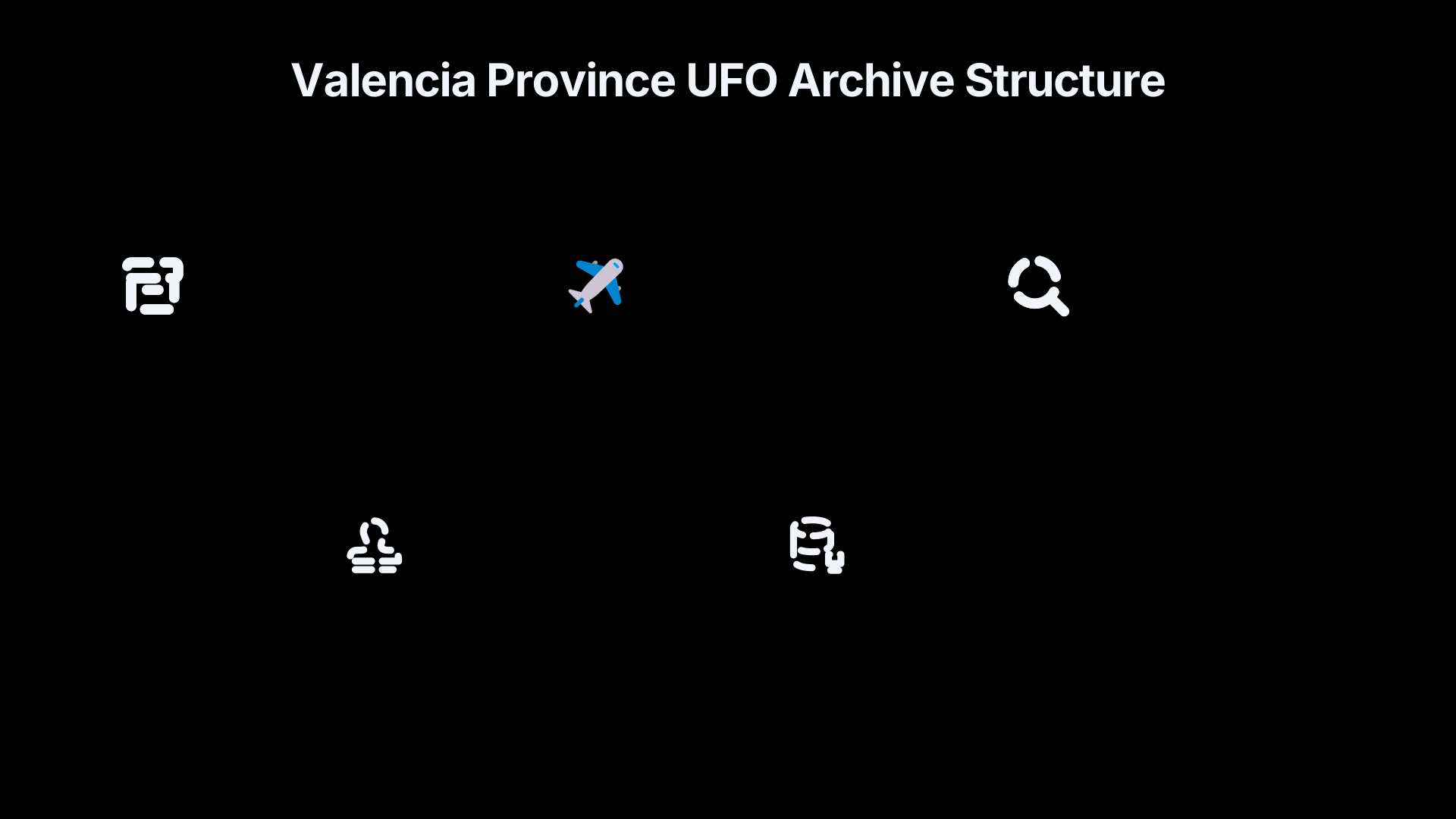
The 4 November 1968 Valencia-Sagunto file is a good example of what an official file can and cannot do. The dossier identifies the case as file number 681104 and places it between Valencia and Sagunto. It says that at 18:23Z, Iberia flight IB-249, a Caravelle flying from Barcelona to Alicante, told Barcelona Area Control that the crew could see a very large light with two smaller side lights. The light was described as descending, going out, later rising and lighting up again, before finally disappearing towards the Mediterranean.[J.J. Benítez]planetabenitez.comJ.J. Benítez
That is better evidence than a loose anecdote because it fixes the observation inside an air traffic conversation. The file also says Barcelona control had no radar contact, but gives a mundane reason for that absence: the estimated position of the light was outside the radar’s reach. In other words, the file does not turn “no radar confirmation” into either proof or disproof. It simply records the technical limitation under which the report was handled.[J.J. Benítez]planetabenitez.comJ.J. Benítez
The same document then pulls the reader back from overclaiming. Its considerations say the phenomenon was observed by the IB-249 crew, but that only the transcript of the conversation with area control survives and that there was no later investigation. It also says there were no recorded data on apparent or estimated size, altitude or speed. The intelligence summary even suggests that the observed descent-and-dimming effect could fit a ventral light, such as aircraft landing lights, fading from view as the viewing angle changed.[J.J. Benítez]planetabenitez.comJ.J. Benítez
The file’s own conclusion is therefore cautious. It says the scarcity of data prevents any explanatory hypothesis being advanced with enough reliability, and it proposed the file should be unclassified. That is a useful model for reading Valencia’s UFO paperwork: the Air Force preserved a real report from professional witnesses, but the official record itself does not support a strong claim about what the light was.[J.J. Benítez]planetabenitez.comJ.J. Benítez
The 1973 Valencia file became a test of pilot testimony
The 26 September 1973 Valencia file is catalogued by the Defence Virtual Library as a 15-page dossier titled “Avistamiento de fenómenos extraños en Valencia”, produced by the Air Operational Command, General Staff, Intelligence Section. The catalogue record gives the subject as UFO observations and encounters in Valencia province and notes that it was declassified under a Chief of Air Staff decision dated 23 September 1993.[Biblioteca Virtual Defensa]bibliotecavirtual.defensa.gob.esOpen source on gob.es.
The case has acquired importance because later researchers treated it as a classic example of how expert witnesses can still misread a bright astronomical object. A detailed study by Vicente-Juan Ballester Olmos, Manuel Borraz and Jordi Plana describes the incident as involving two Mirage III pilots returning to Manises air base over the Mediterranean when they saw an unidentified light. The authors note that some UFO writers had presented it as a strong pilot case with radar support, but their reconstruction argues that Venus is the most likely explanation.[Academia]academia.eduPDF) MIRAGE III RUMBO A VALENCIAPDF) MIRAGE III RUMBO A VALENCIA
The technical point is simple enough for a non-specialist reader: a distant bright object near the horizon can appear to move with an aircraft, especially when the observers themselves are moving. The reconstruction places Venus in a direction and height that would have matched the pilots’ reported line of sight, and argues that variations in brightness could have created an impression of approach, parallel movement or withdrawal.[Academia]academia.eduPDF) MIRAGE III RUMBO A VALENCIAPDF) MIRAGE III RUMBO A VALENCIA
That does not mean the pilots were careless or dishonest. It means the official file is strongest as a record of perception under flight conditions, not as proof of an extraordinary vehicle. The 1973 file is therefore valuable because it preserves the institutional skeleton of the case, while later analysis shows how the same skeleton can be reinterpreted once astronomy, flight path and viewing geometry are checked together.
Manises is the archive’s centre of gravity
The 1979 Manises material dominates Valencia’s UFO memory because it moved beyond a simple sighting. The famous incident began with a commercial aircraft diverting to Valencia after its crew reported alarming lights, and it later involved military interest, an interceptor narrative and political attention. In the Defence archive, the relevant official title covers strange phenomena in Valencia, Motril and Madrid on 11, 17 and 28 November 1979, under file numbers 791111, 791117 and 791128.[Biblioteca Virtual Defensa]bibliotecavirtual.defensa.gob.esOpen source on gob.es.
The Defence catalogue entry is important because it shows that the Manises paperwork is not just a local Valencia folder. It is a combined dossier linking several November 1979 reports across different locations. Later archive indexing and research describe the “Bis” file as a Mando Operativo Aéreo and MACEN dossier gathered in 1994 as part of an internal effort to recover UFO-related information generated within Air Force units.[UFO Transparency]ufotransparency.comOpen source on ufotransparency.com.
That 1994 recovery effort is revealing. It shows that the declassification process was not simply a drawer being opened. It involved institutional housekeeping: asking commands what documentation still existed, checking what had already leaked or appeared in public reporting, and deciding what could be downgraded. The same Manises-related dossier notes that some records were affected by routine destruction rules for vigilance and activity logs, which helps explain why the surviving official record is sometimes thinner than readers expect.[UFO Transparency]ufotransparency.comOpen source on ufotransparency.com.
This is why Manises can feel both well documented and frustrating. It has more official texture than most UFO reports: dates, operational units, air defence references, later correspondence and declassification history. But it also has gaps, joins and retrospective assembly. The files strengthen the case’s historical importance; they do not remove the interpretive problem of what the lights actually were.

Why declassified does not mean confirmed
A common misunderstanding is that “declassified” means “verified”. In the Spanish archive, it means the material no longer needed to remain restricted. The Ministry’s own presentation says the process began because Defence decided to analyse the documents and, where appropriate, lower their classification level so the public could consult them. It also states that the names of declarants and reporting officers are omitted despite declassification.[Biblioteca Virtual Defensa]bibliotecavirtual.defensa.gob.esOpen source on gob.es.
For Valencia, that distinction changes the whole reading. The 1968 case was unclassified not because it had been solved, but because the available material did not justify keeping it classified. The official text explicitly says the data were too scarce for a reliable hypothesis. In the 1973 case, the catalogue confirms an official file and declassification decision, while later specialist analysis argues for a probable Venus misidentification. J.J. Benítez+2Biblioteca Virtual Defensa[planetabenitez.com]planetabenitez.comJ.J. BenítezJ.J. Benítez
The same caution applies to Manises. The presence of a Defence file confirms that the episode entered official channels and that institutional records were preserved or later recovered. It does not confirm the popular version of the case as an encounter with a structured non-human craft. Valencia Plaza, writing about Vicente-Juan Ballester Olmos and the Spanish declassification story, noted that the Manises file was among the documents digitised by Defence and that sceptical researchers linked to Fundación Anomalía later mounted a forceful conventional interpretation of the case.[Valencia Plaza]valenciaplaza.comValencia Plaza Ballester Olmos: El hombre tras la desclasificaciónValencia Plaza…
This does not make the archive useless. It makes it more useful. Properly read, the files separate three questions that are often blurred together: whether a report happened, whether it was documented by the state, and whether the reported phenomenon remains unexplained after later analysis. Valencia has strong evidence for the first two in several cases, but the third varies case by case.
What the files say about investigation quality
The Defence archive’s own structure encourages a graded reading rather than a yes-or-no verdict. A strong file is not merely one with dramatic claims; it is one with independent records, timings, technical checks, witness statements and enough environmental context to test explanations. A weak file may still involve a sincere witness, but it leaves too little data to reconstruct the event.
Valencia’s files illustrate that range clearly:
- 1968 Valencia-Sagunto: useful because it preserves an aircrew-to-control communication, weak because there was no later investigation and no firm data on size, height or speed.[J.J. Benítez]planetabenitez.comJ.J. Benítez
- 1973 Valencia: useful because it generated an official Air Force dossier and later technical reconstruction, weaker as an unexplained case because the Venus interpretation appears reasonably consistent with the geometry described by later researchers.[Biblioteca Virtual Defensa]bibliotecavirtual.defensa.gob.esOpen source on gob.es.
- 1979 Manises-linked files: historically important because they connect Valencia to one of Spain’s best-known aviation UFO episodes and to later Air Force record recovery, but still difficult because the surviving files combine multiple places, later correspondence and incomplete operational records.[Biblioteca Virtual Defensa]bibliotecavirtual.defensa.gob.esOpen source on gob.es.
This quality ladder is more helpful than asking whether Valencia’s files “prove UFOs”. They prove that official systems recorded unusual reports; they do not give all reports equal evidential weight. Some entries are unresolved because the data are poor. Others look less mysterious after later checking. A few remain culturally important because of who reported them and how institutions responded.
How official records shape Valencia’s UFO memory
Valencia’s UFO history is remembered through files as much as through sightings. The cases that survive most vividly are those that generated paperwork: pilots speaking to controllers, military units filing summaries, Defence librarians cataloguing dossiers, journalists mapping the archive, and later researchers revisiting the technical details. This gives Valencia a more aviation-centred UFO identity than provinces whose stories depend mainly on local folklore.
The public archive also changes the balance of authority. Before digitisation, a dramatic retelling could lean heavily on witness memory or selective quotation. Once readers can see catalogue entries, summaries and supporting documents, the story becomes easier to check but also harder to sensationalise. The same file that confirms a strange report may also contain the line that weakens it: no radar contact, no follow-up, no size estimate, no reliable hypothesis, or a plausible conventional explanation.
The archive has also made Valencia part of a wider Spanish pattern. El País’s provincial listing placed Valencia alongside cases in Alicante, Castellón and other Spanish provinces, making clear that the Defence files were a national airspace record rather than a Valencia-only mystery archive. But within that larger pattern, Valencia stands out because its best-known documents are tied to air routes, Manises airport, military aviation and the Mediterranean corridor.[Verne]verne.elpais.comOpen source on elpais.com.
What the files actually prove
The safest conclusion is also the most useful: Valencia’s official UFO files prove that unusual aerial reports entered Spanish military and aviation bureaucracy, not that the reported objects were extraordinary craft. They preserve a public record of uncertainty, and in several places they preserve the limits of that uncertainty as clearly as the mystery itself.
For a reader trying to judge the province’s UFO history, the files support three practical conclusions. First, Valencia’s serious cases are documentary rather than photographic. Second, declassification increases transparency but does not settle identity. Third, the strongest interpretations come from reading the official documents together with later technical work, not from treating either the original witness claim or the later debunking as automatically final.
That is why the files matter. They turn Valencia’s UFO reputation from a collection of dramatic stories into a set of traceable records: some thin, some aviation-rich, some probably explainable, and some still historically significant because of how Spanish institutions reacted when ordinary airspace produced extraordinary reports.
Amazon book picks
Further Reading
Books and field guides related to What Do Valencia's UFO Files Actually Prove?. Use these as the next step if you want deeper reading beyond the article.
UFOs: Generals, Pilots, and Government Officials Go on the Re...
Excellent match for declassified Spanish UFO files.
The Demon-Haunted World
Reinforces evidence-based interpretation of archival material.
eBay marketplace picks
Marketplace Samples
Live-tested eBay searches with available results related to this page.



Endnotes
1.
Source: planetabenitez.com
Title: J.J. Benítez
Link:https://planetabenitez.com/wp-content/uploads/2023/11/1968-11-04_avistamiento_entre_valencia-sagunto.pdf
2.
Source: academia.edu
Title: (PDF) MIRAGE III RUMBO A VALENCIA
Link:https://www.academia.edu/36897206/MIRAGE_III_RUMBO_A_VALENCIA
3.
Source: valenciaplaza.com
Title: Valencia Plaza Ballester Olmos: El hombre tras la desclasificación
Link:https://valenciaplaza.com/valenciaplaza/el-hombre-tras-la-desclasificacion
Source snippet
Valencia Plaza...
4.
Source: academia.edu
Title: LAS BALIZAS DEL 11 DE NOVIEMBRE DE 1979
Link:https://www.academia.edu/44150004/LAS_BALIZAS_DEL_11_DE_NOVIEMBRE_DE_1979
5.
Source: academia.edu
Title: Expediente Manises El terreno alrededor de Escombreras
Link:https://www.academia.edu/103909911/Expediente_Manises_El_terreno_alrededor_de_Escombreras
6.
Source: academia.edu
Title: Spanish Air Force UFO Files The Secrets End pdf
Link:https://www.academia.edu/35786573/Spanish_Air_Force_UFO_Files_The_Secrets_End_pdf
7.
Source: academia.edu
Link:https://www.academia.edu/12717306/El_Mando_Operativo_Aereo_busca_casos_perdidos
8.
Source: archive.org
Link:https://archive.org/download/desclasificacion/desclasificacion.pdf
9.
Source: bibliotecavirtual.defensa.gob.es
Link:https://bibliotecavirtual.defensa.gob.es/BVMDefensa/exp_ovni/es/micrositios/inicio.do
10.
Source: verne.elpais.com
Link:https://verne.elpais.com/verne/2016/10/25/articulo/1477394008_803441.html
11.
Source: bibliotecavirtual.defensa.gob.es
Link:https://bibliotecavirtual.defensa.gob.es/BVMDefensa/exp_ovni/es/consulta/registro.do?id=38125
12.
Source: bibliotecavirtual.defensa.gob.es
Link:https://bibliotecavirtual.defensa.gob.es/BVMDefensa/exp_ovni/es/catalogo_imagenes/grupo.do?path=102238
13.
Source: ufotransparency.com
Link:https://ufotransparency.com/files/intl-es-expediente-manises-1979-1979-11-11-17-28-avistamiento-en-valencia-motril-madrid-ii
14.
Source: es.scribd.com
Title: 1979 11 11 17 28 Avistamiento en Valencia Motril Madrid
Link:https://es.scribd.com/document/328833056/1979-11-11-17-28-Avistamiento-en-Valencia-Motril-Madrid
15.
Source: scribd.com
Title: 1968 11 04 Avistamiento Entre Valencia Sagunto
Link:https://www.scribd.com/document/764048898/1968-11-04-Avistamiento-Entre-Valencia-Sagunto
16.
Source: bibliotecavirtual.defensa.gob.es
Title: defensa.gob.es Listado de títulos
Link:https://bibliotecavirtual.defensa.gob.es/BVMDefensa/exp_ovni/es/consulta/indice_campo.do?campo=idtitulo
17.
Source: bibliotecavirtual.defensa.gob.es
Link:https://bibliotecavirtual.defensa.gob.es/BVMDefensa/es/publicaciones/listar_numeros.do?busq_anyo=1979&busq_dia=&busq_infoArticulos=true&busq_mes=8&campoOrden=fechaPublicacion&descendente=true&tipo_busqueda=calendario
18.
Source: ufotransparency.com
Title: Spain files · 02 International Disclosure
Link:https://ufotransparency.com/international/files/es
19.
Source: ufotransparency.com
Link:https://ufotransparency.com/international/findings/es
20.
Source: english.elpais.com
Link:https://english.elpais.com/cat/2016/11/11/catalunya/1478881679_067169.html
21.
Source: nationalarchives.gov.uk
Title: ufo reports
Link:https://www.nationalarchives.gov.uk/explore-the-collection/explore-by-time-period/postwar/ufo-reports/
Additional References
22.
Source: youtube.com
Title: The UFO that Shocked an Entire Continent
Link:https://www.youtube.com/watch?v=V10Q9AWsOfY
Source snippet
1,900 pages of 'UFO files' are declassified in Spain...
23.
Source: youtube.com
Title: The Manises UFO Incident: A Classic UFO Case from Spain
Link:https://www.youtube.com/watch?v=A7MTdkK_JaM
Source snippet
The UFO that Shocked an Entire Continent - Manises UAP incident in Europe | TAE Flight 297...
24.
Source: youtube.com
Title: 1,900 pages of ‘UFO files’ are declassified in Spain
Link:https://www.youtube.com/watch?v=-XuV39079LA
Source snippet
Manises Airport UFO Incident 1979 Spanish Plane Emergency & UFO Encounter...
25.
Source: youtube.com
Title: The Case of the Manises UFOs
Link:https://www.youtube.com/watch?v=Yq33yXQ6U9o
Source snippet
Manises UFO incident The Manises UFO Incident: A Classic UFO Case from Spain Street of Silence...
26.
Source: facebook.com
Link:https://www.facebook.com/TheSunFootball/posts/after-some-strange-reports-in-spain/4992390037448069/
27.
Source: juntadeandalucia.es
Link:https://www.juntadeandalucia.es/organismos/culturaydeporte/areas/cultura/bibliotecas-documentacion/directorio-bibliotecas/detalle/724.html
28.
Source: zenodo.org
Link:https://zenodo.org/record/6554749/files/DTU3.pdf
29.
Source: handyspanish.com
Link:https://handyspanish.com/descarga/lectura-en-espanol-ovni-manises/
30.
Source: reddit.com
Link:https://www.reddit.com/r/UFOs/comments/15pk0a1/revealing_33_years_of_ufos_over_catalonia_more/
31.
Source: facebook.com
Link:https://www.facebook.com/CanalExtremadura/posts/m%C3%A1s-de-800-casos-relacionados-con-los-ovnis-y-apariciones-extraterrestres-convie/10158127613465172/
Topic Tree