Within Tenerife UFOs
What Spain's UFO Files Really Prove
The declassified files show official attention to Tenerife-related reports without proving an extraordinary origin.
On this page
- How Tenerife appears in the archive
- What investigators recorded
- Why official files are not official proof
Page outline Jump by section
Introduction
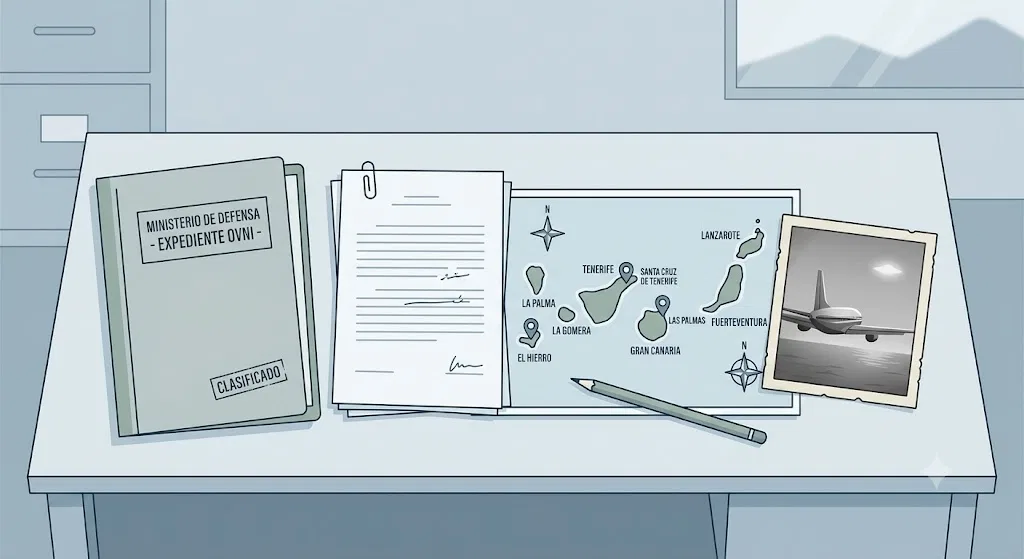
The Spanish Air Force files behind the Tenerife sightings prove something narrower, and more useful, than many dramatic retellings suggest. They show that reports from Tenerife and the wider Canary Islands were taken seriously enough to be logged, interviewed, mapped, summarised and eventually declassified by Spain’s Ministry of Defence. They do not prove that extraordinary craft were present over Santa Cruz de Tenerife. The archive’s real value is documentary: it fixes dates, places, witnesses, official handling and later doubts in a way that local legend alone cannot. The key Tenerife-related material sits inside Spain’s online UFO-file collection, especially the 17 September 1968 Tenerife–Las Palmas aircraft case, the major 22 June 1976 Canary Islands dossier, the 19 November 1976 follow-up file and the 1980 Canary reports. Together, they show official attention, but also why an official file is not the same as official proof.[Biblioteca Virtual Defensa+2Biblioteca Virtual Defensa]bibliotecavirtual.defensa.gob.esOpen source on gob.es.
How Tenerife Appears in the Archive
Spain’s Ministry of Defence says the UFO-file declassification process began in 1991, with a physical copy placed in the Central Library of the Air Force in Madrid in 1992 and later made available online through the Virtual Defence Library. The collection comprises 80 files and about 1,900 pages concerning unusual aerial phenomena in Spanish airspace where Air Force personnel or material were involved in some way. The files cover cases from 1962 to 1995, and the Ministry notes that some reports concern a single location while others span several places because the same phenomenon was seen from an aircraft or from different points with matching dates and descriptions.[Biblioteca Virtual Defensa]bibliotecavirtual.defensa.gob.esOpen source on gob.es.
That last point is crucial for Santa Cruz de Tenerife. Tenerife appears in the archive not only as the scene of isolated reports, but as part of a Canary-wide viewing platform. The Ministry’s title list includes multiple Canary Islands files: the 1968 IB-220 Tenerife–Las Palmas case, 1974 and 1976 Canary sightings, the 5 March 1979 file, the 22 May 1980 file, the 20–21 November 1980 file, a 1985 shipboard case, and later radar-station references.[Biblioteca Virtual Defensa]bibliotecavirtual.defensa.gob.es› Title list…
The earliest sharply Tenerife-labelled item is the 17 September 1968 case involving flight IB-220 between Tenerife and Las Palmas. The catalogue identifies it as a 14-page file by the Air Operational Command’s Intelligence Section, declassified on 11 January 1993, with subject locations including Las Palmas, Tenerife and the Canary Islands. Its importance is not that it proves an exotic object, but that it shows Tenerife entering the official Air Force UFO paperwork before the better-known mid-1970s Canary flap.[Biblioteca Virtual Defensa]bibliotecavirtual.defensa.gob.esOpen source on gob.es.
The archive also shows how uneven the files are. Some are large dossiers with interviews, graphics and maps; others are only a few pages. The Ministry’s own description says each file usually begins with summary pages giving the place, date, account of events, considerations, conclusions and classification proposal, followed where available by witness interviews, incident reports and weather information. This structure helps readers separate first-hand reporting from later interpretation, but it also reminds us that the files were administrative records, not laboratory proofs.[Biblioteca Virtual Defensa]bibliotecavirtual.defensa.gob.esOpen source on gob.es.

What Investigators Recorded
The strongest Tenerife-related file is the 22 June 1976 Canary Islands dossier. The Ministry catalogue lists it as a 107-page Air Operational Command file with illustrations, graphs and plans, declassified on 13 July 1994. That size alone makes it one of the most substantial official records connected to the province’s UFO history.[Biblioteca Virtual Defensa]bibliotecavirtual.defensa.gob.esOpen source on gob.es.
The broad reported pattern was a luminous phenomenon seen from several parts of the archipelago, including Tenerife, La Palma and La Gomera in later summaries, as well as from ships and military observers. Contemporary and later accounts describe a bright light or expanding halo visible for an unusually long period, which is one reason the case became a landmark in Spanish UFO literature. A widely circulated English-language briefing based on Spanish Air Force material says newspaper reports the next day referred to thousands of witnesses and a luminous phenomenon observed from Tenerife, La Palma and La Gomera; it also notes that the full Air Force file ran to more than 100 pages and was officially declassified in 1994.[Biblioteca Pleyades]bibliotecapleyades.netOpen source on bibliotecapleyades.net.
The file also became famous because of the most sensational witness strand: a doctor and taxi driver reported a transparent sphere and figures inside it. That detail dominates popular retellings, but it should not dominate the evidential reading. The more robust part of the case is the multi-location luminous display; the weaker part is the close, highly detailed “occupants” account, which depends on a much smaller witness base and is harder to reconcile with the wider sky phenomenon. James Oberg’s later comparative analysis of missile-plume misperception specifically treats the Canary Islands humanoid story as intriguing but more consistent with imagination or misperception when viewed alongside the timing and direction of the wider reports.[Satellites Observer]satobs.orgSatellites Observer Power Point PresentationSatellites Observer Power Point Presentation
A second major official file followed only months later. The 19 November 1976 Canary Islands dossier is listed by the Ministry as a 91-page Air Operational Command file with illustrations and graphs, declassified on 16 September 1994. Its size matters because it shows that the 22 June incident was not a one-off administrative curiosity. The Air Force continued to gather Canary material in depth during the same flap period.[Biblioteca Virtual Defensa]bibliotecavirtual.defensa.gob.esOpen source on gob.es.
The 1980 files show the opposite end of the evidential scale. The 22 May 1980 Canary Islands file is catalogued as 43 pages with colour illustrations, graphs and a map, declassified on 10 November 1995. By contrast, the 20–21 November 1980 file is only three pages with illustrations, declassified on 14 November 1995. That difference is important for readers: not every official file carries the same investigative weight, even when both appear under the same Ministry UFO archive.[Biblioteca Virtual Defensa]bibliotecavirtual.defensa.gob.esOpen source on gob.es.
Why Official Files Are Not Official Proof
The most common mistake is to read “declassified Air Force file” as “the Air Force confirmed a UFO in the extraordinary sense”. The Ministry’s archive does not support that leap. It confirms that reports were collected, processed and preserved. It also confirms that the files were declassified and made publicly consultable, with personal data removed. But a file can document uncertainty, misidentification, incomplete information or conflicting testimony without validating the most exotic interpretation.[Biblioteca Virtual Defensa]bibliotecavirtual.defensa.gob.esOpen source on gob.es.
This matters especially in Tenerife’s case because the Canary sightings sit at the crossroads of good documentation and plausible later explanation. The 22 June 1976 case had many of the features that make a report feel strong: multiple witnesses, a wide viewing area, military involvement and a large official dossier. Yet those same features can also fit a high-altitude aerospace event seen from far apart, especially around twilight, when observers on the ground are in darkness but upper-atmosphere exhaust or vapour can still be lit by the Sun.
The missile explanation has become central to modern reassessment. Vicente-Juan Ballester Olmos and Ricardo Campo Pérez argued that several multi-observer Canary sightings — including 22 June 1976, 19 November 1976 and 5 March 1979 — were caused by US Navy Poseidon C-3 submarine-launched ballistic missile tests. Their work was significant enough to be published in 2001 in the Spanish Air Force’s own aeronautics and astronautics journal, according to the paper listing and abstract.[Academia]academia.eduOpen source on academia.edu.
Oberg’s later missile-plume analysis explains why such events can look so strange. Twilight launches can create spectacular shapes when the ground is dark but the plume is high enough to catch over-the-horizon sunlight; rocket plumes also expand differently in thin upper atmosphere and near-space conditions than everyday smoke or aircraft exhaust. He stresses that witnesses can badly misjudge distance, size and motion, and explicitly connects earlier Poseidon submarine-launched missile tests in the mid-1970s with similar mass “UFO” reactions.[Satellites Observer]satobs.orgSatellites Observer Power Point PresentationSatellites Observer Power Point Presentation
For Santa Cruz de Tenerife, this does not make the official files worthless. It makes them more valuable. They preserve the raw administrative trail that later researchers can compare against astronomy, missile-test records, weather, witness psychology and local press accounts. The files are strongest as a record of governance: how a military institution responded when many people in strategically important island airspace reported something unusual.
What the Files Change About the Tenerife Story
The declassified files shift Tenerife’s UFO history away from folklore and towards traceable evidence. A reader does not have to accept the most dramatic version of the 1976 case to see why it matters. The province appears in records produced by Air Force intelligence staff, preserved under call numbers, declassified by named orders and now made accessible through a state archive. That gives the Tenerife material a firmer footing than stories passed around without dates, forms or official provenance.[Biblioteca Virtual Defensa+2Biblioteca Virtual Defensa]bibliotecavirtual.defensa.gob.esOpen source on gob.es.
They also show that Tenerife was part of a wider Canary pattern rather than a sealed local mystery. Reports could involve Tenerife, Las Palmas, La Palma, La Gomera, ships at sea, air routes and military installations. That geography is exactly what makes the cases fascinating and difficult: a strange light seen from several islands may feel more convincing than a single-witness report, but it may also point to a distant high-altitude source rather than a nearby object over one town.
The files help sort the evidence into three broad levels:
Stronger evidence: dated official files, named institutional authorship, witness interviews or summaries, maps, graphics and declassification records. The 22 June 1976 and 19 November 1976 dossiers fall into this category because of their size and formal handling.[Biblioteca Virtual Defensa]bibliotecavirtual.defensa.gob.esOpen source on gob.es.
Moderate evidence: smaller but still official records, such as the 1968 IB-220 Tenerife–Las Palmas case and the 22 May 1980 Canary file. These matter because they show continuity, but they do not by themselves establish extraordinary causes.[Biblioteca Virtual Defensa]bibliotecavirtual.defensa.gob.esOpen source on gob.es.
Weak or disputed evidence: vivid details that depend on a narrow witness strand, especially the “figures inside a sphere” element of the 1976 story. Later missile-plume analysis does not prove every witness detail false, but it does weaken the need for an exotic explanation of the main luminous display.[Satellites Observer]satobs.orgSatellites Observer Power Point PresentationSatellites Observer Power Point Presentation
The Best Reading Today
The fairest conclusion is that Spain’s Air Force files give Tenerife-related UFO history documentary weight, not extraordinary certainty. They show that unusual aerial reports around Santa Cruz de Tenerife and the Canary Islands were serious enough to reach military channels, to be investigated in varying depth, and to be declassified for public inspection. That is historically important.
They also show why the word “unidentified” must be handled carefully. In the archive, it often means that a reported phenomenon was not conclusively identified within the original investigation, not that it was beyond ordinary explanation. Later work on missile launches, twilight illumination and witness misperception has weakened the most exotic reading of several Canary cases, especially the spectacular mid-1970s events.[Academia]academia.eduOpen source on academia.edu.
For Santa Cruz de Tenerife, the Air Force files are therefore best understood as a public evidence base. They do not close every question, and they do not turn local sightings into confirmed visitors from elsewhere. They do something more grounded: they let readers see how the reports entered official channels, which cases were substantial, which were thin, and why later explanations can make a famous “unknown” less mysterious without making the original witnesses dishonest.
Amazon book picks
Further Reading
Books and field guides related to What Spain's UFO Files Really Prove. Use these as the next step if you want deeper reading beyond the article.
The UFO Experience: A Scientific Inquiry
Explains investigative standards for reported sightings.
UFOs: Generals, Pilots, and Government Officials Go on the Re...
Directly matches the theme of government UFO files.
The Report on Unidentified Flying Objects
Shows how military investigations were documented.
eBay marketplace picks
Marketplace Samples
Live-tested eBay searches with available results related to this page.



Endnotes
1.
Source: academia.edu
Link:https://www.academia.edu/16027101/Identificados_Los_OVNIS_de_Canarias_fueron_misiles_Poseidon
2.
Source: archive.org
Link:https://archive.org/stream/pdfy-uHw9zGct4dsyqXcU/Unidentified%20Flying%20Objects%20Briefing%20Document%20%5BThe%20Best%20Available%20Evidence%5D_djvu.txt
3.
Source: academia.edu
Title: Spanish Air Force UFO Files The Secrets End pdf
Link:https://www.academia.edu/35786573/Spanish_Air_Force_UFO_Files_The_Secrets_End_pdf
4.
Source: bibliotecavirtual.defensa.gob.es
Link:https://bibliotecavirtual.defensa.gob.es/BVMDefensa/exp_ovni/en/micrositios/inicio.do
5.
Source: bibliotecavirtual.defensa.gob.es
Link:https://bibliotecavirtual.defensa.gob.es/BVMDefensa/exp_ovni/en/consulta/busqueda_referencia.do?campo=idtitulo&idValor=395976
6.
Source: bibliotecavirtual.defensa.gob.es
Link:https://bibliotecavirtual.defensa.gob.es/BVMDefensa/exp_ovni/es/consulta/registro.do?id=38141
7.
Source: bibliotecavirtual.defensa.gob.es
Link:https://bibliotecavirtual.defensa.gob.es/BVMDefensa/exp_ovni/en/consulta/indice_campo.do?campo=idtitulo
Source snippet
› Title list...
8.
Source: bibliotecapleyades.net
Link:https://www.bibliotecapleyades.net/ciencia/ufo_briefingdocument/1976a.htm
9.
Source: satobs.org
Title: Satellites Observer Power Point Presentation
Link:https://satobs.org/seesat_ref/misc/misperceiving_missiles.pdf
10.
Source: bibliotecavirtual.defensa.gob.es
Link:https://bibliotecavirtual.defensa.gob.es/BVMDefensa/es/consulta/registro.do?control=BMDB20160070323
11.
Source: bibliotecavirtual.defensa.gob.es
Link:https://bibliotecavirtual.defensa.gob.es/BVMDefensa/exp_ovni/en/consulta/busqueda_referencia.do?campo=idtitulo&idValor=396010
12.
Source: bibliotecavirtual.defensa.gob.es
Link:https://bibliotecavirtual.defensa.gob.es/BVMDefensa/es/consulta/registro.do?control=BMDB20160070644
13.
Source: bibliotecavirtual.defensa.gob.es
Link:https://bibliotecavirtual.defensa.gob.es/BVMDefensa/exp_ovni/en/consulta/registro.do?control=BMDB20160069082
14.
Source: bibliotecavirtual.defensa.gob.es
Title: defensa.gob.es Listado de títulos
Link:https://bibliotecavirtual.defensa.gob.es/BVMDefensa/exp_ovni/es/consulta/indice_campo.do?campo=idtitulo
15.
Source: bibliotecavirtual.defensa.gob.es
Link:https://bibliotecavirtual.defensa.gob.es/BVMDefensa/exp_ovni/es/consulta/registro.do?id=38366
16.
Source: bibliotecavirtual.defensa.gob.es
Title: defensa.gob.es Colecciones
Link:https://bibliotecavirtual.defensa.gob.es/BVMDefensa/es/lista/micrositios.do
17.
Source: Wikipedia
Title: Canary Islands
Link:https://en.wikipedia.org/wiki/Canary_Islands
18.
Source: astronautix.com
Link:https://www.astronautix.com/p/poseidonc3.html
Additional References
19.
Source: youtube.com
Title: Tenerife’s Strangest Valley – UFOs, Lost Time & The Girl with the Pears
Link:https://www.youtube.com/watch?v=i1H7GTu2RXI
Source snippet
MUFON Presentation by Michael Schratt - Roswell, Socorro, JAL 1628, MORE - Let's Figure This Out...
20.
Source: youtube.com
Title: MUFON Presentation by Michael Schratt
Link:https://www.youtube.com/watch?v=bG4Kx8CuyrY
Source snippet
50 Years Since the Alleged UFO Sighting in Gran Canaria...
21.
Source: youtube.com
Title: Scientific curiosities: A UFO in the Canary Islands
Link:https://www.youtube.com/watch?v=0TrYYlOS294
Source snippet
Javier Sierra: The secret report on UFOs in Franco's Spain...
22.
Source: youtube.com
Title: 50 Years Since the Alleged UFO Sighting in Gran Canaria
Link:https://www.youtube.com/watch?v=Gst0twR_J-A
Source snippet
Scientific curiosities: A UFO in the Canary Islands - Laika Orbit - La 2...
23.
Source: libros-antiguos-alcana.com
Link:https://www.libros-antiguos-alcana.com/j-j-benitez/ovnis/libro
24.
Source: flickr.com
Link:https://www.flickr.com/photos/envision/alltags
25.
Source: facebook.com
Link:https://www.facebook.com/tenerifeweeklynews/posts/composition-showing-a-ufo-over-the-monta%C3%B1a-roja-tenerife-mysteries-of-tenerife-d/595510872250833/
26.
Source: reddit.com
Link:https://www.reddit.com/r/UFOs/comments/18mri4a/declassified_mass_sighting_in_the_canary_islands/
27.
Source: scribd.com
Link:https://www.scribd.com/document/168518253/Desclasificacion-Ufo-Spain
28.
Source: instagram.com
Link:https://www.instagram.com/reel/DY5jJHtioWs/
Topic Tree