Within Las Palmas UFOs
What Do Spain's UFO Files Reveal?
Spain's declassified UFO files turn Las Palmas from folklore into a traceable record of reports, witnesses, maps and official uncertainty.
On this page
- What the Defence Ministry files preserve
- Why file size does not equal alien evidence
- How archives reshaped the Las Palmas story
Page outline Jump by section
Introduction
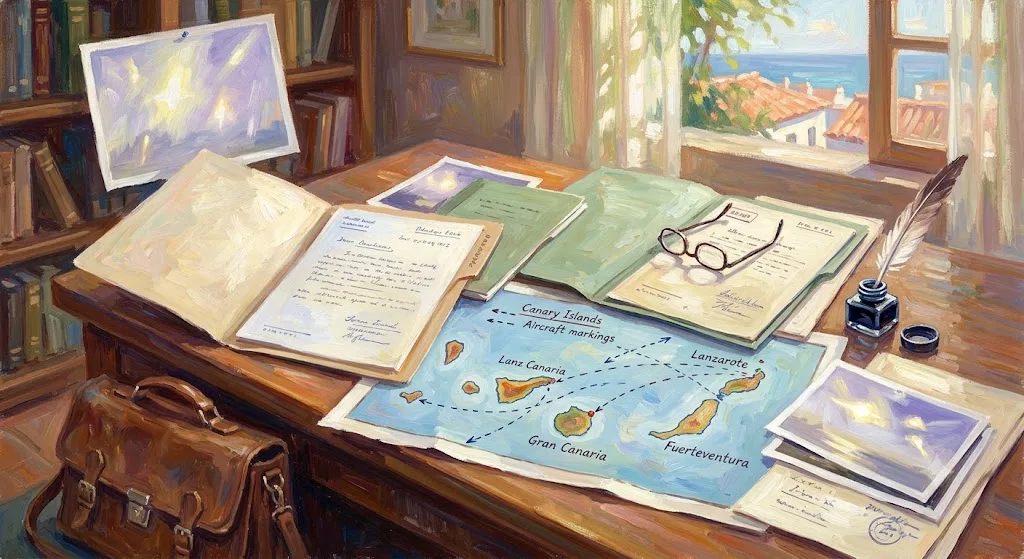
Spain’s declassified Air Force files matter for Las Palmas because they turn a famous regional UFO tradition into a traceable paper trail: dates, witness statements, maps, sketches, radar notes, meteorological checks, declassification decisions and later doubts. The files do not prove alien visitation. They show something more useful for a public history of the province: how unusual lights reported from Gran Canaria, Fuerteventura, Lanzarote, nearby waters and inter-island air routes were filtered through military procedure, local memory and later technical reinterpretation. Spain’s Ministry of Defence says the declassification process began in 1991, that a physical copy was deposited in the Air Force Central Library in Madrid in 1992, and that the digitised collection now covers 80 files and about 1,900 pages of reports involving Spanish airspace and, in some way, Air Force personnel or material.[Biblioteca Virtual Defensa]bibliotecavirtual.defensa.gob.esOpen source on gob.es.
For Las Palmas, the archive trail is especially revealing because several of the Canary Islands’ best-known cases sit inside this official collection. The Ministry’s title index includes the 1968 Tenerife–Las Palmas flight case, the 1974 Canary Islands file, the 22 June 1976 case, the 5 March 1979 case, the 1980 Canary Islands files and the 1985 report from the ship Manuel Soto.[Biblioteca Virtual Defensa]bibliotecavirtual.defensa.gob.es› Listado de títulos… These records preserve official uncertainty, but they also show why “large file” and “unexplained at the time” should not be confused with strong evidence for extraordinary craft.
What the Defence Ministry files preserve
The value of the Spanish Air Force files is not that they provide a neat answer to every Las Palmas-linked report. Their value is that they preserve the administrative life of the sightings: who reported them, which military offices handled them, what kinds of checks were made, and how later officials decided whether a case could be declassified. The Ministry’s presentation explains that each file begins with summary pages covering the place, date, account of events, considerations, conclusions and classification or declassification proposal, followed where relevant by interviews, service reports and weather information. It also notes that personal details of declarants and reporting officers are omitted despite declassification.[Biblioteca Virtual Defensa]bibliotecavirtual.defensa.gob.esOpen source on gob.es.
That structure matters because Las Palmas UFO history is often retold through dramatic fragments: a huge luminous sphere over the islands, a pilot or sailor seeing a strange light, a mass sighting spreading from one island to another. The archive gives those fragments a harder edge. It shows which cases entered official channels, how much paperwork each generated, and how the Spanish Air Force treated them as “strange phenomena” rather than as folklore alone.
The Canary Islands files are not a single Las Palmas dossier. They are a chain of related records, some province-specific and some archipelago-wide. The Ministry’s index lists “Canarias” cases by date, including 24 November 1974, 22 June 1976, 5 March 1979 and the Manuel Soto ship report of 23 December 1985.[Biblioteca Virtual Defensa]bibliotecavirtual.defensa.gob.es› Listado de títulos… That matters for Las Palmas because the province includes Gran Canaria, Lanzarote and Fuerteventura, and several of the sightings were observed from, near or en route to those islands rather than from a single fixed town.
The 24 November 1974 file is a good example of the archive’s evidential weight. The Ministry catalogue describes it as an Air Operational Command and intelligence-section file, published as a 1968–1994 record, physically described as 82 pages, and declassified by order JEMA 415 on 8 February 1994.[Biblioteca Virtual Defensa]bibliotecavirtual.defensa.gob.esOpen source on gob.es. In plain terms, this means the event was not merely a press anecdote: it produced a substantial military file that remained classified until the 1990s.
The 22 June 1976 case, often treated as the centrepiece of Canary Islands UFO lore, has an even larger official footprint. The Ministry’s record lists it as a 107-page file with illustrations, graphs and plans, created under the Air Operational Command’s intelligence section and declassified by JEMA 2866 on 13 July 1994.[Biblioteca Virtual Defensa]bibliotecavirtual.defensa.gob.esOpen source on gob.es. The 5 March 1979 case is larger still: 234 pages, including colour illustrations, graphs and a map, declassified on 3 November 1995.[Biblioteca Virtual Defensa]bibliotecavirtual.defensa.gob.esOpen source on gob.es. File size alone cannot settle what witnesses saw, but it does show which events the military system considered complex enough to document at length.

Why file size does not equal alien evidence
A common mistake in reading the Las Palmas archive trail is to treat every thick file as a sign of suppressed proof. The files support a more cautious conclusion. They show that several Canary Islands sightings were serious enough to investigate, not that investigators had discovered unknown craft. The Ministry’s own description of the collection is administrative: these were reports of strange phenomena in Spanish airspace involving Air Force personnel or material in some way, and the files vary widely in length from very short records to dossiers of many pages.[Biblioteca Virtual Defensa]bibliotecavirtual.defensa.gob.esOpen source on gob.es.
The Las Palmas material is strong evidence for reported phenomena. It is much weaker evidence for extraordinary explanations. There are several reasons for that distinction.
First, mass sightings can be misleading as evidence. A spectacular light seen by many people may be real, but the number of witnesses does not automatically identify its cause. A high-altitude missile plume, rocket stage, re-entry or unusual atmospheric effect can be visible across a huge area while appearing close, silent and enormous. This is especially relevant to the eastern Canary Islands, where observers on land, at sea and in aircraft had wide Atlantic sightlines.
Second, the military files often preserve uncertainty at a particular moment in time. An event could be officially unidentified because investigators lacked launch data, radar correlation, astronomical checks or international military information. That is not the same as saying the event had no possible conventional explanation.
Third, later research changed the evidential balance for several Canary Islands cases. Vicente-Juan Ballester Olmos and Ricardo Campo Pérez argued in a 2001 article in Revista de Aeronáutica y Astronáutica that several Canary Islands UFO reports were caused by U.S. Navy Poseidon missile launches. Dialnet lists the article as “¡Identificados! Los OVNIS de Canarias fueron misiles Poseidón”, published in issue 701 in March 2001, pages 200–207.[Dialnet]dialnet.unirioja.esDialnet¡Identificados! Los OVNIS de Canarias fueron misiles PoseidónDialnet¡Identificados! Los OVNIS de Canarias fueron misiles Poseidón A later paper summary describes the 22 June 1976 and 5 March 1979 displays as spectacular phenomena observed from the Canary Islands and caused by Poseidon missile launches.[Zenodo]zenodo.orgOpen source on zenodo.org.
This missile explanation does not make the archive irrelevant. It makes it more important. The official files preserve what people reported before the likely cause was clear; later technical analysis explains why those reports could be sincere, widespread and still misinterpreted. That is one of the central lessons of the Las Palmas archive trail: official uncertainty is historically important, but it is not the same thing as final mystery.
The Canary Islands cases that anchor the trail
The archive trail becomes clearer when the major files are read as a sequence rather than as isolated legends. For Las Palmas, the strongest pattern is not a single dramatic encounter but repeated luminous phenomena over or near the eastern Canary Islands, many of them involving trained observers, aviation routes, ships or military reporting channels.
The 1974 Canary Islands file is important because it shows the pattern before the famous 1976 case. Its 82-page size, Air Operational Command authorship and 1994 declassification make it one of the key official records in the province-linked history.[Biblioteca Virtual Defensa]bibliotecavirtual.defensa.gob.esOpen source on gob.es. It helps explain why later Canary Islands reports were not treated as one-off curiosities: by the mid-1970s, the area had already produced enough formal material to sit inside the national Air Force UFO archive.
The 22 June 1976 file is the best-known case because it combined scale, spectacle and documentation. The official record’s 107 pages, illustrations, graphs and plans show how much administrative and investigative material gathered around the event.[Biblioteca Virtual Defensa]bibliotecavirtual.defensa.gob.esOpen source on gob.es. In popular retellings, this case often becomes a story of a vast luminous object seen by huge numbers of people. In the archive trail, it is better read as a case study in witness reliability, perception under unusual sky conditions, and the limits of what local investigators could know during the Cold War.
The 5 March 1979 file is perhaps the clearest warning against simple storytelling. At 234 pages, with colour illustrations, graphs and a map, it is the largest of the Canary Islands records highlighted in the Ministry catalogue.[Biblioteca Virtual Defensa]bibliotecavirtual.defensa.gob.esOpen source on gob.es. A reader might assume that such a large file must contain the strongest extraordinary evidence. Yet later research tying major Canary Islands displays to missile launches suggests the opposite lesson: the larger and more spectacular the visible phenomenon, the more likely it was to generate many sincere but inconsistent descriptions.
The 1985 Manuel Soto report shows the other end of the scale. The Ministry record describes a 7-page file concerning a sighting from the ship Manuel Soto on 23 December 1985, produced by the same Air Operational Command and intelligence section and declassified on 1 February 1996.[Biblioteca Virtual Defensa]bibliotecavirtual.defensa.gob.esOpen source on gob.es. This shorter file still matters because maritime observations were part of the Las Palmas and Canary Islands archive ecology. Ferries and ships had open horizons and crews accustomed to watching the sea and sky, making them valuable witnesses but not infallible interpreters.
How archives reshaped the Las Palmas story
Before digitisation, Las Palmas UFO history was easier to tell as local memory: spectacular lights, military interest, rumours of secrecy and later retellings in books, newspapers or television. Digitisation changed the reader’s position. It made the archive searchable, comparable and less dependent on second-hand claims. The Ministry states that the digitised files can be consulted online through the Defence Virtual Library, after the earlier physical copy was deposited in Madrid.[Biblioteca Virtual Defensa]bibliotecavirtual.defensa.gob.esOpen source on gob.es.
That shift reshaped the Las Palmas story in three ways.
The first change is accountability. Claims about official files can now be checked against catalogue entries: title, date, issuing body, page count, declassification note and archive signatura. For example, the 1976 file has the signatura 760622; the 1974 file has 741124; the 1979 file has 790305; and the 1985 Manuel Soto file has 851223. Biblioteca Virtual Defensa+3Biblioteca Virtual Defensa+3Biblioteca Virtual Defensa[bibliotecavirtual.defensa.gob.es]bibliotecavirtual.defensa.gob.esOpen source on gob.es. These details are mundane, but they are exactly what separates a traceable archive trail from a floating legend.
The second change is proportion. The Las Palmas-linked files sit inside a national collection of 80 files covering cases from 1962 in San Javier to 1995 in Morón, not inside a special Canary Islands-only disclosure programme.[Biblioteca Virtual Defensa]bibliotecavirtual.defensa.gob.esOpen source on gob.es. This helps prevent over-reading. Las Palmas was important, but it was one part of a broader Spanish Air Force process for handling reports of strange aerial phenomena.
The third change is interpretation. Once the files became easier to compare with missile-test research, photographic analogues and sceptical analysis, the most dramatic Canary Islands cases looked less like isolated unknowns and more like a cluster of spectacular misperceptions under similar viewing conditions. Ballester Olmos and Campo Pérez’s Poseidon-missile argument, published in an aviation and astronautics context rather than only in paranormal literature, is central here because it directly addresses the Canary Islands cases rather than dismissing them generically.[Dialnet]dialnet.unirioja.esDialnet¡Identificados! Los OVNIS de Canarias fueron misiles PoseidónDialnet¡Identificados! Los OVNIS de Canarias fueron misiles Poseidón
That does not mean every Las Palmas-linked report is neatly solved. Some files are short. Some witness descriptions are incomplete. Some records preserve uncertainty because the evidence available at the time was limited. But the archive trail has weakened the most sensational reading of the province’s UFO history. It has strengthened a more grounded reading: people saw unusual and sometimes spectacular aerial phenomena; official investigators documented them; later researchers found plausible technical explanations for several major displays.
What readers should take from the official record
The Spanish Air Force files reveal a Las Palmas UFO history that is more interesting than a simple “true or false” debate. The province’s importance lies in the combination of credible witnesses, Atlantic geography, official documentation and later reinterpretation. Gran Canaria, Fuerteventura, Lanzarote and nearby sea routes were well placed for dramatic sky observations. The military archive then preserved many of those observations in a form that can be checked rather than merely repeated.
The best-supported conclusion is cautious. The files show that unusual phenomena were reported and investigated; they do not show that alien craft were confirmed. The strongest later explanation for several spectacular Canary Islands cases points towards U.S. Navy Poseidon missile launches, whose high-altitude plumes could produce vast luminous forms visible across the islands.[Dialnet]dialnet.unirioja.esDialnet¡Identificados! Los OVNIS de Canarias fueron misiles PoseidónDialnet¡Identificados! Los OVNIS de Canarias fueron misiles Poseidón That explanation fits the pattern of wide-area sightings better than many close-object interpretations, while also respecting the fact that witnesses may have described what they genuinely saw.
For a Las Palmas province-level history, the archive trail is therefore not a footnote. It is the backbone. It shows why the region became one of Spain’s most discussed UFO settings, why the military took some reports seriously enough to preserve them, and why later evidence has made the most extraordinary claims harder to sustain. The enduring lesson is not that the files “prove UFOs”, but that official records can make a local mystery more precise: who reported it, how it was handled, what was missing, and how later research changed the meaning of the story.

Amazon book picks
Further Reading
Books and field guides related to What Do Spain's UFO Files Reveal?. Use these as the next step if you want deeper reading beyond the article.
UFOs: Generals, Pilots, and Government Officials Go on the Re...
Best fit for readers interested in military UFO archives.
The UFO Experience: A Scientific Inquiry
Provides context for evaluating official files.
The Report on Unidentified Flying Objects
Explains official case documentation and analysis.
eBay marketplace picks
Marketplace Samples
Live-tested eBay searches with available results related to this page.



Endnotes
1.
Source: zenodo.org
Link:https://zenodo.org/records/10588466/files/Reliability_III-3_Campo-Perez.pdf
2.
Source: archive.org
Link:https://archive.org/download/jufoh/jufoh.pdf
3.
Source: bibliotecavirtual.defensa.gob.es
Link:https://bibliotecavirtual.defensa.gob.es/BVMDefensa/exp_ovni/es/micrositios/inicio.do
4.
Source: bibliotecavirtual.defensa.gob.es
Link:https://bibliotecavirtual.defensa.gob.es/BVMDefensa/exp_ovni/es/consulta/indice_campo.do?campo=idtitulo
Source snippet
› Listado de títulos...
5.
Source: bibliotecavirtual.defensa.gob.es
Link:https://bibliotecavirtual.defensa.gob.es/BVMDefensa/exp_ovni/es/consulta/busqueda_referencia.do?campo=idtitulo&idValor=395918
6.
Source: bibliotecavirtual.defensa.gob.es
Link:https://bibliotecavirtual.defensa.gob.es/BVMDefensa/exp_ovni/es/consulta/busqueda_referencia.do?campo=idtitulo&idValor=395904
7.
Source: bibliotecavirtual.defensa.gob.es
Link:https://bibliotecavirtual.defensa.gob.es/BVMDefensa/exp_ovni/es/consulta/busqueda_referencia.do?campo=idtitulo&idValor=396016
8.
Source: dialnet.unirioja.es
Title: Dialnet¡Identificados! Los OVNIS de Canarias fueron misiles Poseidón
Link:https://dialnet.unirioja.es/servlet/articulo?codigo=10026940
9.
Source: bibliotecavirtual.defensa.gob.es
Link:https://bibliotecavirtual.defensa.gob.es/BVMDefensa/exp_ovni/es/consulta/busqueda_referencia.do?campo=idtitulo&idValor=395990
10.
Source: dialnet.unirioja.es
Title: es Ricardo Campo Pérez
Link:https://dialnet.unirioja.es/servlet/extaut?codigo=1044614
11.
Source: bibliotecapleyades.net
Link:https://www.bibliotecapleyades.net/ciencia/ufo_briefingdocument/1976a.htm
Additional References
12.
Source: youtube.com
Title: Tenerife’s Strangest Valley – UFOs, Lost Time & The Girl with the Pears
Link:https://www.youtube.com/watch?v=i1H7GTu2RXI
Source snippet
UFO files declassified: “There are videos taken from military bases”...
13.
Source: youtube.com
Title: UFO files declassified: “There are videos taken from military bases”
Link:https://www.youtube.com/watch?v=Ob91Cf3zO7E
Source snippet
72 UFO reports declassified with no evidence of extraterrestrial life...
14.
Source: youtube.com
Title: Scientific curiosities: A UFO in the Canary Islands
Link:https://www.youtube.com/watch?v=0TrYYlOS294
Source snippet
Tenerife's Strangest Valley – UFOs, Lost Time & The Girl with the Pears...
15.
Source: youtube.com
Title: Javier Sierra: The secret report on UFOs in Franco’s Spain
Link:https://www.youtube.com/watch?v=_lSEWzNb2rc
Source snippet
Scientific curiosities: A UFO in the Canary Islands...
16.
Source: facebook.com
Link:https://www.facebook.com/TheSunFootball/posts/after-some-strange-reports-in-spain/4992390037448069/
17.
Source: muckrack.com
Link:https://muckrack.com/campo-perez/articles
18.
Source: reddit.com
Link:https://www.reddit.com/r/UFOs/comments/18mri4a/declassified_mass_sighting_in_the_canary_islands/
19.
Source: reddit.com
Link:https://www.reddit.com/r/UFOs/comments/qx6zx5/i_mightve_solved_one_of_my_favorite_ufo_cases/
20.
Source: academia.edu
Link:https://www.academia.edu/16027101/Identificados_Los_OVNIS_de_Canarias_fueron_misiles_Poseidon?ms=EOY24_CFIlightbox2
21.
Source: academia.edu
Link:https://www.academia.edu/16027101/Identificados_Los_OVNIS_de_Canarias_fueron_misiles_Poseidon
Topic Tree