Within Castellon UFOs
Missile, Meteor or Space Debris?
The leading sceptical explanations all accept that something may have been seen, but differ on what kind of sky event it was.
On this page
- The missile explanation
- Meteor and re entry possibilities
- How one event can grow into a local flap
Page outline Jump by section
Introduction
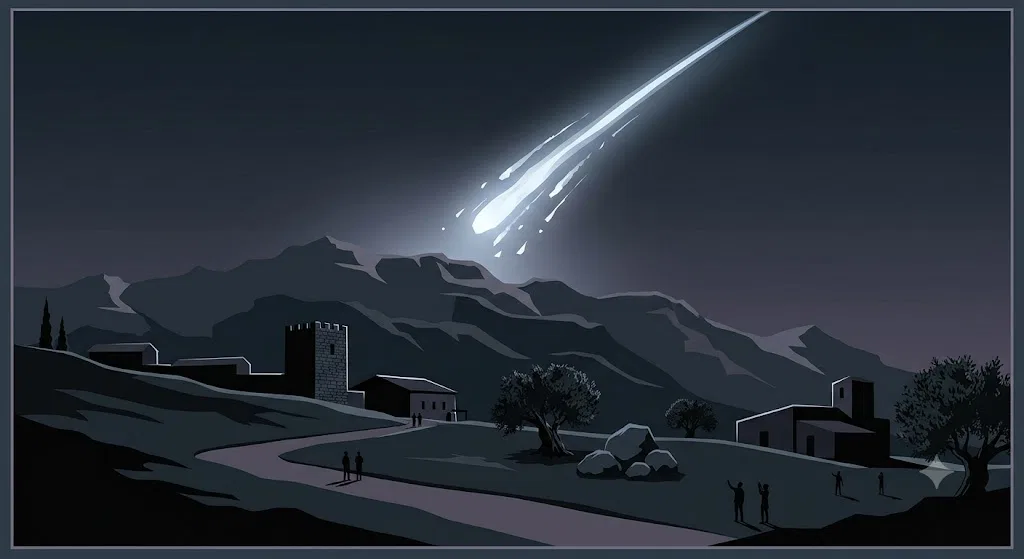
Castellon’s best-known UFO episode is powerful precisely because the leading sceptical explanations do not dismiss the witnesses as foolish. They accept that a striking aerial event may really have been seen over the Vinaros and Benicasim area in July 1983, but ask whether it was an extraordinary craft or a more familiar sky event seen under dramatic conditions. The main candidates are a missile or high-speed military object, a meteor, or space debris re-entering the atmosphere.
That distinction matters because the same clues can pull in different directions. Reports of a luminous trail, rapid movement, odd curves and a spindle-like shape helped the case reach police, military and parliamentary attention. Yet those same details also fit a family of spectacular aerial phenomena that routinely produce UFO reports: missiles, fireballs and artificial objects breaking up high above the Earth. Spain’s own defence archive lists the Vinaros-Led 104 file as a 19-page online record, produced by the Air Operational Command and declassified in 1996.[Biblioteca Virtual Defensa]bibliotecavirtual.defensa.gob.esOpen source on gob.es.
The missile explanation
The missile theory became prominent because early reporting did not describe a slow light or a vague object. El Pais reported in October 1983 that specialist opinions collected by Gabriel Elorriaga, a Popular Group deputy on the defence commission, suggested the July object might have been a military or spy missile. The same report said the Government acknowledged an unidentified object had been present, although it had not been detected by Spanish radar systems.[El País]elpais.comOpen source on elpais.com.
The strongest point for the missile reading was movement. The Benicasim accounts described rapid, irregular motion, a trail and a spindle-like appearance, and the missile hypothesis was linked to the object’s irregular track and spiral-like turns. El Pais attributed the technical comparison to specialists including the director of the civil air-control centre at Paracuellos, while also noting that an aircraft explanation had been considered.[El País]elpais.comOpen source on elpais.com.
This is why the case felt more serious than a normal summer sighting. A United States military aircraft pilot reportedly asked Paracuellos whether any rocket area was active, after seeing an object at an estimated 60,000 feet and perhaps four or five times the speed of sound. Those figures were presented as estimates, not measured facts, and the object was not detected by Spanish electronic systems; the report also said French authorities sent Mirage aircraft, which failed to identify or intercept it.[El País]elpais.comOpen source on elpais.com.
The missile explanation therefore had a clear logic: a fast, high object with a trail, odd manoeuvres and defence-sector interest could plausibly suggest a missile or test vehicle. But it also had weaknesses. There was no confirmed launch, no recovered debris, no radar track strong enough to settle the question, and no later public identification of a specific weapon system. For a missile case, that is a substantial evidential gap. The theory explains why officials worried about airspace control, but it does not by itself identify the object.
Meteor and re-entry possibilities
The later, more conservative explanation is that the object may have been either a meteor in atmospheric flight or the re-entry of an artificial object from orbit. Aguaita’s 2016 account, based on the declassified file, says the Air Force investigation reached two possible but non-definitive conclusions: a meteor disintegrating, or remains of a space object losing orbit and returning through the atmosphere.[Aguaita]aguaita.catOpen source on aguaita.cat.
A meteor is the luminous event produced when a meteoroid enters Earth’s atmosphere. The American Meteor Society explains that meteoroids striking the atmosphere create a brief moving flash, and that most meteors occur roughly 80 to 120 kilometres above the ground. Visible meteors can be extremely fast, entering the atmosphere at speeds from about 11 to 72 kilometres per second.[American Meteor Society]amsmeteors.orgAmerican Meteor Society Meteor FAQsAmerican Meteor Society Meteor FAQs
That helps explain why witnesses can honestly report something as fast, bright and apparently purposeful. A bright meteor, especially a fireball, can be startling, can leave a luminous trail, and can appear to move across a large part of the sky. It can also be seen from widely separated locations, which may make a single high-altitude event feel like many local incidents. What it does less well, however, is explain an observation said to last several minutes in one area, unless the quoted duration includes afterglow, repeated observations, confusion between stages of the event, or later memory-stretching.
Space debris solves some of that timing problem. The Aerospace Corporation’s re-entry guidance notes that human-made debris can look like a shooting star, with a bright central body, long tail and multiple fragments. It also says re-entering debris normally moves roughly parallel to the ground and can be confused with meteors.[aerospace.org]aerospace.orgOpen source on aerospace.org.
A European technical paper on fireball monitoring makes the same distinction sharper: natural meteors can be very bright, but re-entering space debris can produce long-lasting fireballs, strong fragmentation and fragments that continue travelling together, sometimes making the event look like a formation following the main body.[ESA Proceedings Database]conference.sdo.esoc.esa.intProceedings Database SP-672 5th European Conference on Space DebrisProceedings Database SP-672 5th European Conference on Space Debris This is a particularly good fit for reports of a luminous trail and an object whose shape seemed to change or stretch.
The 1983 Castellon case sits right in that grey zone. A natural meteor better fits a very fast, high-altitude, dramatic flash. Space debris better fits a longer-lasting luminous passage with fragmentation or a sustained trail. A missile better fits the defence anxiety and reported irregular track. None of the three explanations is proven from the public evidence, but meteor and re-entry explanations have the advantage of requiring no unknown aircraft, secret launch or deliberate intrusion.
How one event can grow into a local flap
The Vinaros-Benicasim story is a useful example of how a single spectacular sky event can grow into a local UFO flap. The first Vinaros strand involved a French witness who reported seeing an unusual object from a seventh-floor apartment, with his wife and daughter also present. He reportedly used binoculars but could not identify it, describing a luminous trail with smooth rising, falling and spiral-like curves towards the mountains between Chert and Morella.[Aguaita]aguaita.catOpen source on aguaita.cat.
That report gained force because it did not remain isolated. The witness said other holidaymakers nearby had seen the same trail, and the municipal police report was passed to the air-sector authorities in Valencia. By the time officials tried to re-interview the witnesses, they had returned to France, which weakened the investigation at exactly the moment when precise questioning would have mattered most.[Aguaita]aguaita.catOpen source on aguaita.cat.
The Benicasim strand then widened the case dramatically. El Pais reported that hundreds of people were said to have watched the object for several minutes, with police and Civil Guard checks finding agreement in witness descriptions of speed, irregular motion, a trail and a spindle-like form.[El País]elpais.comOpen source on elpais.com. Once a case has multiple witnesses, police interest, air-control discussion and parliamentary attention, it naturally becomes more than a strange light in the sky.
But a flap does not require many separate causes. One high-altitude event can be visible from several towns. It can be interpreted differently depending on viewing angle, distance, local landmarks, cloud, dusk conditions, rumour and the order in which people hear other accounts. A bright re-entry can look slow and fragmenting to one observer, fast and missile-like to another, and stationary or looping to someone judging motion against mountains or buildings.
Modern Spanish examples show how easily this confusion still happens. In March 2024, a bright object over eastern Spain was first discussed in some reports as a possible ballistic missile, before CSIC-linked analysis described it instead as the re-entry of an artificial object in Earth orbit; the astronomy network involved apologised for the confusion.[Maldita]maldita.esOpen source on maldita.es. The comparison does not prove what happened in Castellon in 1983, but it shows that even with cameras, networks and modern communication, missile, meteor and space-debris explanations can compete for the same event.

What the explanations change about the Castellon case
The missile, meteor and space-debris readings change the case from a simple “mystery object” story into a problem of classification. The object was unidentified in the public record, but “unidentified” is not the same as “unexplainable”. In Castellon, the key question is whether the reported features are more like controlled technology, a natural fireball, or orbital debris burning up.
The missile theory remains the most dramatic ordinary explanation. It fits the defence framing, the pilot’s reported question about rocket activity, and the anxiety about an uncontrolled intrusion into Spanish airspace. Its weakness is the absence of a confirmed launch, radar confirmation or official identification. It is plausible as a concern; it is not established as the answer.
The meteor theory is the cleanest natural explanation. It fits brightness, great speed, height, wide visibility and a trail. Its weakness is duration and manoeuvre: an eight-minute observation and spiral-like movements are harder to reconcile with a normal meteor unless those details were exaggerated, misperceived, or bundled together from several perspectives.
The space-debris theory is often the most balanced fit. It can account for a long luminous path, fragmentation, a slow-looking but very high track, and multiple witnesses across a wide area. It also matches the Air Force file’s later reported openness to re-entering space remains. Its weakness is the lack of a publicly tied object: without a named satellite, rocket stage or orbital element, it remains a plausible category rather than a solved identification.
The cautious reading
The most evidence-led conclusion is that the Castellon event was probably a real aerial observation that became enlarged by distance, uncertainty and institutional concern. A missile was a reasonable fear in the context of airspace defence, but not a proven identification. A meteor or space-debris re-entry better explains why a luminous object could be seen across a wide area and still leave no conventional aircraft trace.
That makes the case important, but not because it proves an exotic craft. It matters because it shows how Castellon’s main UFO story sits between witness testimony and ordinary spectacular sky mechanisms. The unresolved status is part of the history: enough was seen for police, aviation and parliamentary channels to take notice, but not enough was preserved to settle whether the object was a missile, a meteor, or space debris burning across the Spanish sky.

Amazon book picks
Further Reading
Books and field guides related to Missile, Meteor or Space Debris?. Use these as the next step if you want deeper reading beyond the article.
The UFO Experience
Explains how to distinguish unusual phenomena from conventional causes.

Passport to Magonia: from folklore to flying saucers
Adds historical context to unexplained sky reports.

eBay marketplace picks
Marketplace Samples
Live-tested eBay searches with available results related to this page.


Endnotes
1.
Source: aguaita.cat
Link:https://www.aguaita.cat/societat/el-cas-dun-ovni-albirat-a-vinaros-que-va-arribar-al-congres-dels-diputats.html
2.
Source: aerospace.org
Link:https://aerospace.org/node/44081/printable/print
3.
Source: conference.sdo.esoc.esa.int
Title: Proceedings Database SP-672 5th European Conference on Space Debris
Link:https://conference.sdo.esoc.esa.int/proceedings/neosst1/paper/432/NEOSST1-paper432.pdf
4.
Source: maldita.es
Link:https://maldita.es/malditaciencia/20240401/csic-misil-francia-satelite-elon-musk/
5.
Source: aerospace.org
Title: brief history space debris
Link:https://aerospace.org/article/brief-history-space-debris
6.
Source: archive.org
Title: Complete Atlas of the World 3rd Edition (2016) djvu.txt
Link:https://archive.org/stream/CompleteAtlasOfTheWorld3rdEdition2016/Complete%20Atlas%20of%20the%20World%203rd%20Edition%20%282016%29_djvu.txt
7.
Source: bibliotecavirtual.defensa.gob.es
Link:https://bibliotecavirtual.defensa.gob.es/BVMDefensa/exp_ovni/es/consulta/busqueda_referencia.do?campo=idtitulo&idValor=395984
8.
Source: elpais.com
Link:https://elpais.com/diario/1983/10/14/espana/434934022_850215.html
9.
Source: amsmeteors.org
Title: American Meteor Society Meteor FAQs
Link:https://amsmeteors.org/meteor-showers/meteor-faq/
10.
Source: bibliotecavirtual.defensa.gob.es
Title: defensa.gob.es Listado de títulos
Link:https://bibliotecavirtual.defensa.gob.es/BVMDefensa/exp_ovni/es/consulta/indice_campo.do?campo=idtitulo
11.
Source: bibliotecavirtual.defensa.gob.es
Title: defensa.gob.es Revista de historia militar
Link:https://bibliotecavirtual.defensa.gob.es/BVMDefensa/exp_ovni/es/publicaciones/verNumero.do?anyo=1961&idPublicacion=85
12.
Source: verne.elpais.com
Link:https://verne.elpais.com/verne/2016/10/25/articulo/1477394008_803441.html
13.
Source: biblioteca.sicyt.gob.ar
Link:https://biblioteca.sicyt.gob.ar/recursos/BVMDEF
14.
Source: cobdcv.es
Title: biblioteca virtual defensa puerta acceso patrimonio cultural defensa
Link:https://cobdcv.es/simile/biblioteca-virtual-defensa-puerta-acceso-patrimonio-cultural-defensa/
Additional References
15.
Source: youtube.com
Title: Avi Loeb explains mysterious light seen after Philippines meteor strike
Link:https://www.youtube.com/watch?v=p9jfFCOxS-4
Source snippet
This WION Podcast breakdown explains how bright fireballs and space debris re-entering the Earth's atmosphere generate spectacular visual...
16.
Source: youtube.com
Title: Mysterious White Light After Meteor Strike Sparks UFO Debate | WION Podcast
Link:https://www.youtube.com/watch?v=LwHzggncvlo
Source snippet
Avi Loeb explains mysterious light seen after Philippines meteor strike...
17.
Source: youtube.com
Title: South Koreans spooked as secret rocket launch mistaken for UFO
Link:https://www.youtube.com/watch?v=FFXvtcVIQTE
Source snippet
Mysterious White Light After Meteor Strike Sparks UFO Debate | WION Podcast...
18.
Source: nasa.gov
Link:https://www.nasa.gov/wp-content/uploads/2017/04/580931main_nasa_cp_2011_216469.pdf?emrc=ca6c60
19.
Source: youtube.com
Title: Mystery Fireballs Spotted From Space Explained | WION Podcast
Link:https://www.youtube.com/watch?v=KKhPgJLeDjo
Source snippet
South Korea: UFO Was Military Rocket Test | VOA News...
20.
Source: youtube.com
Title: South Korea: UFO Was Military Rocket Test | VOA News
Link:https://www.youtube.com/watch?v=s3Zmm1uKchg
Source snippet
South Koreans spooked as secret rocket launch mistaken for UFO...
21.
Source: instagram.com
Link:https://www.instagram.com/reel/DZ49dTDyc8a/
22.
Source: reddit.com
Link:https://www.reddit.com/r/UFOs/comments/1brrhze/artificial_unknown_object_observed_flying_over/
23.
Source: instagram.com
Link:https://www.instagram.com/p/DLnQsIqgrhc/?hl=en
24.
Source: instagram.com
Link:https://www.instagram.com/reel/C7OKabuP129/
Topic Tree