Within Ciudad Real UFOs
The Rocket Cloud Mistaken for a UFO
The Alcazar de San Juan sighting is a strong example of a spectacular UFO report later explained by a rocket experiment.
On this page
- What witnesses saw from Alcazar
- The Rubis rocket and chemical cloud
- Why later evidence changed the story
Page outline Jump by section
Introduction
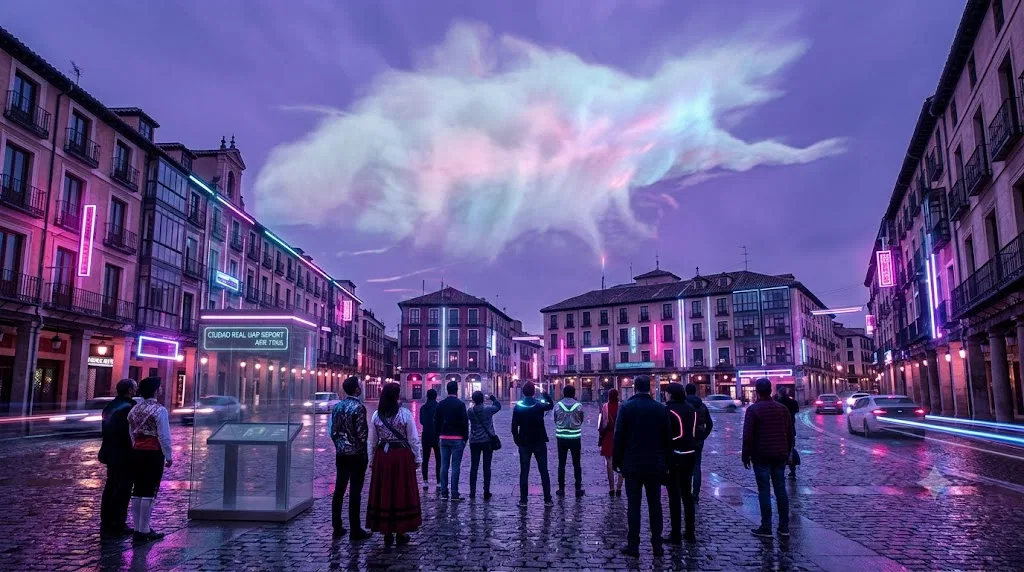
The Alcázar de San Juan sighting of 22 April 1966 is one of the clearest examples in Ciudad Real’s UFO history of a spectacular report that later became more interesting as an explanation than as a mystery. Witnesses in and around the province saw a bright, coloured, expanding shape in the evening sky and some described it in dramatic terms: a luminous cloud, a circular body, coloured lights and traces that seemed to fall or spread. The best-supported explanation is not an unknown craft but a high-altitude scientific rocket experiment: a French Rubis sounding rocket launched from Hammaguir in the Algerian Sahara, carrying barium and copper oxide payloads that created artificial luminous clouds in the upper atmosphere.[Academia]academia.eduLa experiencia espacial del 22 de abril de 1966La experiencia espacial del 22 de abril de 1966
That makes the case valuable rather than disposable. It shows how a real, physical, unusual sky event could produce honest UFO reports across Spain, Portugal and much of Europe, while later technical reconstruction could connect those reports to a known space-age mechanism. For Ciudad Real, the Alcázar episode is a useful anchor case: it belongs in the province’s UFO record, but mainly as a well-explained mass sighting that warns against treating impressive testimony as automatically unexplained.
What witnesses saw from Alcázar
The most detailed Spanish press treatment known from later research appeared in the Madrid newspaper Pueblo shortly after the event, and it focused heavily, though not exclusively, on Alcázar de San Juan. The witnesses included soldiers, a sergeant and his family in a military enclosure in the area, which gave the report a more disciplined setting than a casual single-witness roadside story. Their descriptions were still strongly visual and emotional: a faint cloud, a light separating from it, vivid colours, and a slow, parachute-like motion.[Academia]academia.eduLa experiencia espacial del 22 de abril de 1966La experiencia espacial del 22 de abril de 1966
One sub-officer, identified in the later reconstruction as Martínez, described a thin cloud about three times the apparent size of the Moon, from which a light seemed to detach. He recalled colours including green, violet and orange, and called the spectacle beautiful and impressive. A soldier, Asdrúbal Abengozar, described a white circle about twice the diameter of the Moon, crossed by two curved lines, followed by a smaller coloured light that appeared to fall, grow, merge with the first circle and then diffuse into curved traces before disappearing.[Academia]academia.eduLa experiencia espacial del 22 de abril de 1966La experiencia espacial del 22 de abril de 1966
These accounts matter because they do not sound like a simple point of light. The witnesses reported structure, colour, growth, transformation and apparent movement. Those are exactly the features that can make a sighting memorable and later UFO-like. Yet they also match what a high-altitude chemical release can look like: a luminous cloud expanding and changing shape while sunlight, ionisation and upper-atmospheric winds alter its appearance.
The Alcázar sighting also had a local echo beyond the town itself. Later tabulated data in the same reconstruction includes observations from Alcázar de San Juan, Ciudad Real and Abenójar, all within the Ciudad Real provincial frame, as well as reports from nearby Casasimarro in Cuenca and more distant Spanish and European locations. That spread is a crucial clue: the “object” was not behaving like something hovering over Alcázar at low altitude, but like a very high phenomenon visible over an enormous area.[Academia]academia.eduLa experiencia espacial del 22 de abril de 1966La experiencia espacial del 22 de abril de 1966

The Rubis rocket and the chemical cloud
The technical explanation centres on a Rubis sounding rocket launched on 22 April 1966 from the Brigitte launch base at Hammaguir, then a French space and missile testing complex in the Algerian Sahara. According to the detailed reconstruction by Vicente-Juan Ballester Olmos and Julio Plaza del Olmo, the launch occurred at 20:00 UTC, corresponding to 21:00 local time in Spain, and carried two payloads of barium and copper oxide intended for release in the upper atmosphere.[Academia]academia.eduLa experiencia espacial del 22 de abril de 1966La experiencia espacial del 22 de abril de 1966
The experiment produced two large artificial luminous clouds at around 2,000 and 2,019 kilometres altitude, with the rocket reaching an apogee of about 2,038 kilometres. The clouds persisted for roughly 45 minutes, which fits the broad reported window of observations from the Iberian Peninsula and elsewhere. Later orbital and visibility analysis by satellite-tracking specialist Ted Molczan placed the rocket’s apogee at about 20:14 UTC and showed that the clouds could be visible to observers across a radius of thousands of kilometres.[Academia]academia.eduLa experiencia espacial del 22 de abril de 1966La experiencia espacial del 22 de abril de 1966
The Rubis vehicle itself was part of France’s early rocket development programme, linked to the technology path that led towards the Diamant orbital launcher. The 22 April 1966 flight is listed in technical summaries as Rubis 03, with the payload “MPE Ba-17”, indicating its connection with Max Planck Institute barium work.[Wikipedia]WikipediaRubis (rocketRubis (rocket
The mechanism is not exotic in the paranormal sense. Space agencies use sounding rockets to carry instruments or small payloads on brief high-altitude trajectories. NASA’s explanation of vapour tracer missions describes the basic principle: small amounts of material are released high above Earth so that scientists can watch the resulting trail or cloud and track upper-atmospheric winds or ion drifts. Common tracer materials include barium, lithium and trimethyl aluminium.[NASA]nasa.govAbout Vapor TracersAbout Vapor Tracers
Barium is especially relevant because it can become strongly ionised and visibly trace electromagnetic and atmospheric behaviour in near-space conditions. Scientific literature from the Max Planck research tradition includes work on artificial strontium and barium clouds in the upper atmosphere, including Sahara and Sardinia experiments from the mid-1960s, and later NASA–Max Planck barium cloud work investigated how ionised barium clouds interacted with their surrounding medium and local electric fields.[Astrophysics Data System]ui.adsabs.harvard.eduOpen source on harvard.edu.
Why it looked like a UFO from Ciudad Real
The strongest reason the Alcázar report became UFO-like is that the witnesses were seeing a space experiment without the context needed to recognise it. A luminous cloud at about 2,000 kilometres altitude is far above ordinary aircraft, weather balloons or low cloud. It can appear still or slow-moving, then suddenly seem to expand, brighten, split, elongate or dissolve. To an observer on the ground, those changes can look like an object approaching, falling, deploying something or transforming.
That perceptual trap appears repeatedly in the 1966 material. The later analysis notes that observers often described the phenomenon as descending towards the ground even though it was an expanding cloud at extreme altitude and great distance. In Alcázar, some young observers reportedly reacted as if the Moon itself were about to crash into Earth. From Ciudad Real, one witness estimated an altitude of only about 500 metres, whereas the reconstructed altitude was thousands of kilometres.[Academia]academia.eduLa experiencia espacial del 22 de abril de 1966La experiencia espacial del 22 de abril de 1966
This is not a reason to mock the witnesses. It is the main lesson of the case. Human observers are poor at judging the distance, altitude and size of unfamiliar lights in the sky, especially when the object has no familiar reference point. A bright expanding cloud can seem nearby because it appears large; it can seem to descend because its shape changes; it can seem mechanical because its curves and streaks look structured.
The reported size estimates from Alcázar and Ciudad Real also fit the broader pattern. The later table gives Alcázar observations of around two to three lunar diameters and Ciudad Real estimates in the same range. Across the wider sample, the initial rounded cloud was commonly reported as about two to four times the Moon’s apparent diameter. That consistency strengthens the explanation: many independent observers were describing the same unusual but real phenomenon, not separate local craft.[Academia]academia.eduLa experiencia espacial del 22 de abril de 1966La experiencia espacial del 22 de abril de 1966
Why later evidence changed the story
The case weakened as an unexplained UFO claim because later evidence did three things at once: it identified a matching launch, reconstructed where the luminous clouds should have appeared, and showed that reports from widely separated places lined up with that predicted geometry. Alcázar was not an isolated mystery; it was one observation point in a much larger European viewing area.[Academia]academia.eduLa experiencia espacial del 22 de abril de 1966La experiencia espacial del 22 de abril de 1966
The reconstructed figures are especially damaging to the UFO interpretation. From Alcázar de San Juan, the phenomenon was calculated at an azimuth of about 165 degrees, an elevation of about 52 degrees and a range of about 2,427 kilometres. From Ciudad Real, the corresponding values were about 161 degrees, 53 degrees and 2,411 kilometres. From Abenójar, also in Ciudad Real province, they were about 160 degrees, 54 degrees and 2,376 kilometres. These values place the Ciudad Real reports in a coherent regional geometry rather than in a local low-altitude encounter.[Academia]academia.eduLa experiencia espacial del 22 de abril de 1966La experiencia espacial del 22 de abril de 1966
The international spread also matters. The same event was reported from Spain, Portugal, France, Italy, Switzerland, Germany, Austria, Morocco and what was then Upper Volta. Observations from places such as Paris, Gordes, Hartha and Frauenfeld described luminous discs, expanding clouds, comet-like tails and colour changes, and some observers used astronomical references such as the constellation Hydra. Those independent reports make the event more objectively real, but less mysterious: a single high-altitude experiment explains why so many places saw related versions of the same display.[Academia]academia.eduLa experiencia espacial del 22 de abril de 1966La experiencia espacial del 22 de abril de 1966
A later French UFO catalogue page on a related Alsace observation preserves an especially useful detail: an astronomical association letter from Vienna, dated 9 May 1966, stated that the cause of the luminous appearance had already been found and described it as two gas-filled clouds formed at about 2,000 kilometres altitude above the Sahara for a Max Planck Institute experiment. That does not replace the later technical reconstruction, but it shows that the space-experiment explanation was not merely a modern sceptical invention imposed decades afterwards.[Ufologie]ufologie.patrickgross.orgOpen source on patrickgross.org.
The official Spanish Air Force angle is also modest. Spain’s digitised UFO files in the Defence Virtual Library contain declassified dossiers with summaries, witness material, weather notes and other case documents depending on the file, and Spanish media reported the public release as 80 files and about 1,900 pages covering strange aerial sightings from 1962 to 1995.[Biblioteca Virtual Defensa]bibliotecavirtual.defensa.gob.esBiblioteca Virtual Defensa Expedientes OVNIBiblioteca Virtual Defensa Expedientes OVNI But the later Alcázar reconstruction states that when the 22 April 1966 event was checked with Air Force contacts during the early 1990s declassification push, no official file was found for it, and it did not appear in the declassified military reports.[Academia]academia.eduLa experiencia espacial del 22 de abril de 1966La experiencia espacial del 22 de abril de 1966
That absence should be read carefully. It does not mean nobody saw anything. It means the Alcázar rocket cloud is best documented through press accounts, witness reports, astronomical and UFO-research follow-up, and later technical reconstruction, not through a major Spanish military investigation.
What the Alcázar case tells us about Ciudad Real UFO history
For Ciudad Real, the 1966 Alcázar event is important because it is both spectacular and solved. It gives the province a strong example of how a dramatic UFO report can begin with genuine witnesses and still end with a prosaic, well-supported explanation. The witnesses saw something real; the weak part was not the observation itself, but the immediate interpretation of distance, scale and nature.
The case also helps separate different kinds of “unidentified” reports in the province. Some local UFO stories are thin because they lack documentation. Others are ambiguous because the observation was brief or solitary. The Alcázar rocket cloud is different: it became stronger as a historical case precisely because later evidence tied it to a known event. Its value lies in the before-and-after contrast.
Before the explanation, it could be described as a large coloured object or cloud seen by multiple people from Alcázar and elsewhere in Ciudad Real. After the explanation, it becomes a textbook example of a space-age misidentification: a barium cloud from a scientific rocket, seen over a vast region, translated by observers into the language of falling lights, discs, coloured bodies and strange aerial objects.
That makes it one of the most useful Ciudad Real UFO cases for readers who want more than a catalogue of odd reports. It shows why witness testimony deserves attention, but also why it needs geometry, timing, astronomy, launch records and comparison with reports from other places. In this case, those checks do not leave a stubborn unknown. They turn Alcázar de San Juan’s “UFO” into a clear example of how the early space age entered provincial Spanish skies as a mystery before later evidence gave it a name.
Amazon book picks
Further Reading
Books and field guides related to The Rocket Cloud Mistaken for a UFO. Use these as the next step if you want deeper reading beyond the article.
Bad Astronomy
The page explains a spectacular UFO report as a known atmospheric/space event.

Rocket men
Only adjacent, but supports the rocket/space-age context behind the sighting.
The Demon-Haunted World
Fits the theme of revising extraordinary claims through later evidence.
eBay marketplace picks
Marketplace Samples
Live-tested eBay searches with available results related to this page.

Endnotes
1.
Source: academia.edu
Title: La experiencia espacial del 22 de abril de 1966
Link:https://www.academia.edu/36433365/La_experiencia_espacial_del_22_de_abril_de_1966
2.
Source: Wikipedia
Title: Rubis (rocket)
Link:https://en.wikipedia.org/wiki/Rubis_%28rocket%29
3.
Source: nasa.gov
Title: About Vapor Tracers
Link:https://www.nasa.gov/soundingrockets/about-vapor-tracers/
4.
Source: ntrs.nasa.gov
Link:https://ntrs.nasa.gov/citations/19730057130
5.
Source: academia.edu
Title: Spanish Air Force UFO Files The Secrets End pdf
Link:https://www.academia.edu/35786573/Spanish_Air_Force_UFO_Files_The_Secrets_End_pdf
6.
Source: ui.adsabs.harvard.edu
Link:https://ui.adsabs.harvard.edu/abs/1967P%26SS…15..357F/abstract
7.
Source: ufologie.patrickgross.org
Link:https://www.ufologie.patrickgross.org/alsacat/1966-04-22-petitrombach2.htm
8.
Source: bibliotecavirtual.defensa.gob.es
Title: Biblioteca Virtual Defensa Expedientes OVNI
Link:https://bibliotecavirtual.defensa.gob.es/BVMDefensa/exp_ovni/es/micrositios/inicio.do
9.
Source: bibliotecavirtual.defensa.gob.es
Title: defensa.gob.es Listado de títulos
Link:https://bibliotecavirtual.defensa.gob.es/BVMDefensa/exp_ovni/es/consulta/indice_campo.do?campo=idtitulo
10.
Source: adsabs.harvard.edu
Link:https://adsabs.harvard.edu/full/2003ESASP.530…39P
11.
Source: scribd.com
Title: Artificial Strontium and Barium Clouds
Link:https://www.scribd.com/doc/83104596/Artificial-Strontium-and-Barium-Clouds
12.
Source: weathermodificationhistory.com
Title: artificial strontium and barium clouds in the upper atmosphere
Link:https://weathermodificationhistory.com/artificial-strontium-and-barium-clouds-in-the-upper-atmosphere/
Additional References
13.
Source: arxiv.org
Link:https://arxiv.org/html/2502.06794v2
14.
Source: youtube.com
Title: NASA Black Brant XII launch could light up sky with colorful display
Link:https://www.youtube.com/watch?v=wFMOd-f8oAg
Source snippet
Multicolored artificial clouds to be visible after NASA launch...
15.
Source: youtube.com
Title: Multicolored artificial clouds to be visible after NASA launch
Link:https://www.youtube.com/watch?v=GHoyUzDNiq4
Source snippet
NASA Launches Rocket and Generates Colorful Clouds in the Sky...
16.
Source: loc.gov
Link:https://www.loc.gov/aba/publications/Archived-LCSH34/R.pdf
17.
Source: osti.gov
Link:https://www.osti.gov/biblio/4428187
18.
Source: youtube.com
Title: Water vapor effect in the upper atmosphere
Link:https://www.youtube.com/watch?v=Gg-Il2bG4u8
Source snippet
Spectacular Spirals In The Sky Over Europe Traced To Classified SpaceX Mission...
19.
Source: youtube.com
Title: NASA Launches Rocket and Generates Colorful Clouds in the Sky
Link:https://www.youtube.com/watch?v=nZn9w2uIeeU
Source snippet
Water vapor effect in the upper atmosphere...
20.
Source: semanticscholar.org
Link:https://www.semanticscholar.org/paper/ARTIFICIAL-STRONTIUM-AND-BARIUM-CLOUDS-IN-THE-UPPER-F%C3%B6ppl-Haerendel/47f9e8f48ec91bab9b327c58a6ed197cd761aaaa
21.
Source: scilit.com
Link:https://www.scilit.com/publications/f79de705f3ef5967fcdb9be3f93261f7
22.
Source: fumetto-online.it
Link:https://www.fumetto-online.it/it/ricerca_editore.php?COLLANA=SCHELETRO+serie&EDITORE=EDIFUMETTO&TITOLO=SERIE&vall=1
Topic Tree