Within Ciudad Real UFOs
Why Ciudad Real's UFO Record Looks Thin
The province's thin official record makes its newspapers, catalogues and local testimony especially important to evaluate carefully.
On this page
- What official files do not show
- Local reports and catalogue entries
- How to weigh weak and useful evidence
Page outline Jump by section
Introduction
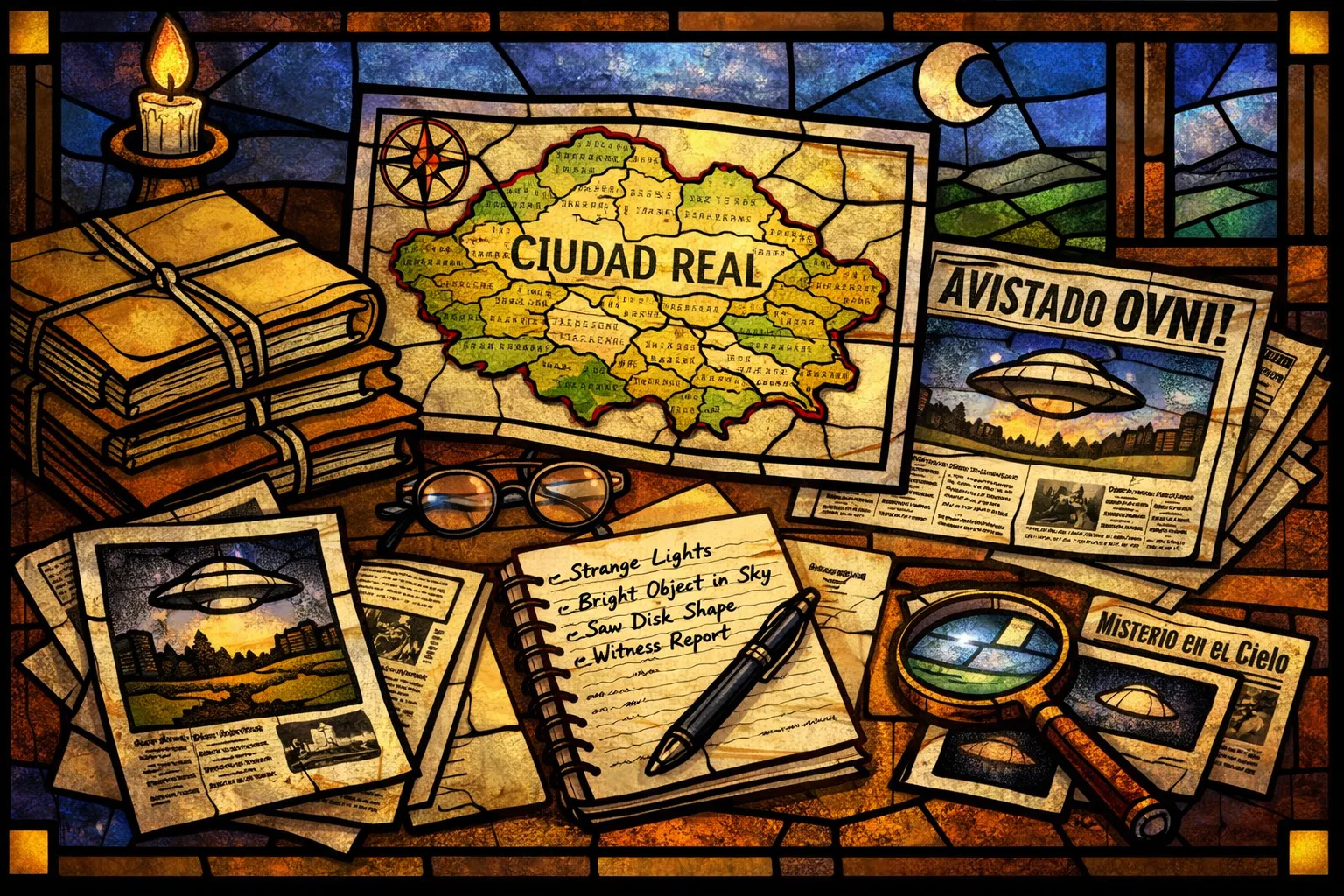
Ciudad Real’s UFO evidence trail is striking because of what is missing. Spain’s official declassified UFO collection is real, searchable and substantial, but it does not make Ciudad Real look like a major military or air-defence UFO province. The best record for the province instead sits in scattered local press references, retrospective catalogues, memories of rural sightings, and later UFO-culture events such as the 1983 Ciudad Real UFO congress. That does not make the subject worthless. It makes it a useful test case for how UFO history should be weighed when the official dossier trail is thin, the surviving stories are uneven, and later retellings can make modest reports sound stronger than they were. Spain’s Defence Virtual Library says its UFO collection contains 80 files and about 1,900 pages, covering strange aerial phenomena from 1962 to 1995 in which Air Force personnel or equipment were involved in some way.[Biblioteca Virtual Defensa]bibliotecavirtual.defensa.gob.esOpen source on gob.es.
The central question, then, is not whether Ciudad Real has a hidden mountain of UFO files. On the public evidence now available, it does not. The better question is how readers should handle a province where the archive points are small but still revealing: an early nineteenth-century “fire globe” report from Campo de Criptana, a 1950s flying-saucer press moment, local claims around Calatrava, Puertollano and Almodóvar del Campo, a probable balloon episode that stirred the newsroom of Lanza, and a 1983 congress that brought contactee-style claims into the provincial spotlight. The thinness is part of the story.
What the official files do not show
The strongest negative evidence is the Defence Virtual Library’s own title list. Its public UFO collection is not a vague rumour about “secret files”; it is a named digital set created after a declassification process that began in 1991, with a physical copy deposited in the Central Library of the Air Force in Madrid in 1992 and later made available online. The library explains that the files include summaries, witness interviews, incident reports and, where relevant, meteorological material, but also notes that personal data for witnesses and officers is omitted.[Biblioteca Virtual Defensa]bibliotecavirtual.defensa.gob.esOpen source on gob.es.
That matters for Ciudad Real because the visible title list names many places and aviation contexts but does not present a clear Ciudad Real dossier as a headline item. The first page alone includes cases from Agoncillo, the Balearic waters, Alcorcón, Alicante, Almería, Barcelona, Burgos, the Canary Islands, Constantina, El Garrobo, Majadahonda, Reus and Talavera in Badajoz, among others.[Biblioteca Virtual Defensa]bibliotecavirtual.defensa.gob.es› Listado de títulos… The next page continues with La Línea, Madrid, Toledo, Cuenca, Pamplona, Mazarrón, Morón, San Javier, Sevilla, Valencia, Zaragoza and several flight or radar-related cases, but again does not mark Ciudad Real as a primary case location.[Biblioteca Virtual Defensa]bibliotecavirtual.defensa.gob.es› Listado de títulos… The final page contains not local case files but general items: an interview with Vicente-Juan Ballester Olmos, an article on declassified UFO files, and military UFO regulations.[Biblioteca Virtual Defensa]bibliotecavirtual.defensa.gob.es› Listado de títulos…
This absence should be read carefully. It does not prove that nobody in Ciudad Real ever reported strange lights, nor does it prove that local police, newspapers or private investigators never kept notes. The Defence collection has a narrower filter: it concerns strange aerial phenomena in Spanish airspace where Air Force personnel or equipment played some role.[Biblioteca Virtual Defensa]bibliotecavirtual.defensa.gob.esOpen source on gob.es. A rural witness report, a local newspaper item, a conference testimony, or a remembered family sighting could survive outside that military channel. But the absence does weaken any claim that Ciudad Real was a major unresolved official UFO hotspot comparable to better-documented Spanish cases involving radar, pilots, bases or formal Air Force investigation.
The useful conclusion is modest but important: Ciudad Real’s official paper trail is thin not because the province is necessarily “erased”, but because its better-known UFO material seems to have lived mostly in public culture rather than in declassified military investigation. For a reader, that changes the burden of proof. A story preserved in a newspaper or catalogue may be historically interesting, but it needs to be assessed differently from a case file with multiple witness statements, radar data, meteorological checks and military conclusions.

Where the evidence trail actually runs
Ciudad Real’s UFO record is better approached as a set of surviving traces than as a single archive. The earliest frequently cited trace is not a modern UFO case at all: it is the 14 February 1826 Campo de Criptana report, later published in the Diario Mercantil de Cádiz. A sceptical archival blog that checked the newspaper source notes that the report was presented at the time as an “extraordinary phenomenon”, not as a mysterious craft, and argues that a spectacular fireball or bolide is a more appropriate modern reading than a retrofitted UFO claim.[misteriosdelaire.blogspot.com]misteriosdelaire.blogspot.comMisterios del Aire: Uno de los primeros casos ovni ocurridos en EspañaMisterios del Aire: Uno de los primeros casos ovni ocurridos en España That distinction is crucial: it may belong in the province’s “pre-UFO” folklore, but it is weak evidence for any anomalous vehicle.
A second trace comes from Spain’s early flying-saucer culture. Local reports in the early 1950s were often shaped by national and international press language, and Ciudad Real appears in that broader pattern rather than as a heavily investigated technical case. This was the period when “flying saucer” stories were still spreading through newspapers, before later Spanish UFO organisations developed more formal cataloguing habits. The evidential problem is obvious: a witness account published after similar stories had circulated may preserve a genuine observation, but it may also reflect suggestion, expectation, or the borrowing of fashionable descriptions.
A third trace appears in the later provincial press memory recorded by Lanza. In a 2025 retrospective article, the paper referred to local claims including shepherds near Calzada de Calatrava seeing a silent luminous sphere, workers near Puertollano in the early 1980s reporting an elongated object with intermittent lights, and residents of a hamlet of Almodóvar del Campo in 1982 describing a bright oval object over fields for more than five minutes.[Lanzadigital]lanzadigital.comConfiesa, en Ciudad Real, que estuvo en un OVNIConfiesa, en Ciudad Real, que estuvo en un OVNI These are valuable as local folklore and press-memory entries, but the public article gives them in compressed form, without the full original witness statements, exact dates, weather checks, independent corroboration or later investigation needed to rank them as strong cases.
The fourth trace is more social than aerial: the First UFO Congress of Ciudad Real in October 1983. Lanza reports that the event was organised by the UFO Monitoring Group and supported by institutions including the Provincial Council, the City Council, the provincial rural savings bank and the provincial labour office. Speakers included recognised names in Spanish UFO culture such as Julio Arcas, Enrique de Vicente and J. J. Benítez, and the event also featured claims connected with the UMMO mythology.[Lanzadigital]lanzadigital.comConfiesa, en Ciudad Real, que estuvo en un OVNIConfiesa, en Ciudad Real, que estuvo en un OVNI For Ciudad Real’s evidence trail, the congress matters less as proof of unusual objects and more as proof that the province briefly became a public platform for Spanish UFO belief, debate and spectacle.
Why missing dossiers are not automatically suspicious
The phrase “missing dossiers” is tempting, but in Ciudad Real it needs discipline. A dossier can be missing because it was never created, because the event did not meet the threshold for military investigation, because it remained in local police or newspaper files, because later cataloguers did not obtain the primary source, or because the story was always anecdotal. None of those possibilities requires a cover-up.
The official collection itself explains why some sightings entered the archive and others did not. It covers events in which the Air Force was involved in some way, sometimes because an incident was seen from an aircraft, reported through military channels, or connected to equipment or airspace monitoring. It also notes that some files include multiple locations because the same phenomenon was seen from an aircraft or matched descriptions across different areas.[Biblioteca Virtual Defensa]bibliotecavirtual.defensa.gob.esOpen source on gob.es. That means a province can have local UFO stories without having a large named presence in the military file list.
Ciudad Real is also geographically and institutionally different from provinces with famous aviation-linked UFO cases. A sighting near a major airbase, a commercial flight path, a radar station or a military alert system is more likely to generate official paperwork than a brief rural light seen by villagers, workers or motorists. The Defence list shows how often the official titles are tied to airports, bases, flights, radar traces or named air-control contexts: Reus air base, the IB-435 Palma-Madrid flight, Sevilla’s San Pablo airport, a Barcelona-Zaragoza flight, a screen trace at an alert and control wing, and GRUCEMAC sightings all appear in the public list.[Biblioteca Virtual Defensa]bibliotecavirtual.defensa.gob.es› Listado de títulos…[Biblioteca Virtual Defensa]bibliotecavirtual.defensa.gob.es› Listado de títulos…
That does not make non-military reports worthless. It means they need a different evidential ladder. A local newspaper item can show that a story circulated at a given time. A catalogue entry can show that later UFO researchers considered it worth preserving. A named witness can increase accountability. Multiple independent witnesses, precise timing, direction of travel, duration, weather, astronomical checks and aviation records can strengthen a report. But a short retrospective anecdote, even from a reputable local paper, remains a weak case until those details are recovered.
Local reports and catalogue entries
The most useful way to read Ciudad Real’s local evidence is to separate “event evidence” from “transmission evidence”. Event evidence helps answer what happened in the sky. Transmission evidence helps answer how the story survived. Ciudad Real often has more of the second than the first.
The Campo de Criptana 1826 case is a good example. The transmission evidence is relatively concrete: a later researcher says he checked the Diario Mercantil de Cádiz publication and confirmed the date and newspaper trail.[misteriosdelaire.blogspot.com]misteriosdelaire.blogspot.comMisterios del Aire: Uno de los primeros casos ovni ocurridos en EspañaMisterios del Aire: Uno de los primeros casos ovni ocurridos en España The event evidence is weaker for UFO purposes: the description is of a dramatic luminous phenomenon long before aircraft, rockets or modern UFO terminology, and a bolide-like explanation fits the broad shape of the account better than a craft hypothesis. The case is therefore historically interesting, but not strong evidence for an unexplained controlled object.
The Calzada de Calatrava, Puertollano and Almodóvar del Campo references are different. Here the value lies in showing that local UFO stories were present in the province’s twentieth-century memory. Lanza summarises claims of a silent luminous sphere, an elongated object with flashing lights, and a bright oval object, with the latter two placed in the early 1980s and 1982 respectively.[Lanzadigital]lanzadigital.comConfiesa, en Ciudad Real, que estuvo en un OVNIConfiesa, en Ciudad Real, que estuvo en un OVNI Yet the same summary format also reveals the problem: without original dates, named witnesses, diagrams, sky conditions, angular size estimates or investigation notes, these remain leads rather than settled cases.
Catalogue work offers a broader context. Mercedes Pullman’s study of Spanish close-encounter-type UFO reports uses 975 landing or close-encounter cases drawn from catalogues built by Vicente-Juan Ballester Olmos and notes that Spanish UFO statistics have long depended on researchers such as Ballester Olmos, Miguel Guasp, Félix Ares de Blas and others.[Academia]academia.eduOpen source on academia.edu. The same study says that the centre of the peninsula shows few large concentrations of UFO reports in the 1950-1977 sample, with both Castiles described as sparse or almost non-existent in comparison with more active areas.[Academia]academia.eduOpen source on academia.edu. This supports the idea that Ciudad Real’s record is not merely hidden in one missing file series; it appears thin in the broader catalogue tradition too.
That broader statistical picture should not be overstated. A low provincial count can reflect population patterns, reporting culture, local press survival, researcher access, and the uneven appeal of UFO groups in different places. Pullman’s article itself frames the topic partly through anthropology, sociology and psychology, and stresses the lack of definitive physical proof across decades of UFO reporting.[Academia]academia.eduOpen source on academia.edu. For Ciudad Real, that means catalogue entries are useful for mapping the culture of reports, not for proving that the province had a concealed cluster of extraordinary events.
The 1983 congress changed the archive without proving the sky
The 1983 First UFO Congress of Ciudad Real is one of the clearest documented moments in the province’s UFO history because it left a local press trail and had named organisers, speakers and institutional support. According to Lanza, the congress took place in mid-October 1983 and brought Ciudad Real into the map of Spanish UFO culture for that decade.[Lanzadigital]lanzadigital.comConfiesa, en Ciudad Real, que estuvo en un OVNIConfiesa, en Ciudad Real, que estuvo en un OVNI
Its strongest evidential value is not that it verified sightings. It shows how UFO claims were staged, discussed and amplified in a provincial public setting. The event gathered established UFO writers and enthusiasts, including J. J. Benítez, and included UMMO-related claims, a strand of Spanish UFO belief that has long been controversial.[Lanzadigital]lanzadigital.comConfiesa, en Ciudad Real, que estuvo en un OVNIConfiesa, en Ciudad Real, que estuvo en un OVNI For readers assessing evidence, this is a key distinction: a congress can document belief, networks and media attention, but it does not automatically document the reality of the claims presented there.
The Próspera Muñoz testimony illustrates the problem. Lanza records that she told the congress she had been taken into a UFO at the age of seven, medically examined by its occupants, surgically operated on and offered a future gift.[Lanzadigital]lanzadigital.comConfiesa, en Ciudad Real, que estuvo en un OVNIConfiesa, en Ciudad Real, que estuvo en un OVNI As a cultural document, that is vivid and important: it shows that abduction-style testimony, not just lights in the sky, reached the Ciudad Real public stage. As evidence for an event, however, it is very weak unless supported by contemporaneous records, medical documentation, independent witnesses, or a reliable chain of investigation. The public material now available mainly supports the fact that the testimony was made and reported, not that the alleged abduction occurred.
The congress also helps explain why Ciudad Real can feel more prominent in UFO memory than in official files. Public events produce newspaper articles, photographs, interviews and later retrospectives. Military files are produced only when particular reporting channels and investigative thresholds are met. A province may therefore be culturally active in UFO history while remaining thin in the declassified official record.
A useful sceptical clue: balloons, bright objects and press contagion
Ciudad Real’s thin evidence trail becomes more readable when placed beside known Spanish UFO misidentification patterns. Ignacio Cabria’s social history of Spanish UFO culture describes how a slow, high-altitude object seen over Madrid on 4 September 1968 became a national press event, only for the Ministry of Air press office later to report that it had been a sounding balloon. The correction did not stop the wider flying-saucer excitement; newspapers continued publishing observations.[Academia]academia.eduOpen source on academia.edu.
The same social-history source contains a pointed Ciudad Real detail: one August evening, the phones at Lanza’s newsroom were said to have been ringing constantly because of what was probably a balloon shining in the last light of sunset.[Academia]academia.eduOpen source on academia.edu. That kind of episode is small but highly useful. It gives a plausible mechanism for several provincial reports: an ordinary high-altitude object becomes strange because it is bright, slow, silent, difficult to judge for distance, and viewed at dusk.
This does not mean every Ciudad Real report was a balloon. It means that “bright, silent, hovering or slow-moving object at twilight” should be treated cautiously unless the original record rules out common causes. Balloons, aircraft landing lights, astronomical bodies, re-entering debris, meteors, atmospheric optics and military or scientific activity have all played roles in Spanish UFO history. In a province where many surviving reports are brief, the safest judgement is not “explained” in every case, but “not strong enough to call unresolved in a technical sense”.
Press contagion is the other recurring clue. Cabria’s history describes how Spanish UFO excitement was fed by rumours, newspaper coverage and imported flying-saucer ideas, especially as the topic became popular in the late 1960s.[Academia]academia.eduOpen source on academia.edu. Ciudad Real’s early and mid-century material fits that pattern. A local report printed after similar stories have appeared elsewhere may still describe a real observation, but the language used to describe it may already have been shaped by the UFO vocabulary of the moment.
How to weigh weak and useful evidence
Ciudad Real’s record rewards careful sorting. The province has enough UFO-related traces to deserve a place in Spanish provincial UFO history, but not enough strong documentation to support dramatic claims of a suppressed official archive.
A practical ranking helps:
Strongest for archive history: the Defence Virtual Library itself, because it defines what Spain’s public military UFO corpus contains and shows that Ciudad Real is not prominent in the named official title list.[Biblioteca Virtual Defensa]bibliotecavirtual.defensa.gob.esOpen source on gob.es.[Biblioteca Virtual Defensa]bibliotecavirtual.defensa.gob.es› Listado de títulos…[Biblioteca Virtual Defensa]bibliotecavirtual.defensa.gob.es› Listado de títulos…
Strongest for local UFO culture: the 1983 Ciudad Real congress, because it has a clear press trail, named participants and institutional context. It is evidence that UFO belief and debate had a public platform in the province, not evidence that the claims heard there were true.[Lanzadigital]lanzadigital.comConfiesa, en Ciudad Real, que estuvo en un OVNIConfiesa, en Ciudad Real, que estuvo en un OVNI
Most interesting as pre-UFO folklore: the 1826 Campo de Criptana “fire globe” report, because it is early, traceable to historical press, and often retold as a precursor. Its likely value is as a spectacular natural phenomenon later absorbed into UFO lore.[misteriosdelaire.blogspot.com]misteriosdelaire.blogspot.comMisterios del Aire: Uno de los primeros casos ovni ocurridos en EspañaMisterios del Aire: Uno de los primeros casos ovni ocurridos en España
Most fragile as event evidence: compressed local sighting memories from Calzada de Calatrava, Puertollano and Almodóvar del Campo. These are worth flagging for future archival work, but they need original reports and independent checks before they can carry much evidential weight.[Lanzadigital]lanzadigital.comConfiesa, en Ciudad Real, que estuvo en un OVNIConfiesa, en Ciudad Real, que estuvo en un OVNI
The test for any Ciudad Real UFO claim should be simple. Can the original report be located? Does it give a precise date, time, direction, duration and location? Are witnesses named or at least independently countable? Did anyone check weather, astronomy, aircraft movements, balloons or military activity? Was the story reported before or after a national UFO wave? Did later retellings add details not present in the first account? These questions are not debunking tricks. They are the difference between preserving folklore and evaluating evidence.
Why the thin record still matters
Ciudad Real matters because it shows a quieter side of Spanish UFO history. Not every province has a spectacular declassified file, a famous pilot case or a heavily documented radar incident. Some provinces survive in the record through newspaper echoes, private catalogues, local testimony and public meetings. That kind of material is easier to romanticise, but it is also easier to misuse.
The province’s UFO trail therefore teaches three useful lessons. First, absence from the official title list is meaningful but limited: it weakens claims of major military investigation, but it does not erase local stories. Second, local press is essential but uneven: it can preserve dates, voices and social context, yet it may also compress, dramatise or inherit earlier UFO language. Third, later UFO culture can create a stronger archive of belief than of events, as the 1983 congress shows.
The fairest reading is that Ciudad Real’s UFO record is thin, fragmented and culturally revealing. Its best-documented materials point less towards a hidden chain of official dossiers and more towards the ordinary routes by which UFO stories survive: a startling light becomes a newspaper item, a remembered sighting becomes a local anecdote, a conference claim becomes a clipping, and a sparse province becomes part of Spain’s wider UFO map without ever becoming one of its strongest evidential centres.
Amazon book picks
Further Reading
Books and field guides related to Why Ciudad Real's UFO Record Looks Thin. Use these as the next step if you want deeper reading beyond the article.
The Demon-Haunted World
Encourages critical evaluation of extraordinary claims and weak evidence.
eBay marketplace picks
Marketplace Samples
Live-tested eBay searches with available results related to this page.




Endnotes
1.
Source: misteriosdelaire.blogspot.com
Title: Misterios del Aire: Uno de los primeros casos ovni ocurridos en España
Link:https://misteriosdelaire.blogspot.com/2007/05/uno-de-los-primeros-casos-ovni.html
2.
Source: lanzadigital.com
Title: Confiesa, en Ciudad Real, que estuvo en un OVNI
Link:https://www.lanzadigital.com/archivo-lanza/confiesa-en-ciudad-real-que-estuvo-en-un-ovni/
3.
Source: academia.edu
Link:https://www.academia.edu/37524948/Estudio_distribucion_geografica_fenomenos_EC_en_Espana_By_Mercedes_Pullman_pdf
4.
Source: academia.edu
Link:https://www.academia.edu/116893052/Entre_uf%C3%B3logos_creyentes_y_contactados_Una_historia_social_de_los_ovnis_en_Espa%C3%B1a
5.
Source: academia.edu
Title: Los expedientes OVNI desclasificados Online
Link:https://www.academia.edu/35429868/Los_expedientes_OVNI_desclasificados_Online
6.
Source: academia.edu
Title: LOS OVNIS DE DICIEMBRE DE 1954
Link:https://www.academia.edu/16786792/LOS_OVNIS_DE_DICIEMBRE_DE_1954
7.
Source: academia.edu
Title: Revista de Antropología y Tradiciones Populares No9
Link:https://www.academia.edu/50392274/Revista_de_Antropolog%C3%ADa_y_Tradiciones_Populares_No9
8.
Source: lanzadigital.com
Link:https://www.lanzadigital.com/archivo-lanza/page/2/
9.
Source: lanzadigital.com
Link:https://www.lanzadigital.com/tag/testimonios/
10.
Source: lanzadigital.com
Link:https://www.lanzadigital.com/tag/volando-voy/
11.
Source: archive.org
Link:https://archive.org/stream/compendioelemen00brazgoog/compendioelemen00brazgoog_djvu.txt
12.
Source: bibliotecavirtual.defensa.gob.es
Link:https://bibliotecavirtual.defensa.gob.es/BVMDefensa/exp_ovni/es/micrositios/inicio.do
13.
Source: bibliotecavirtual.defensa.gob.es
Link:https://bibliotecavirtual.defensa.gob.es/BVMDefensa/exp_ovni/es/consulta/indice_campo.do?campo=idtitulo
Source snippet
› Listado de títulos...
14.
Source: bibliotecavirtual.defensa.gob.es
Link:https://bibliotecavirtual.defensa.gob.es/BVMDefensa/exp_ovni/es/consulta/indice_campo.do?campo=idtitulo&posicion=41
Source snippet
› Listado de títulos...
15.
Source: bibliotecavirtual.defensa.gob.es
Link:https://bibliotecavirtual.defensa.gob.es/BVMDefensa/exp_ovni/es/consulta/indice_campo.do?campo=idtitulo&posicion=81
Source snippet
› Listado de títulos...
16.
Source: Wikipedia
Link:https://es.wikipedia.org/wiki/Ciudad
17.
Source: bibliotecavirtual.defensa.gob.es
Title: defensa.gob.es Colecciones
Link:https://bibliotecavirtual.defensa.gob.es/BVMDefensa/es/lista/micrositios.do
18.
Source: bibliotecavirtual.defensa.gob.es
Title: defensa.gob.es Búsqueda de obras
Link:https://bibliotecavirtual.defensa.gob.es/BVMDefensa/exp_ovni/es/consulta/busqueda.do
19.
Source: bibliotecavirtual.defensa.gob.es
Link:https://bibliotecavirtual.defensa.gob.es/BVMDefensa/es/consulta/registro.do?id=42382
20.
Source: facebook.com
Link:https://www.facebook.com/groups/2574817519218698/posts/28086476994292733/
21.
Source: ondacero.es
Link:https://www.ondacero.es/temas/mercedes-1
22.
Source: spanishdict.com
Link:https://www.spanishdict.com/translate/ciudad
23.
Source: biblioteca.sicyt.gob.ar
Link:https://biblioteca.sicyt.gob.ar/recursos/BVMDEF
Additional References
24.
Source: youtube.com
Title: UFO files declassified: “There are videos taken from military bases”
Link:https://www.youtube.com/watch?v=Ob91Cf3zO7E
Source snippet
72 UFO reports declassified with no evidence of extraterrestrial life...
25.
Source: youtube.com
Title: NEW DECLASSIFIED UFO FILES | The Pentagon released secret footage
Link:https://www.youtube.com/watch?v=hpdaHzD3d7Y
Source snippet
UFO files declassified: “There are videos taken from military bases”...
26.
Source: youtube.com
Title: 72 UFO reports declassified with no evidence of extraterrestrial life
Link:https://www.youtube.com/watch?v=mEEpDnvLfyw
Source snippet
UFO Files Explained: What's Really Inside? ft. Pragati | Jist...
27.
Source: youtube.com
Title: Javier Sierra: The secret report on UFOs in Franco’s Spain
Link:https://www.youtube.com/watch?v=_lSEWzNb2rc
Source snippet
NEW DECLASSIFIED UFO FILES | The Pentagon released secret footage...
28.
Source: instagram.com
Link:https://www.instagram.com/reel/DZ49dTDyc8a/
29.
Source: ciudadreal.es
Link:https://www.ciudadreal.es/
30.
Source: instagram.com
Link:https://www.instagram.com/p/DYJoZ-iiPRF/
31.
Source: ovniteca.net
Link:https://ovniteca.net/ovnis-en-la-red/expedientes-ovni-biblioteca-virtual-del-ministerio-de-defensa-de-espana
32.
Source: instagram.com
Link:https://www.instagram.com/p/DZga4wfHJC2/
33.
Source: facebook.com
Link:https://www.facebook.com/canalnoficial/posts/el-departamento-de-defensa-de-los-ee-uu-oficializ%C3%B3-la-liberaci%C3%B3n-de-un-segundo-p/1018345730743334/
Topic Tree