Within Alicante UFOs
Were the Aitana Radar Cases Alicante's Best Evidence?
The Aitana radar reports are Alicante's strongest UFO material because they combine military observers, sea echoes and official files.
On this page
- What EVA 5 was watching
- The 1975 and 1979 radar incidents
- Why radar cases still need caution
Page outline Jump by section
Introduction
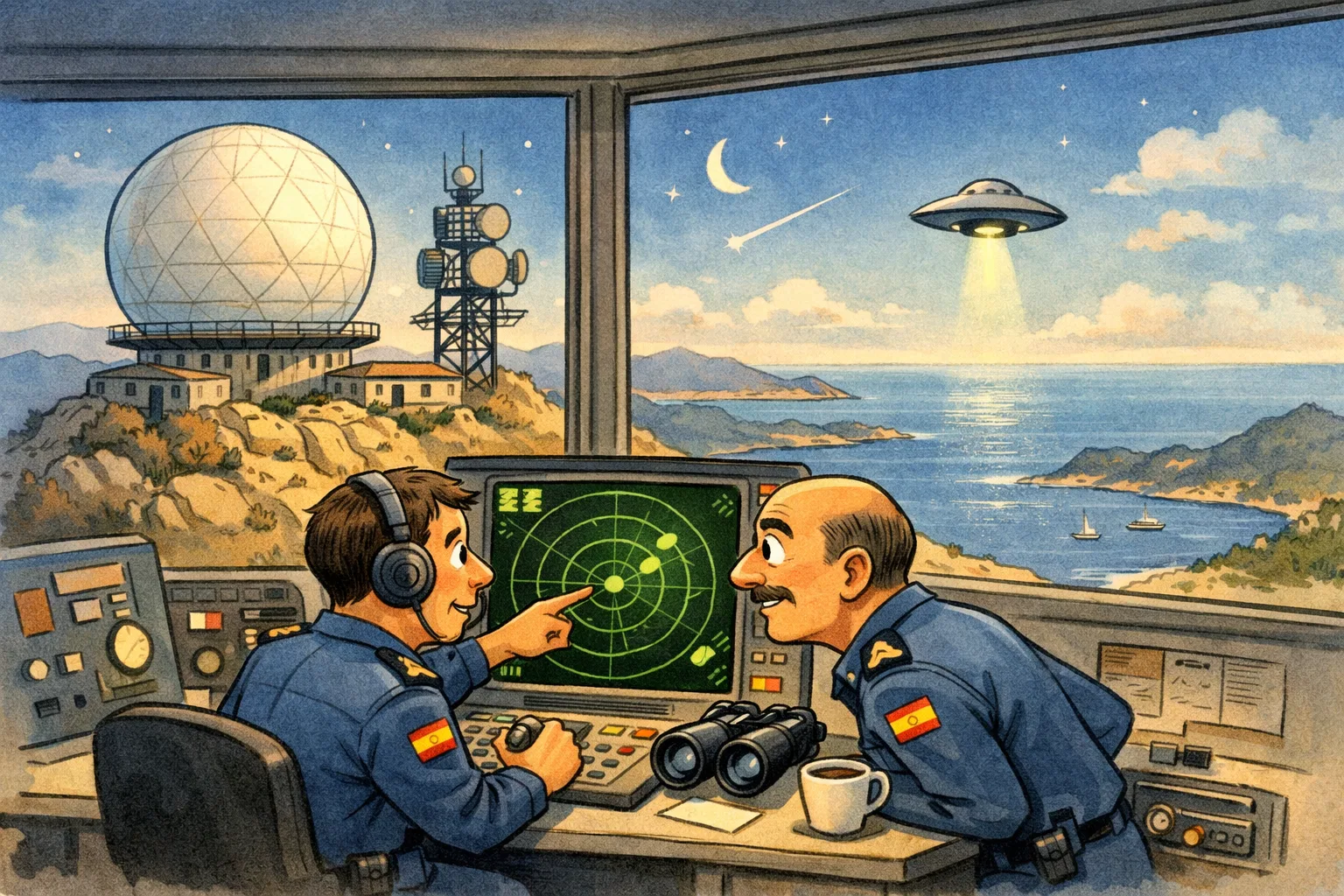
The Aitana radar cases are probably Alicante’s strongest UFO material, but not because they prove anything exotic. They matter because several reports came from EVA-5, a Spanish Air Force air-surveillance station on the Sierra de Aitana, and because the best-known entries combine radar echoes, military personnel, sea-facing tracks, and official files rather than only casual witness testimony. EVA-5 sits at about 1,558 metres in the municipality of Confrides, facing the Mediterranean from the highest point of Alicante province, which made it a natural place for watching air and sea approaches.[Ejercito Del Aire]ejercitodelaireydelespacio.defensa.gob.esOpen source on gob.es.
The cautious answer is that Aitana gives Alicante unusually credible UFO records, not confirmed unknown craft. The files show that military operators logged and sometimes escalated unusual detections; they also show missing context, possible conventional explanations, and the ordinary difficulty of interpreting radar returns over the sea. Spain’s declassified UFO archive contains 80 files and about 1,900 pages of reports from 1962 to 1995 involving Spanish Air Force personnel or equipment in some way.[Biblioteca Virtual Defensa]bibliotecavirtual.defensa.gob.esBiblioteca Virtual Defensa Expedientes OVNIBiblioteca Virtual Defensa Expedientes OVNI Within that national collection, the Aitana material stands out locally because it repeatedly links Alicante to trained observers and operational radar rather than to folklore alone.
What EVA-5 was watching
EVA-5 was not a random hilltop lookout. It was an air-surveillance squadron, part of the Spanish military system for detecting and controlling aircraft in national airspace. The official Air and Space Force unit page places the squadron on the summit area of the Sierra de Aitana, at 1,558 metres and facing the Mediterranean; it also describes the site as the highest point in Alicante province.[Ejercito Del Aire]ejercitodelaireydelespacio.defensa.gob.esOpen source on gob.es. That geography is central to the UFO history of Alicante: the station looked out over a busy maritime and aviation corridor between the Valencian coast, the Balearic area and the wider western Mediterranean.
This is why Aitana’s reports carry more weight than many ordinary light-in-the-sky stories. A radar station records objects, echoes and anomalies within a professional air-defence environment. Operators are trained to distinguish routine traffic from unusual returns, and reports can enter military channels with dates, times, bearings, altitudes and follow-up actions. That does not make every return physically extraordinary, but it does make the original record harder to dismiss as simple misremembering.
The official catalogue entry for the 1986 Aitana file identifies it as a document from the Air Operational Command, intelligence section, concerning unusual phenomena at EVA-5 on 24 and 26 April and 26 July 1986. It is listed as an eight-page online manuscript, published in 1994 and declassified by a 31 May 1998 order.[Biblioteca Virtual Defensa]bibliotecavirtual.defensa.gob.esOpen source on gob.es. The title list of the Defence Virtual Library also places the Aitana file among the national UFO dossiers, alongside other airbase, radar and aircraft-related files.[Biblioteca Virtual Defensa]bibliotecavirtual.defensa.gob.es› Title list…
The significance for Alicante is therefore practical rather than sensational. Aitana gives the province a documented military node: a place where repeated unusual detections were not merely reported to local newspapers but preserved in a state archive. The limits are equally important. A radar file is not the same thing as a full scientific reconstruction. It may tell us what operators saw on instruments and what action followed, while leaving weather, traffic, equipment behaviour and later identification unresolved.

The 1975 and 1979 radar incidents
The earlier Aitana material is more fragmentary than the 1986 file, but it is important because it gives the station a pattern before the better-catalogued later entries. Local reporting based on the digitised Defence files says the Ministry of Defence knew of at least eight unusual aerial cases in Alicante province during the 1970s and 1980s, including five linked to the Aitana EVA-5 radar site in 1975, 1979 and 1986.[ALICANTE PRESS periódico digital]alicantepress.comOpen source on alicantepress.com.
The first often-cited Aitana case is dated 28 July 1975. According to the Alicante Press summary, several non-commissioned officers saw an object pass at low altitude over the EVA-5 installations at about 05:30, shortly after the radar had detected a stationary echo over the sea.[ALICANTE PRESS periódico digital]alicantepress.comOpen source on alicantepress.com. That combination is the reason the case is remembered: a visual observation by military personnel was linked, at least in the narrative record, with a radar anomaly over the Mediterranean.
The difficulty is that the 1975 material appears to have had a troubled archival history. Researcher Vicente-Juan Ballester Olmos has written that three EVA-5 sightings from 1975 were sought during the Air Force’s declassification work but were not initially found in the expected military files; he later traced them through a Ministry of Defence-published history of EVA-5.[Academia]academia.eduEVA 5 Los informes perdidos de 1975EVA 5 Los informes perdidos de 1975 This matters for credibility in both directions. It weakens any claim that the 1975 case is cleanly documented in the main declassified dossier sequence, but it also shows that serious researchers were trying to reconcile publicised military-origin reports with official archival holdings.
The 1979 entries are more tightly connected to radar and air-defence response. On 6 February 1979, EVA-5 reportedly detected radar echoes over the sea at 21:17 while the crew of the butane carrier Tamames saw multiple lights in the Mediterranean. The Air Force report, as summarised by Alicante Press, noted a possible parachute exercise as an explanation still to be verified.[ALICANTE PRESS periódico digital]alicantepress.comOpen source on alicantepress.com. That is exactly the kind of detail that makes the case useful: the record is not just “mystery lights”, but a radar-and-witness coincidence with a proposed conventional lead.
The 13 March 1979 incident raises the level of military seriousness. At 10:59, the Aitana radar reportedly detected an unknown echo heading towards the Peninsula, and a Mirage III was scrambled from Manises to investigate.[ALICANTE PRESS periódico digital]alicantepress.comOpen source on alicantepress.com. In UFO lore, an interceptor launch sounds dramatic, but in air-defence practice it can be a precautionary response to an unidentified return rather than proof of an extraordinary object. The important point is that the Aitana detection crossed a threshold: it was not merely logged, but treated as something worth checking with an aircraft.
The official Defence catalogue also contains a separate file for unusual phenomena in Balearic waters on 6 February 1979, listed as a six-page Air Operational Command intelligence-section document and declassified in November 1995.[Biblioteca Virtual Defensa]bibliotecavirtual.defensa.gob.esOpen source on gob.es. That helps place the Aitana-linked sea reports within a broader western Mediterranean picture rather than as isolated mountain folklore. For Alicante, the key is not that every 1979 return remained unexplained; it is that Aitana appears in a chain of military records where radar, ships, sea routes and air-defence procedures overlap.
The 1986 Aitana file is the clearest official anchor
The 1986 file is the strongest single anchor for Aitana because it is directly catalogued by the Spanish Defence Virtual Library and can be tied to a specific expediente: EVA-5 JUL 94. The official record describes the file as concerning events at EVA-5 on 24 and 26 April and 26 July 1986, with the author listed as the Air Operational Command, intelligence section.[Biblioteca Virtual Defensa]bibliotecavirtual.defensa.gob.esOpen source on gob.es. A separate index entry confirms its place in the national list of UFO files.[Biblioteca Virtual Defensa]bibliotecavirtual.defensa.gob.es› Title list…
A published transcription and metadata page for the same Spanish Air Force file summarises how the dossier was assembled. It says the file drew on Air Operational Command correspondence after a July 1994 message asked subordinate units to recover information about UFO detections that had appeared publicly in the media. JACAR AITANA replied with the information still held at EVA-5, and a later intelligence assessment concluded that no aspect justified keeping the file classified.[UFO Transparency]ufotransparency.comOpen source on ufotransparency.com.
The three main 1986 entries show why the case has stayed important:
- 24 April 1986: EVA-5 logged a manual-altitude radar detection at 00:22Z involving strange objects between bearings of 100 and 120 degrees, with altitude beginning at 8,000 feet and no change of position recorded in the summary.[UFO Transparency]ufotransparency.comOpen source on ufotransparency.com.
- 26 April 1986: EVA-5 observed an object falling into the sea off Benidorm at 18:00 and notified the Guardia Civil; later that evening, at 19:30Z, EVA-5 switched to manual altitude for an unknown at bearing 180 degrees, 40 nautical miles, 39,000 feet, and two Mirages were scrambled from Manises.[UFO Transparency]ufotransparency.comOpen source on ufotransparency.com.
- 26 July 1986: EVA-5 detected an unknown radar echo on the Balearic Islands to Cádiz route at 23:30.[UFO Transparency]ufotransparency.comOpen source on ufotransparency.com.
These details make the 1986 file more than a vague anecdote. It includes bearings, altitude, distance, a coastal visual report near Benidorm, notification to the Guardia Civil and an interceptor response from Manises. It also shows how the official record was reconstructed: the 1994 recovery effort was partly a response to public claims that the Air Force was hiding UFO information.[UFO Transparency]ufotransparency.comOpen source on ufotransparency.com.
That reconstruction is a double-edged point for credibility. On one hand, the material comes from military correspondence and was later declassified, which gives it a firmer basis than rumour. On the other hand, the file was assembled in 1994 from archived correspondence about 1986 events, not written as a full technical investigation immediately after each detection. For a reader, that means the 1986 cases should be treated as strong historical records of unusual military observations, but not as complete forensic proof of what caused them.
Why military radar makes the cases stronger
Military involvement improves the evidential value of the Aitana cases in three main ways. First, it brings trained observers into the story. Radar operators and air-defence personnel are not infallible, but they work in an environment where identifying aircraft, tracks and anomalies is part of the job. Their reports deserve more attention than casual impressions from an untrained witness.
Second, the Aitana material sometimes combines different kinds of observation. The 1975 account links a radar echo over the sea with a low-altitude visual overflight observed by several subofficers. The February 1979 report links EVA-5 and Pegaso radar echoes over the sea with multiple lights seen from a vessel. The 1986 file includes radar detections, a reported object falling into the sea off Benidorm, Guardia Civil notification and Mirage scrambles.[ALICANTE PRESS periódico digital]alicantepress.comOpen source on alicantepress.com. Cases become more interesting when independent channels seem to point to the same broad event.
Third, some reports triggered procedures rather than remaining passive notes. Scrambling a Mirage from Manises in March 1979, and two Mirages during the 26 April 1986 sequence, suggests the detections were operationally meaningful at the time.[ALICANTE PRESS periódico digital]alicantepress.comOpen source on alicantepress.com. Again, that does not tell us the target was exotic. It tells us that the return was not dismissed instantly by the people responsible for the air picture.
This is why Aitana deserves a prominent place in Alicante’s UFO history. The province’s strongest material is not a single spectacular landing story; it is a repeated set of radar-linked anomalies at a high military station watching the Mediterranean. The result is a credibility upgrade from “someone saw something” to “a military surveillance unit logged something unusual”. That is a real distinction.
Why radar cases still need caution
Radar can make a UFO case stronger, but it can also create false confidence. A blip on a screen is not a photograph of an object. Radar returns are interpretations of reflected radio energy, affected by atmosphere, terrain, sea surface, equipment settings and filtering. The US Federal Aviation Administration explains that anomalous propagation, or ducting, can bend radar pulses, causing extraneous blips to appear if the beam is bent towards the ground, and notes that stationary or slow-moving returns are often reduced by beacon radar and moving target indicator techniques.[Federal Aviation Administration]faa.govOpen source on faa.gov.
This is especially relevant to Aitana because several reports involve the sea. Coastal and marine environments can complicate radar interpretation through sea clutter, temperature inversions and propagation effects. NOAA’s JetStream education material describes anomalous propagation as false echoes that are not precipitation and says such returns can contaminate radar displays.[NOAA]noaa.govanomalous propagationanomalous propagation A technical study of coastal radar effects likewise notes that anomalous propagation can cause radars to observe ground clutter far beyond the normal radar horizon, with coastal regions across nearby waters being a useful setting for analysing the effect.[amt.copernicus.org]amt.copernicus.orgOpen source on copernicus.org.
That does not automatically explain Aitana away. It simply sets the standard for caution. A stationary echo over the sea, for example, could be more ambiguous than a tracked object with consistent motion, altitude, speed and independent visual confirmation. A report of lights from a ship may support a radar return, but lights over the Mediterranean can also come from aircraft, exercises, flares, vessels, reflections or distant activity seen under unusual visibility conditions.
The February 1979 case shows this caution inside the record itself. The reported combination of radar echoes and multiple lights is interesting, but the Air Force summary mentioned a possible parachute exercise.[ALICANTE PRESS periódico digital]alicantepress.comOpen source on alicantepress.com. That is not a debunking by itself; it is a reminder that military files often preserve uncertainty and possible explanations rather than closing the case neatly.
The 1986 file also needs careful reading. It is strong because it is official, specific and tied to operational response. It is weaker than some later retellings imply because the public record does not provide a complete technical reconstruction of the radar environment, weather, traffic, equipment performance and post-event identification checks. A responsible reading leaves the most notable entries unresolved or insufficiently explained, not confirmed as extraordinary craft.
Did later reporting strengthen or weaken the claim?
Later reporting strengthened the historical importance of Aitana, but weakened any simple mystery narrative. It strengthened the case because the Defence Virtual Library made the official file trail easier to inspect, and because local reports could point to specific catalogue entries rather than rely only on hearsay. Alicante Press, for example, summarised the province’s declassified UFO material and identified five Aitana radar-linked cases across 1975, 1979 and 1986.[ALICANTE PRESS periódico digital]alicantepress.comOpen source on alicantepress.com. The official catalogue confirms the existence, scope and declassification status of the 1986 Aitana file.[Biblioteca Virtual Defensa]bibliotecavirtual.defensa.gob.esOpen source on gob.es.
But later research also complicates the story. Ballester Olmos’s discussion of the “lost” 1975 reports suggests that some Aitana material did not sit neatly inside the main Air Force declassification sequence and had to be recovered through other routes.[Academia]academia.eduEVA 5 Los informes perdidos de 1975EVA 5 Los informes perdidos de 1975 That makes the history more interesting, but also less tidy. It is harder to treat the 1975 events as fully transparent, complete official case files when part of their modern visibility depends on later archival detective work.
The 1994 context of the 1986 file also changes how it should be read. The dossier was assembled after the Air Force sought information about cases that had appeared in public media, partly to answer accusations of concealment.[UFO Transparency]ufotransparency.comOpen source on ufotransparency.com. That does not make the file unreliable. It does mean the file is not a pristine scientific investigation created solely for anomaly analysis. It is also an institutional record shaped by public pressure, internal correspondence and declassification policy.
The best conclusion is therefore balanced. Later reporting makes Aitana more credible as a documented Alicante UFO node. It does not make the underlying phenomena more certainly extraordinary. The strongest surviving value is evidential and historical: Aitana shows how Spanish military radar, coastal geography and public UFO concern intersected in Alicante during the 1970s and 1980s.
How Aitana should be ranked in Alicante’s UFO history
Aitana should sit at the top of Alicante’s UFO record, but with a careful label. It is not “proof of aliens”. It is Alicante’s best-documented military-radar cluster: a set of reports involving EVA-5, Mediterranean radar echoes, trained personnel, official correspondence and at least two interceptor responses.
That ranking rests on several concrete strengths. The station’s role and location are independently documented by the Spanish Air and Space Force.[Ejercito Del Aire]ejercitodelaireydelespacio.defensa.gob.esOpen source on gob.es. The national Defence archive confirms the existence of the 1986 Aitana file and its declassification.[Biblioteca Virtual Defensa]bibliotecavirtual.defensa.gob.esOpen source on gob.es. Local reporting connects Aitana to repeated 1975, 1979 and 1986 incidents within Alicante’s wider declassified UFO material.[ALICANTE PRESS periódico digital]alicantepress.comOpen source on alicantepress.com. The 1986 file summary provides operational details that include bearings, altitude, distance, sea observations and Mirage scrambles.[UFO Transparency]ufotransparency.comOpen source on ufotransparency.com.
The weaknesses are just as important. Some early material is incomplete or archivally awkward. Some reports point towards possible conventional explanations. Radar over sea-facing terrain is vulnerable to atmospheric and clutter effects. And the public files do not always contain enough data to reconstruct the events to modern investigative standards.
For a mainstream reader, the most honest verdict is this: Aitana is Alicante’s most credible UFO evidence because it is official, repeated and military-linked, but its credibility is the credibility of a serious unresolved air-surveillance record, not of a solved extraordinary event. Its importance lies in showing that Alicante’s UFO history includes real military attention, not in proving what the strange echoes and lights ultimately were.
Amazon book picks
Further Reading
Books and field guides related to Were the Aitana Radar Cases Alicante's Best Evidence?. Use these as the next step if you want deeper reading beyond the article.

eBay marketplace picks
Marketplace Samples
Live-tested eBay searches with available results related to this page.
Endnotes
1.
Source: academia.edu
Title: EVA 5 Los informes perdidos de 1975
Link:https://www.academia.edu/31802317/EVA_5_Los_informes_perdidos_de_1975
2.
Source: noaa.gov
Title: anomalous propagation
Link:https://www.noaa.gov/jetstream/anomalous-propagation
3.
Source: amt.copernicus.org
Link:https://amt.copernicus.org/articles/16/1789/2023/
4.
Source: egusphere.copernicus.org
Title: egusphere 2025 1790
Link:https://egusphere.copernicus.org/preprints/2025/egusphere-2025-1790/egusphere-2025-1790.pdf
5.
Source: academia.edu
Title: El Mando Operativo Aereo busca casos perdidos
Link:https://www.academia.edu/12717306/El_Mando_Operativo_Aereo_busca_casos_perdidos
6.
Source: academia.edu
Link:https://www.academia.edu/35786573/Spanish_Air_Force_UFO_Files_The_Secrets_End_pdf
7.
Source: academia.edu
Title: Bibliography V J Ballester Olmos 1965 2025
Link:https://www.academia.edu/145582281/Bibliography_V_J_Ballester_Olmos
8.
Source: academia.edu
Title: Los expedientes OVNI desclasificados Online
Link:https://www.academia.edu/35429868/Los_expedientes_OVNI_desclasificados_Online
9.
Source: academia.edu
Link:https://www.academia.edu/12561888/DESCLASIFICACION_OVNI_EL_ULTIMO_EXPEDIENTE
10.
Source: ejercitodelaireydelespacio.defensa.gob.es
Link:https://ejercitodelaireydelespacio.defensa.gob.es/EA/ejercitodelaire/es/Unidades/Unidad/edd28d67-7a2d-11ee-99f3-005056bf91c5/?path=%2Fsites%2Finternet.es%2F.content%2Funidad%2Funidad_00004.xml&resourceId=edd28d67-7a2d-11ee-99f3-005056bf91c5
11.
Source: bibliotecavirtual.defensa.gob.es
Title: Biblioteca Virtual Defensa Expedientes OVNI
Link:https://bibliotecavirtual.defensa.gob.es/BVMDefensa/exp_ovni/es/micrositios/inicio.do
12.
Source: bibliotecavirtual.defensa.gob.es
Link:https://bibliotecavirtual.defensa.gob.es/BVMDefensa/exp_ovni/en/consulta/busqueda_referencia.do?campo=idtitulo&idValor=395964
13.
Source: bibliotecavirtual.defensa.gob.es
Link:https://bibliotecavirtual.defensa.gob.es/BVMDefensa/exp_ovni/en/consulta/indice_campo.do?campo=idtitulo
Source snippet
› Title list...
14.
Source: alicantepress.com
Link:https://alicantepress.com/archive/33209/defensa-investigo-al-menos-8-casos-ovni-en-la-provincia-de-alicante-en-los-anos-70-y-80
15.
Source: bibliotecavirtual.defensa.gob.es
Link:https://bibliotecavirtual.defensa.gob.es/BVMDefensa/exp_ovni/en/consulta/busqueda_referencia.do?campo=idtitulo&idValor=396018
16.
Source: ufotransparency.com
Link:https://ufotransparency.com/files/intl-es-expediente-eva-5-aitana-1986-1986-04-24-avistamiento-en-eva-5-aitana-alicante
17.
Source: faa.gov
Link:https://www.faa.gov/air_traffic/publications/atpubs/aim_html/chap4_section_5.html
18.
Source: Wikipedia
Title: Anomalous propagation
Link:https://en.wikipedia.org/wiki/Anomalous_propagation
19.
Source: bibliotecavirtual.defensa.gob.es
Title: defensa.gob.es Listado de títulos
Link:https://bibliotecavirtual.defensa.gob.es/BVMDefensa/exp_ovni/es/consulta/indice_campo.do?campo=idtitulo
20.
Source: publicaciones.defensa.gob.es
Title: raa 615
Link:https://publicaciones.defensa.gob.es/media/downloadable/files/links/r/a/raa_615.pdf
21.
Source: mendoza.gov.ar
Title: 20121205 29280 edictos
Link:https://www.mendoza.gov.ar/wp-content/uploads/boletin.old/20121205-29280-edictos.pdf
22.
Source: dsca.gob.es
Title: 52 dinero
Link:https://www.dsca.gob.es/sites/default/files/52_dinero.pdf
23.
Source: ensta.hal.science
Link:https://ensta.hal.science/hal-03687164/document
Additional References
24.
Source: youtube.com
Link:https://www.youtube.com/watch?v=OsfO2Vaulc8
Source snippet
Spanish air force UFO files declassified Pentagon releases declassified UFO files detailing more than 400 incidents NBC News...
25.
Source: youtube.com
Title: Mass UFO Sightings: Thousands of Witnesses, Military Radar, Official Documents
Link:https://www.youtube.com/watch?v=x49nlVe-c9g
Source snippet
Manises Airport UFO Incident 1979 Spanish Plane Emergency & UFO Encounter...
26.
Source: youtube.com
Title: Declassified Spain: Where Military UAPs Meet Ancient Paranormal Mysteries
Link:https://www.youtube.com/watch?v=8vxqPUmSgIw
Source snippet
The Manises UFO Incident: A Classic UFO Case from Spain...
27.
Source: youtube.com
Title: Air Force hunting UFOs in Belgium
Link:https://www.youtube.com/watch?v=UgjVvTfibnw
Source snippet
Mass UFO Sightings: Thousands of Witnesses, Military Radar, Official Documents...
28.
Source: youtube.com
Title: The Manises UFO Incident: A Classic UFO Case from Spain
Link:https://www.youtube.com/watch?v=A7MTdkK_JaM
Source snippet
Air Force hunting UFOs in Belgium - Sighting Case Study...
29.
Source: facebook.com
Link:https://www.facebook.com/groups/scientificcosmology/posts/10174976489890268/
30.
Source: usni.org
Link:https://www.usni.org/magazines/proceedings/1973/december/dont-fall-radar-hole
31.
Source: librerianubedepapel.com
Link:https://www.librerianubedepapel.com/en/libro/kansasalcoy-historia-del-acuartelamiento-aereo-de-aitana-y-escuadron-de-vigilancia-aerea-n-5_T469780395
32.
Source: papirolibreria.com
Link:https://www.papirolibreria.com/es/libro/kansasalcoy-historia-del-acuartelamiento-aereo-de-aitana-y-escuadron-de-vigilancia-aerea-n-5_T469780395
33.
Source: facebook.com
Link:https://www.facebook.com/EjercitoAire/posts/los-escuadrones-de-vigilancia-a%C3%A9rea-eva-del-ej%C3%A9rcito-del-aire-velan-por-nuestra-/3338209069610054/
Topic Tree