Within Navarre UFOs
What Do Navarre's Declassified UFO Files Show?
Navarre's public UFO record is unusually small, with four military archive entries doing most of the historical work.
On this page
- The four Navarre related entries
- What declassification adds and omits
- How official files shape local memory
Page outline Jump by section
Introduction
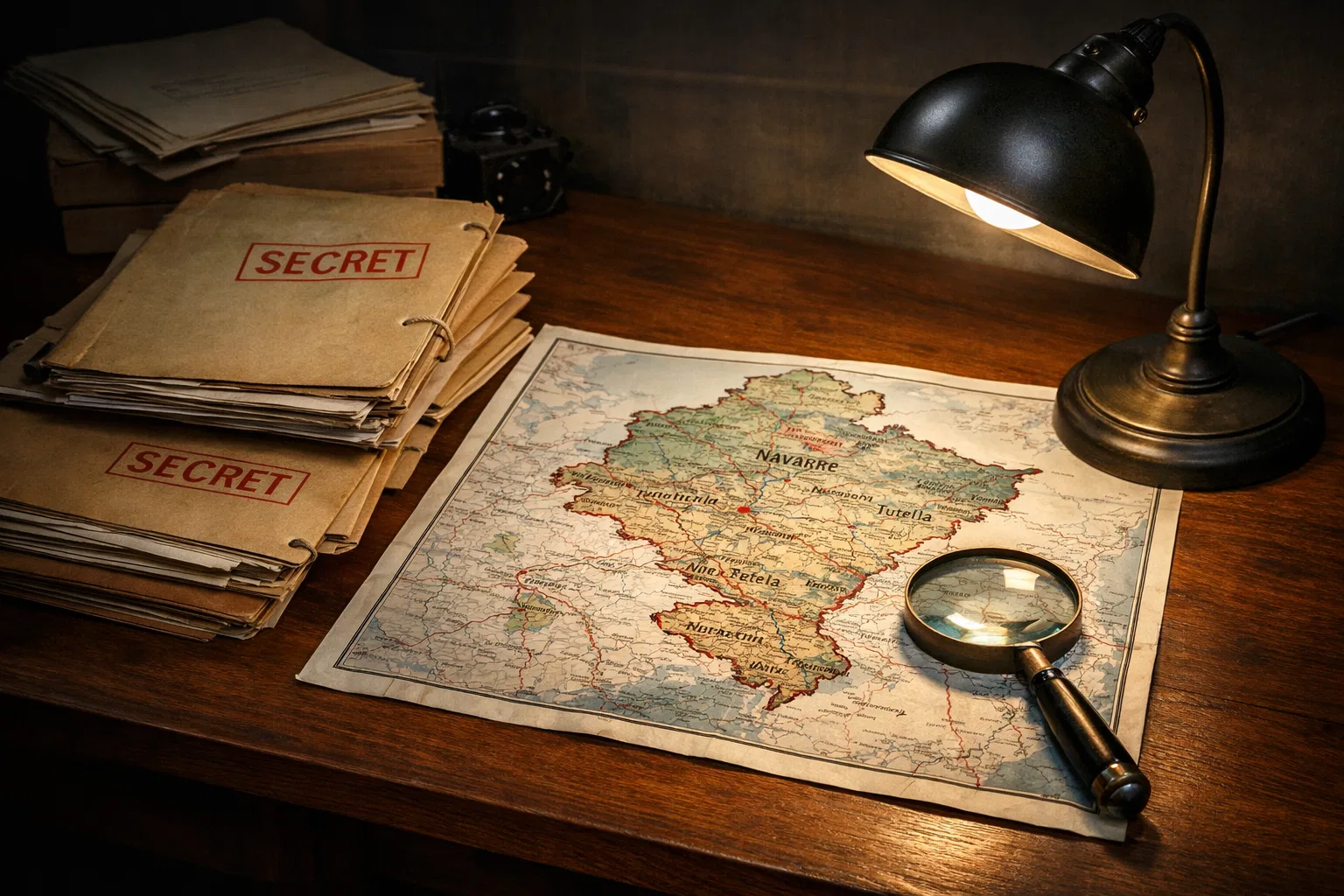
Navarre’s declassified UFO record is small, but unusually revealing. In the Spanish Air Force archive, the province is represented mainly by four entries: a 1968 multi-location report that includes Pamplona, two Bardenas Reales firing-range files from 1975 and 1980, and a 1988 Navarra file linked in later reporting to Pamplona and Burlada. That modest paper trail matters because it shows how official institutions handled odd aerial reports: they collected witness statements, made quick judgements, removed personal names before release, and later turned once-confidential files into public archive material. It does not prove extraordinary craft over Navarre. It does show how a thin set of sightings became the backbone of the province’s public UFO memory. Spain’s Defence Virtual Library describes the national collection as 80 files and around 1,900 pages, covering reports from 1962 to 1995 in which Air Force personnel or equipment were involved in some way.[Biblioteca Virtual Defensa]bibliotecavirtual.defensa.gob.esOpen source on gob.es.
For Navarre, the archive is less a catalogue of mysteries than a record of governance. It tells us which reports reached military desks, which did not, what kinds of explanations were considered acceptable, and how much uncertainty remained once the paperwork was closed.
The four Navarre-related entries
The clearest way to read Navarre’s official UFO history is to treat the four Air Force entries as a small case family rather than as four equally strong mysteries. They differ sharply in quality, witness type, location and evidential weight.
The earliest relevant file is the 5 and 6 September 1968 report covering Madrid, Toledo, Cuenca and Pamplona. The Defence Virtual Library catalogue identifies it as an Air Operational Command and Intelligence Section file, 18 pages long, declassified by JEMA order 5546 on 13 September 1993.[Biblioteca Virtual Defensa]bibliotecavirtual.defensa.gob.esOpen source on gob.es. Local summaries later described the Pamplona element as an object observed from a Lufthansa Boeing and eventually confirmed as a French weather balloon, making it the most straightforwardly explained Navarre-related entry.[Pamplona Actual]pamplonaactual.comOpen source on pamplonaactual.com.
The strongest and best-known file is the Bardenas Reales case of 2 January 1975. The official catalogue lists it as a 30-page file with graphics, produced by the Air Operational Command, General Staff, Intelligence Section, and declassified by JEMA order 2867 on 13 July 1994.[Biblioteca Virtual Defensa]bibliotecavirtual.defensa.gob.esOpen source on gob.es. Unlike the 1968 Pamplona entry, this was not a brief peripheral mention in a wider national report. It centred on a military firing range in Navarre and involved personnel on duty.
The third entry is another Bardenas Reales file, dated 25 December 1980. It is much thinner: the Defence Virtual Library records it as a four-page Air Force file, declassified by JEMA order 5099 on 14 November 1995.[Biblioteca Virtual Defensa]bibliotecavirtual.defensa.gob.esOpen source on gob.es. Its small size is itself significant. It suggests that not every Navarre-related report became a deep investigation, even when the location carried military importance.
The fourth entry is the Navarra file dated 1 May 1988. The catalogue records it as an eight-page file produced by the Air Operational Command and declassified by JEMA order 960 on 27 February 1996.[Biblioteca Virtual Defensa]bibliotecavirtual.defensa.gob.esOpen source on gob.es. Later local reporting and national round-ups associate this case with Pamplona and Burlada: a reported triangular white form seen above the clouds, followed by an Air Force response stating that no UFO sighting or strange radar echoes had been recorded.[Pamplona Actual]pamplonaactual.comOpen source on pamplonaactual.com.
Taken together, the four entries show a lopsided record. One case was probably a balloon, one became a classic military UFO story, one was a short Bardenas follow-up, and one depended heavily on civilian testimony and press transmission rather than radar confirmation.
Why Bardenas dominates the archive
Bardenas Reales dominates Navarre’s official UFO record because it was not just a scenic desert-like landscape where people happened to look up. It was, and remains, a military air-to-ground training area. The Spanish Air and Space Force says the Bardenas firing range was created on 9 June 1951 on land leased from the Community of Bardenas Reales de Navarra. It also notes that fixed modern infrastructure was developed in the early 1970s for joint Spanish and United States Air Force use under Spanish control.[ejercitodelaireydelespacio.defensa.gob.es]ejercitodelaireydelespacio.defensa.gob.esUnidades - Unidad…
That setting changes the meaning of a sighting. A strange light over a town might be logged as a local curiosity. A strange light over a firing range can raise questions about aircraft, range security, restricted operations, radar, duty officers and reporting chains. The same official unit page says Bardenas’ main mission is training combat pilots in air-to-ground firing, and lists regular use by Spanish combat wings, naval aircraft, helicopters, allied aircraft, search-and-rescue units, air defence teams and unmanned aircraft activity.[ejercitodelaireydelespacio.defensa.gob.es]ejercitodelaireydelespacio.defensa.gob.esUnidades - Unidad…
The military context cuts both ways. On one hand, service personnel may be more familiar than casual witnesses with aircraft, lights, engines and range activity. On the other, Bardenas is exactly the sort of place where ordinary military or rural lights can be misread: training targets, towers, vehicles, roads, uneven terrain, mist, moonlight and night duty stress all complicate perception. Julio Plaza’s sceptical reconstruction emphasises that the range included a main tower, an auxiliary tower about 1,500 metres away, an observatory on a mound, target areas, tanks and obsolete aircraft used for bombing practice.[Naukas]naukas.comBardenas Reales: Confusión en el campo de tiroBardenas Reales: Confusión en el campo de tiro
That is why the Bardenas files are valuable even when they do not settle the mystery. They record a collision between official procedure and messy human perception in a place where unusual aerial activity was already normal.
What the 1975 file adds
The 2 January 1975 Bardenas case is the central Navarre Air Force file because it contains the ingredients readers usually expect in a serious UFO report: trained or semi-trained military witnesses, a restricted location, a written official investigation, diagrams, later press interest, and a contested explanation.
According to later reporting based on the Defence file, the incident began at about 22:55 when personnel on guard at the firing range saw two intermittent red lights that at first seemed like a vehicle two to five kilometres away. The lights reportedly rose to roughly 50 metres, moved towards the auxiliary tower, then changed direction towards the main tower, where soldiers prepared their weapons before the lights climbed and disappeared. A second object was then observed by a senior non-commissioned officer using binoculars; his reported description was of a form like an inverted cup, with white, amber and intermittent side lights.[Diario de Navarra]diariodenavarra.esdos ovnis avistaron 1975 poligono tiro bardenas 825273 22dos ovnis avistaron 1975 poligono tiro bardenas 825273 22
The official file did not simply dismiss the witnesses as fantasists. Local reporting on the declassified material says an early military report noted that the witness statements were not contradictory and treated the objects as unidentified within the limits of the evidence. The same reporting also notes vivid details preserved in the file: the patrol’s high agitation, the loading of weapons, good weather conditions, and the mundane observation that the soldiers had only consumed half a bottle of ordinary red wine with their meal.[Pamplona Actual]pamplonaactual.comOpen source on pamplonaactual.com.
But the final official posture was more sceptical. A higher command interpretation on 11 January 1975 reportedly stated that there was no proof to accept, and rather reason to reject, the passage or landing of UFOs in the Bardenas range. The suggested explanations included a lunar halo, a star, a nearby tractor, or light passing through intermittent mist or haze, creating the impression of an illuminated moving body.[Pamplona Actual]pamplonaactual.comOpen source on pamplonaactual.com.
That split between early witness credibility and final administrative closure is why the file endured. It is not compelling because it proves an exotic object. It is compelling because the documents show how quickly a baffling military report could be both formally recorded and institutionally neutralised.
What declassification adds and omits
Declassification gave Navarre’s UFO story a firmer documentary base, but it did not turn the archive into a complete truth machine. Spain’s Defence Virtual Library says the national process began in 1991, after the Ministry of Defence decided to review and, where appropriate, lower the classification of UFO-related documents. A physical copy was deposited in the Central Library of the Air Force in Madrid in 1992, and digitisation later made the files consultable online.[Biblioteca Virtual Defensa]bibliotecavirtual.defensa.gob.esOpen source on gob.es.
The same official presentation explains what readers should expect inside the files: summary pages with place, date, account of events, considerations, conclusions and proposed classification or declassification, followed where available by witness interviews, incident logs and meteorological reports. It also warns that each file differs: some are only a few pages, while others run to many dozens.[Biblioteca Virtual Defensa]bibliotecavirtual.defensa.gob.esOpen source on gob.es.
That matters in Navarre because the four entries are not equally rich. The 1975 Bardenas file has 30 pages and graphics; the 1980 Bardenas file has four pages; the 1988 Navarra file has eight; and the 1968 Pamplona-related report is embedded in a wider multi-place file. Biblioteca Virtual Defensa+3Biblioteca Virtual Defensa+3Biblioteca Virtual Defensa[bibliotecavirtual.defensa.gob.es]bibliotecavirtual.defensa.gob.esOpen source on gob.es. A reader should not infer that all four were investigated with the same intensity.
Declassification also omits personal details. The Defence Virtual Library states that, despite release, the names of declarants and reporting officers are withheld.[Biblioteca Virtual Defensa]bibliotecavirtual.defensa.gob.esOpen source on gob.es. That protects privacy, but it limits later historical checking. Researchers can compare summaries, testimony patterns and official reasoning, but they cannot always reconstruct witness backgrounds, follow-up interviews or chains of responsibility from the public catalogue alone.
The result is a useful but partial record: strong enough to anchor local history, too incomplete to justify confident extraordinary claims.

The 1988 Pamplona and Burlada file shows a different pattern
The 1988 Navarra file is important precisely because it is not another Bardenas-style military-range incident. It appears in later public accounts as a Pamplona and Burlada report, with civilian witnesses and press involvement rather than on-duty soldiers at a firing range.
Pamplona Actual, summarising the declassified material in 2016, reported that the case had appeared in the newspaper Navarra Hoy. One named witness in that article, then 18 years old, reportedly described a clearly triangular white form moving slowly at considerable height above the highest clouds, and said it was not an aircraft, balloon or familiar shape.[Pamplona Actual]pamplonaactual.comOpen source on pamplonaactual.com.
The Air Force response was much cooler. The same local summary says the information was sent to Defence by a Navarre UFO research association, and that the interim commanding officer replied that no UFO sightings had been recorded and no strange radar echoes had appeared on the screens.[Pamplona Actual]pamplonaactual.comOpen source on pamplonaactual.com.
That makes the 1988 file a useful contrast with 1975. In Bardenas, the witness context forced an internal military report because the event involved personnel at a military site. In 1988, the record seems to have been driven by a public report and a civilian UFO group forwarding material to the authorities. The official answer then turned on the absence of corroborating military or radar data.
For local memory, however, the 1988 file still matters. It shows that Navarre’s official UFO archive was not limited to the firing range. Pamplona and Burlada enter the record through a more familiar urban pattern: an unusual shape, a newspaper article, a civilian investigator or association, and a later official note saying that the systems that might have strengthened the claim had found nothing.
The 1968 Pamplona entry is the cautionary case
The 1968 Pamplona-related entry is easy to overlook because it is not a dramatic Navarre-only incident. Yet it may be the most useful file for understanding how archive status can inflate a weak mystery.
The Defence catalogue places Pamplona inside a broader 5 and 6 September 1968 report covering Madrid, Toledo and Cuenca as well.[Biblioteca Virtual Defensa]bibliotecavirtual.defensa.gob.esOpen source on gob.es. National and local round-ups later list the Pamplona component as one of Navarre’s UFO entries, but Pamplona Actual reports that it involved an object detected or observed by a Lufthansa Boeing and was confirmed as a French meteorological balloon.[Pamplona Actual]pamplonaactual.comOpen source on pamplonaactual.com.
That matters because the phrase “declassified UFO file” can sound more mysterious than the contents justify. In Spanish official usage, these were files on unusual aerial phenomena reported to or involving the Air Force. A file could remain interesting, weak, explained, unresolved or simply administratively preserved. The 1968 Pamplona entry reminds readers that inclusion in the archive is not the same as official endorsement of a genuine unknown.
It also gives Navarre’s set an internal balance. The province has one strongly debated Bardenas case, one short Bardenas file, one urban triangular-object report without radar support, and one balloon explanation. That is a much more sober picture than a simple list of “four UFO cases” suggests.
What the files changed in local memory
The public release of the files changed Navarre’s UFO memory in three main ways.
First, it gave local stories an official shelf mark. The Bardenas 1975 incident was no longer only a press tale or a ufology anecdote. It became a documented Air Force file with a date, authoring body, page count, declassification order and catalogue record.[Biblioteca Virtual Defensa]bibliotecavirtual.defensa.gob.esOpen source on gob.es. That is why later newspapers could return to the story decades afterwards with archival confidence rather than relying only on retelling.
Second, the files narrowed the serious record. Pamplona Actual noted in 2016 that, among the 80 declassified Spanish documents then published online, only four referred to Navarre.[Pamplona Actual]pamplonaactual.comOpen source on pamplonaactual.com. This makes the province’s official UFO history unusually compact. The archive does not support a picture of constant military concern across Navarre. It supports a much smaller picture: a handful of reports, with Bardenas doing most of the historical work.
Third, the files made sceptical re-reading easier. Plaza’s later analysis of the 1975 case argues that the official inquiry was too quick, later journalistic treatments added confusion, and some reported movements could plausibly relate to vehicle lights, roads, terrain and perception — while also acknowledging that not every detail fits neatly, especially the claimed approach towards the main tower and the lack of sound.[Naukas]naukas.comBardenas Reales: Confusión en el campo de tiroBardenas Reales: Confusión en el campo de tiro That kind of critique depends on having documents to compare, not just stories to repeat.
In this sense, declassification did not kill the mystery. It made the mystery more disciplined. It shifted the question from “Did something extraordinary visit Navarre?” to “What exactly did the witnesses report, what did officials check, what did they fail to check, and which explanations survive close comparison with the setting?”
How to read Navarre’s Air Force files today
The most careful reading is neither credulous nor dismissive. The files show that unusual aerial reports in Navarre did reach Spanish military channels, especially when they involved Bardenas Reales. They also show that official closure was not always the same as full explanation.
The 1975 Bardenas file remains the province’s strongest unresolved official case because it combines multiple military witnesses, a restricted setting, detailed movement claims and an explanation that many later readers have found too quick. But it is not a clean evidential breakthrough. The record contains uncertainties about direction, distance, witness vantage points and later retellings. Plaza’s reconstruction points to possible vehicle-light and terrain effects, but also notes that some features are hard to square with that solution.[Naukas+2Naukas]naukas.comBardenas Reales: Confusión en el campo de tiroBardenas Reales: Confusión en el campo de tiro
The 1980 Bardenas file confirms that the range generated more than one official UFO-related entry, but its four-page size warns against overbuilding the story.[Biblioteca Virtual Defensa]bibliotecavirtual.defensa.gob.esOpen source on gob.es. The 1988 Pamplona and Burlada case shows how a striking civilian claim could enter official channels yet remain unsupported by radar or other military confirmation.[Biblioteca Virtual Defensa]bibliotecavirtual.defensa.gob.esOpen source on gob.es. The 1968 Pamplona element shows the opposite end of the scale: a report that made the archive but appears to have a conventional balloon explanation.[Biblioteca Virtual Defensa]bibliotecavirtual.defensa.gob.esOpen source on gob.es.
That leaves Navarre with a public UFO record that is small, uneven and historically useful. Its value is not that it proves visitors from elsewhere. Its value is that it preserves the administrative life of uncertainty: how people reported strange things, how the Air Force filtered them, how explanations were proposed, and how a few thin files came to define a province’s official UFO memory.
Amazon book picks
Further Reading
Books and field guides related to What Do Navarre's Declassified UFO Files Show?. Use these as the next step if you want deeper reading beyond the article.
eBay marketplace picks
Marketplace Samples
Live-tested eBay searches with available results related to this page.


Endnotes
1.
Source: bibliotecavirtual.defensa.gob.es
Link:https://bibliotecavirtual.defensa.gob.es/BVMDefensa/exp_ovni/es/micrositios/inicio.do
2.
Source: bibliotecavirtual.defensa.gob.es
Link:https://bibliotecavirtual.defensa.gob.es/BVMDefensa/exp_ovni/es/consulta/busqueda_referencia.do?campo=idlugar&idValor=659567
3.
Source: bibliotecavirtual.defensa.gob.es
Link:https://bibliotecavirtual.defensa.gob.es/BVMDefensa/es/consulta/busqueda_referencia.do?campo=idtitulo&idValor=3454506
4.
Source: bibliotecavirtual.defensa.gob.es
Link:https://bibliotecavirtual.defensa.gob.es/BVMDefensa/es/consulta/registro.do?id=38300
5.
Source: bibliotecavirtual.defensa.gob.es
Link:https://bibliotecavirtual.defensa.gob.es/BVMDefensa/en/consulta/busqueda_referencia.do?campo=idtitulo&idValor=3454722
6.
Source: ejercitodelaireydelespacio.defensa.gob.es
Link:https://ejercitodelaireydelespacio.defensa.gob.es/EA/ejercitodelaire/es/Unidades/Unidad/4f98fc09-9f2b-11ee-b1b1-005056bf91c5/?path=%2Fsites%2Finternet.es%2F.content%2Funidad%2Funidad_00062.xml&resourceId=4f98fc09-9f2b-11ee-b1b1-005056bf91c5
Source snippet
Unidades - Unidad...
7.
Source: naukas.com
Title: Bardenas Reales: Confusión en el campo de tiro
Link:https://naukas.com/2017/02/21/bardenas-reales-confusion-en-el-campo-de-tiro/
8.
Source: bibliotecavirtual.defensa.gob.es
Title: defensa.gob.es Listado de títulos
Link:https://bibliotecavirtual.defensa.gob.es/BVMDefensa/exp_ovni/es/consulta/indice_campo.do?campo=idtitulo
9.
Source: bibliotecavirtual.defensa.gob.es
Title: defensa.gob.es Title list
Link:https://bibliotecavirtual.defensa.gob.es/BVMDefensa/exp_ovni/en/consulta/indice_campo.do?campo=idtitulo
10.
Source: bibliotecavirtual.defensa.gob.es
Link:https://bibliotecavirtual.defensa.gob.es/BVMDefensa/es/consulta/busqueda_referencia.do?campo=idtitulo&idValor=3456225
11.
Source: bibliotecavirtual.defensa.gob.es
Link:https://bibliotecavirtual.defensa.gob.es/BVMDefensa/exp_ovni/es/consulta/registro.do?id=38317
12.
Source: bibliotecavirtual.defensa.gob.es
Title: defensa.gob.es Búsqueda avanzada de obras
Link:https://bibliotecavirtual.defensa.gob.es/BVMDefensa/exp_ovni/es/consulta/busqueda_avanzada.do
13.
Source: pamplonaactual.com
Link:https://pamplonaactual.com/pamplona-actual/70232/militares-aseguraron-ver-varios-episodios-ovni-en-bardenas-reales-segun-documentos-desclasificados-por-defensa/
14.
Source: diariodenavarra.es
Title: dos ovnis avistaron 1975 poligono tiro bardenas 825273 22
Link:https://www.diariodenavarra.es/noticias/navarra/tudela-ribera/2026/06/20/dos-ovnis-avistaron-1975-poligono-tiro-bardenas-825273-22.html
15.
Source: diariodenavarra.es
Link:https://www.diariodenavarra.es/noticias/navarra/navarra/2016/10/24/defensa_desclasifica_tres_informes_avistamientos_ovni_bardenas_burlada_493971_2061.html
16.
Source: diariodenavarra.es
Link:https://www.diariodenavarra.es/noticias/opinion/2026/06/04/poligono-tiro-bardenas-75-anos-corazon-estrategico-defensa-europea-dnexclusivo-823374-52.html
17.
Source: x.com
Link:https://x.com/DiariodeNavarra/status/2068232498081906727
Additional References
18.
Source: youtube.com
Link:https://www.youtube.com/watch?v=aOttfrSi0Is
Source snippet
Bardenas Reales by Car - Europe's Lonely Desert...
19.
Source: youtube.com
Title: Low pass fighter F-18 Spanish Bardenas Reales
Link:https://www.youtube.com/watch?v=a38j9xklktI
Source snippet
In 1979, a Spanish plane was chased by a UFO over the Mediterranean Sea and nearly crashed!!!?...
20.
Source: youtube.com
Title: Javier Sierra: The secret report on UFOs in Franco’s Spain
Link:https://www.youtube.com/watch?v=_lSEWzNb2rc
Source snippet
Low pass fighter F-18 Spanish Bardenas Reales...
21.
Source: academia.edu
Link:https://www.academia.edu/31712315/Bardenas_Reales_Confusion_en_el_campo
22.
Source: researchgate.net
Link:https://www.researchgate.net/publication/376912623_Collateral_Noise_Military_Secrecy_and_Secretions_in_Southern_Navarre%27s_Bardenas_during_Late_Francoism
23.
Source: facebook.com
Link:https://www.facebook.com/groups/4aviation.flightline/posts/7518110024947674/
24.
Source: visitnavarra.es
Link:https://www.visitnavarra.es/en/bardenas-reales
25.
Source: facebook.com
Link:https://www.facebook.com/100064419680577/videos/ejercicios-t%C3%A1cticos-a%C3%A9reos-primavera-01-77-en-presencia-del-rey-juan-carlos-i-en/1648419209776166/
26.
Source: textarchive.ru
Link:https://textarchive.ru/c-1724655-pall.html
27.
Source: facebook.com
Link:https://www.facebook.com/ehbildu/posts/se-cumplen-75-a%C3%B1os-desde-la-puesta-en-marcha-del-pol%C3%ADgono-de-tiro-de-las-bardena/1316064520715136/
Topic Tree