Within Biscay UFOs
Could the Landscape Have Made the Mystery?
Gallarta's industrial terrain helps explain why unusual marks, sightlines and local rumours could be read as landing evidence.
On this page
- Spoil heaps, holes and industrial marks
- Why mining terrain complicates testimony
- The retroexcavator explanation
Page outline Jump by section
Introduction
The Gallarta landing traces matter because they show how Biscay’s most famous UFO case grew out of a very earthly setting: a worked-over mining landscape full of spoil, holes, stones, machinery marks and unstable ground. In 1977, reports of strange marks on a spoil heap helped turn a local sighting claim into an official Air Force file. Later investigation, however, strongly weakened the “landing evidence” by linking the holes to ordinary extraction work by a mechanical digger operator.[Biblioteca Virtual Defensa]bibliotecavirtual.defensa.gob.es› Listado de títulos…
This does not make the Gallarta story unimportant. It makes it more useful. The case is a reminder that physical traces are not automatically stronger than witness testimony. In a place where mining had already remade the ground, the landscape itself could produce marks that looked mysterious once they were framed as evidence of a craft.
Why Gallarta Was the Wrong Kind of Blank Canvas
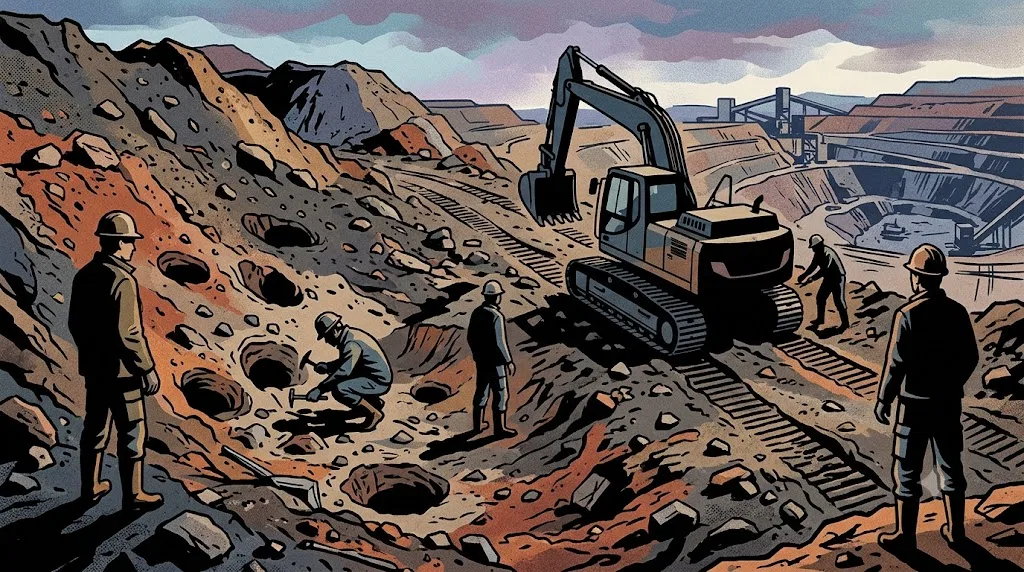
The claimed landing site was not a quiet field where a circular scar would stand out as an obvious anomaly. Gallarta sits within Biscay’s historic mining belt, and the surrounding terrain had been shaped by iron extraction, spoil heaps, open workings and heavy industrial movement. The Basque Country Mining Museum is located in the old Gallarta slaughterhouse, beside the Concha II mine, described by Visit Biscay as the largest open-pit mine in the Basque Country. The same official tourism page stresses that the area is marked by the transformation of the environment by human industrial activity.[Visit Biscay]visitbiscay.eusVisit Biscay Mining Museum of the Basque CountryVisit Biscay Mining Museum of the Basque Country
That setting is central to the UFO question. A spoil heap is not neutral ground. It is artificial, loose, disturbed and often littered with stones, dumped material and machine-made irregularities. When a witness or reporter sees a line of holes there, the first question should not be “what landed?” but “what has already happened to this ground?”
The wider mining landscape around Gallarta and La Arboleda reinforces the point. Visit Biscay describes former mines giving way to reservoirs, old mining sites and the Concha II open-pit workings, including a mine 700 metres long and 350 metres wide, reaching 37 metres below sea level. This is not background colour; it explains why unusual ground marks in the Gallarta case were so hard to read.[Visit Biscay]visitbiscay.eusVisit Biscay The story of the iron slideVisit Biscay The story of the iron slide
Spoil Heaps, Holes and Industrial Marks
The first public version of the Gallarta mystery leaned heavily on the idea of “landing traces”. According to Magonia’s later account of the case, drawing on the press and the declassified file, La Gaceta del Norte reported on 24 March 1977 that numerous possible UFO landing marks had been found on a spoil heap in Gallarta. José Luis Lozón, a naval engineer and technical director at a Bilbao shipyard, said he had seen a large shiny object rise rapidly from the place.[Magonia]magonia.comEncuentros en la tercera fase en Gallarta – MagoniaEncuentros en la tercera fase en Gallarta – Magonia
That combination was powerful: an apparently credible witness, a dramatic object description, and physical marks on the ground. For readers in 1977, the holes could seem to move the story beyond a simple sighting. They looked like something that could be photographed, counted and inspected.
But physical evidence is only as good as its context. In Gallarta, the reported holes were not discovered in a controlled scene preserved immediately after an incident. They were found in an industrially altered area where extraction, dumping and stone removal were normal activities. The marks also had to be interpreted after the story had already acquired a UFO frame, which increased the risk that ordinary features would be selected because they matched the expected narrative.
A spoil heap can mislead in several ways:
- It preserves disorder. Loose and mixed material can leave cavities, depressions and oddly shaped holes without requiring a single dramatic event.
- It records work. Buckets, tyres, stabilisers, dragged stones and removed rocks can all leave marks that look intentional when seen later.
- It changes quickly. Rain, settlement and further activity can alter edges, making old industrial traces look fresher or stranger.
- It encourages pattern-finding. Once people expect “landing legs” or “supports”, scattered marks may be mentally grouped into circles, lines or repeated formations.
The key issue is not whether witnesses were lying. It is that the site itself was highly capable of producing misleading traces.
Why Mining Terrain Complicates Testimony
Gallarta also shows how terrain and testimony can reinforce each other. A witness who hears noise at night, sees lights or notices strange ground marks may build one observation around another. In a mining district, however, the same features can have separate mundane causes: machinery, disturbed animals, industrial sound, artificial slopes, reflective surfaces, and irregular ground.
Magonia notes that the early press coverage included reports of night-time noises from the spoil heap, while the Air Force investigation then expanded from Lozón’s claim into the much more elaborate accounts of Juan Sillero, who lived near the site. The official investigators were reportedly struck by the fantastic tone of Sillero’s story, which included repeated encounters and beings.[Magonia]magonia.comEncuentros en la tercera fase en Gallarta – MagoniaEncuentros en la tercera fase en Gallarta – Magonia
That matters because the “landing traces” became part of a larger narrative. Once the case included a shining craft, repeated visits and alleged occupants, the holes were no longer just holes. They became supporting props in a story that had already moved far beyond ambiguous ground marks.
The problem for investigators is that witness credibility and trace interpretation can blur together. Lozón’s professional status made the initial report harder to dismiss casually. Sillero’s proximity to the site gave his testimony local immediacy. Yet neither factor proved that the marks were anomalous. A witness can be sincere and still misread an industrial landscape; a technically educated person can accurately describe what they believe they saw while still being mistaken about the origin of nearby traces.

The Retroexcavator Explanation
The strongest later explanation for the Gallarta marks is strikingly ordinary. According to Magonia, investigators found that many supposed landing marks were irregular, and that stones beside them matched the shape of the holes. They then located Adrián Tramón, a mechanical digger operator, who explained that he had made the marks while extracting mineral stones. Sillero reportedly acknowledged in writing on 18 May 1980 that the marks photographed and published by Juan José Benítez in La Gaceta del Norte and Ya were Tramón’s work.[Magonia]magonia.comEncuentros en la tercera fase en Gallarta – MagoniaEncuentros en la tercera fase en Gallarta – Magonia
This is the turning point for the “mistaken traces” subtopic. The explanation does not need to account for every claimed experience in the Gallarta file. It specifically addresses the physical marks that had been treated as possible landing evidence. If the holes were produced by a digger removing stones, then the most concrete-looking part of the case becomes one of its weakest parts.
The detail about stones matching the holes is especially important. It gives the explanation a mechanism rather than a vague dismissal. A bucket or tool removes a rock; the rock leaves a cavity; the rock remains nearby; the cavity is later interpreted as a landing mark. In a mining spoil heap, that sequence is not only plausible but expected.
The later dispute also helps explain why Gallarta remained controversial. Sancho el Sabio’s catalogue records a 1980 article by Juan José Benítez titled Sí hubo OVNI en Gallarta, framed as a response to sceptical criticism, and lists related items on the Gallarta file and later arguments over fraud or manipulation. The archive trail shows that the case did not simply end with one explanation; it became a small media and ufology dispute about what counted as evidence.[Sancho El Sabio Library Catalogue]catalogo.sanchoelsabio.eusOpen source on sanchoelsabio.eus.
What the Marks Can and Cannot Prove
The Gallarta traces cannot responsibly be treated as strong evidence of a landing. The best available later account identifies a mundane source for the photographed holes, and the local setting makes that explanation more convincing rather than less. The marks were found on industrially disturbed ground, in a district where tools, machines and mineral extraction had long shaped the surface.
What they can prove is more subtle: they show how a UFO case can gain strength from the appearance of physical confirmation before that confirmation has been properly tested. A light in the sky is easy to dismiss as ambiguous; a hole in the ground feels tangible. But Gallarta shows that tangibility is not the same as reliability.
The case also helps separate three different questions that are often blended together:
- Was there a reported sighting? Yes. Gallarta appears in Spain’s official UFO file list as an Air Force case concerning strange phenomena in Gallarta on 13 February 1977.[Biblioteca Virtual Defensa]bibliotecavirtual.defensa.gob.es› Listado de títulos…
- Were there reported physical traces? Yes. Contemporary reporting described numerous possible landing marks on a spoil heap.[Magonia]magonia.comEncuentros en la tercera fase en Gallarta – MagoniaEncuentros en la tercera fase en Gallarta – Magonia
- Do those traces survive as good evidence for a craft? No. Later investigation linked the key holes to ordinary mechanical work in the mining landscape.[Magonia]magonia.comEncuentros en la tercera fase en Gallarta – MagoniaEncuentros en la tercera fase en Gallarta – Magonia
That distinction is vital for Biscay’s UFO history. Gallarta is not best understood as a clean “unexplained landing” case. It is better understood as a case in which a disturbed industrial environment helped create, amplify and then partly unravel an extraordinary claim.
Why This Landscape Still Matters to Biscay’s UFO Story
The mining ground is not a side detail in Gallarta. It is one of the main reasons the case developed as it did. Without the spoil heap, there may have been no dramatic “landing marks” for the press to photograph and no physical hook strong enough to give the story wider momentum. Without later attention to the same terrain, there may also have been no clear route to the retroexcavator explanation.
This is why Gallarta belongs in Biscay’s UFO history even though the landing-trace evidence is weak. It captures a recurring problem in close-encounter cases: the environment is often treated as a passive stage, when it may be an active source of the mystery. In Gallarta, the ground had already been broken, moved, dug and marked before anyone tried to read it as evidence of a visitor from elsewhere.
For readers approaching the case today, the safest conclusion is not that “nothing happened” in every possible sense. It is that the most memorable physical evidence does not support the extraordinary version of the story. The mining landscape made the mystery easier to believe at first, and easier to explain once investigators looked closely at how such ground was actually made.
Amazon book picks
Further Reading
Books and field guides related to Could the Landscape Have Made the Mystery?. Use these as the next step if you want deeper reading beyond the article.
UFOs: Generals, Pilots, and Government Officials Go on the Re...
Broader context for official investigations.
eBay marketplace picks
Marketplace Samples
Live-tested eBay searches with available results related to this page.




Endnotes
1.
Source: magonia.com
Title: Encuentros en la tercera fase en Gallarta – Magonia
Link:https://magonia.com/2016/11/07/encuentros-en-la-tercera-fase-en-gallarta/
2.
Source: archive.org
Link:https://archive.org/download/jufoh/jufoh.pdf
3.
Source: bibliotecavirtual.defensa.gob.es
Link:https://bibliotecavirtual.defensa.gob.es/BVMDefensa/exp_ovni/es/consulta/indice_campo.do?campo=idtitulo
Source snippet
› Listado de títulos...
4.
Source: visitbiscay.eus
Title: Visit Biscay Mining Museum of the Basque Country
Link:https://www.visitbiscay.eus/c/portal/update_language?languageId=en_GB&p_l_id=7999917&redirect=%2Feu%2Feuskal-herriko-meatzaritzaren-museoa
5.
Source: visitbiscay.eus
Title: Visit Biscay The story of the iron slide
Link:https://www.visitbiscay.eus/en/-/la-historia-del-tobogan-del-hierro
6.
Source: catalogo.sanchoelsabio.eus
Link:https://catalogo.sanchoelsabio.eus/Record/emd-10357-8816/Details
7.
Source: euskalmemoriadigitala.sanchoelsabio.eus
Link:https://euskalmemoriadigitala.sanchoelsabio.eus/items/cffa46d9-c7cf-4b7c-bded-bf97ac720dcc
8.
Source: bibliotecavirtual.defensa.gob.es
Link:https://bibliotecavirtual.defensa.gob.es/BVMDefensa/exp_ovni/es/consulta/registro.do?id=38366
9.
Source: visitbiscay.eus
Title: EKOETXE A MEATZALDEA
Link:https://www.visitbiscay.eus/en/web/actividades/-/ekoetxea-meatzaldea
10.
Source: visitbiscay.eus
Title: Basque Country mining museum
Link:https://www.visitbiscay.eus/en/iron-river/route-5b-basque-country-mining-museum/basque-country-mining-museum
Additional References
11.
Source: silo.tips
Link:https://silo.tips/download/grupo-de-trabajo-29-activos-ambientales-en-la-mineria-documento-final
12.
Source: euskadi.eus
Link:https://www.euskadi.eus/en/towns/abanto-y-ciervana-abanto-zierbena/web01-ejeduki/en/
13.
Source: circulobellasartes.com
Link:https://www.circulobellasartes.com/en/humanidades/azul-verde-negro-as-pontes-mina-lago/
14.
Source: geopark-hblo.de
Link:https://geopark-hblo.de/en/locations/visitor-mines/pit-glasebach/
15.
Source: cmmedia.es
Link:https://www.cmmedia.es/play/podcast/el-dragon-invisible/ciencia-frente-ovnis-entrevista-vicente-juan-ballester-olmos-10x43.html
16.
Source: coe.int
Link:https://www.coe.int/pl/web/cultural-routes/-/mining-museum-of-the-basque-country-foundation
17.
Source: facebook.com
Link:https://www.facebook.com/groups/gallartaayeryhoy/posts/820901100923548/
18.
Source: aevv-egwa.org
Link:https://www.aevv-egwa.org/portfolio-item/montes-de-hierro/
19.
Source: facebook.com
Link:https://www.facebook.com/embassyofswedeninkampala/posts/a-church-on-the-move-swedish-stylein-northern-sweden-a-113-year-old-landmark-chu/1096415915964858/
20.
Source: insertec.biz
Link:https://www.insertec.biz/blog/the-mining-landscapes/
Topic Tree