Within Badajoz UFOs
Were The Talavera Echoes Really Unidentified Craft?
The 1975 Talavera echoes show how a technical-looking UFO report can still leave room for equipment, weather or traffic explanations.
On this page
- What The Control Screen Reported
- Possible Technical Explanations
- Why The Case Matters More Than Its Fame
Page outline Jump by section
Introduction
The Talavera radar echoes were a modest but important Badajoz UFO case from 14 January 1975. Unlike the better-known 1976 Talavera humanoid story, this one was not about soldiers seeing a figure near the base perimeter. It was about moving returns on a control screen at Talavera la Real, the military air base linked with Badajoz Airport. The strongest reading is cautious: the echoes were unusual enough to enter Spain’s official UFO files, but the later explanation leans towards false radar returns, weather-related propagation, equipment interpretation or ordinary air traffic rather than confirmed unidentified craft. Spain’s Defence Virtual Library catalogues the file as a six-page Air Force document, declassified on 13 October 1993, under the title “Avistamiento de fenómenos extraños en Talavera la Real: 14 de Enero de 1975”.[Biblioteca Virtual Defensa]bibliotecavirtual.defensa.gob.esOpen source on gob.es.
That is why the case matters. It shows how a report can look technical, military and impressive while still being vulnerable to mundane explanations. The Talavera echoes belong in Badajoz’s UFO history not because they prove a hidden aircraft, but because they demonstrate the province’s recurring pattern: trained aviation personnel, official paperwork, incomplete data and later debate over whether “unidentified” really means extraordinary.
What The Control Screen Reported
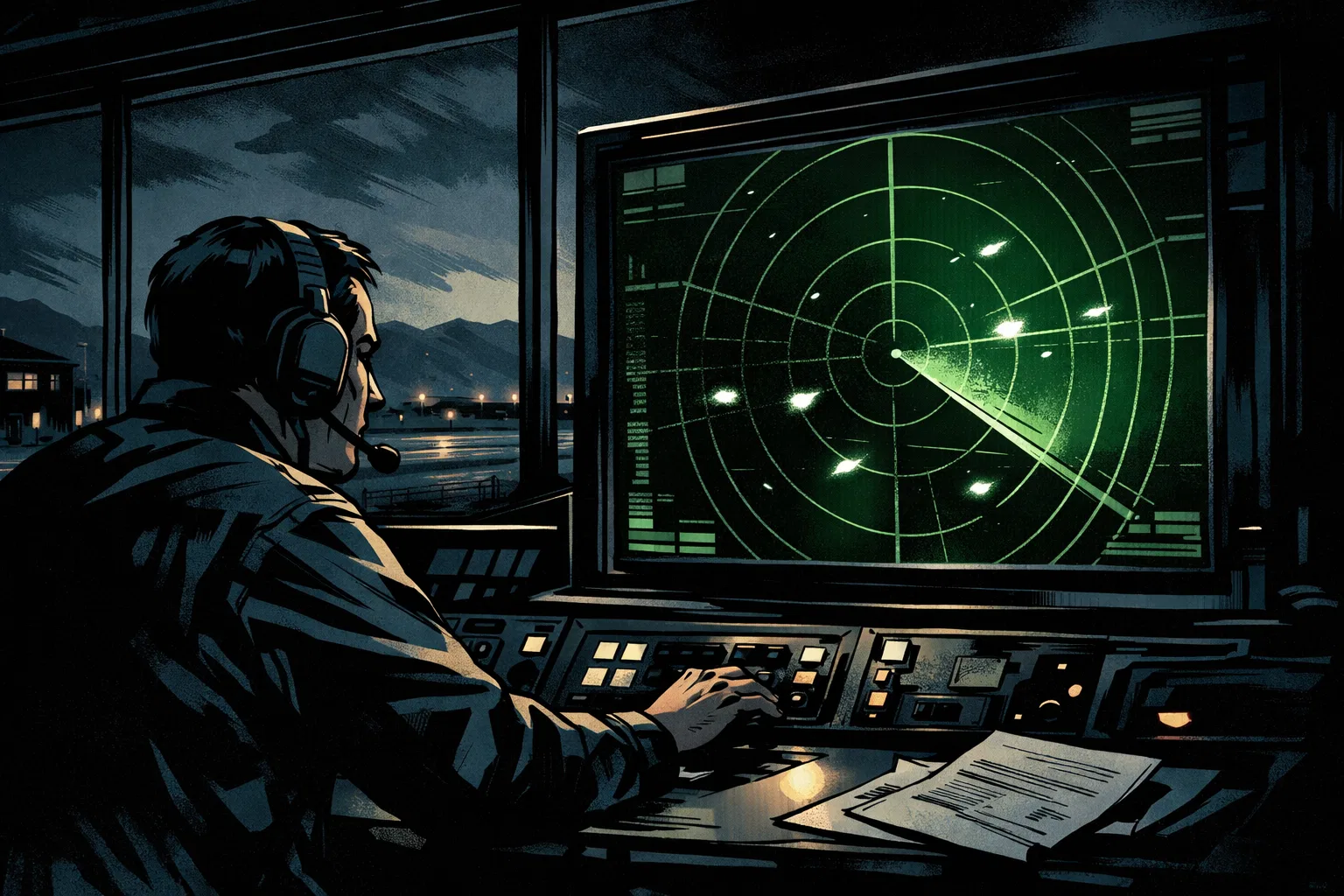
The 1975 incident reportedly began when Talavera control staff saw a group of moving echoes on a recognition or radar-related screen. A modern archive summary of the declassified file says an air traffic controller observed seven or eight objects between about 19:15 and 19:40, with returns that appeared to move and change speed, sometimes at rates compatible with ordinary aircraft and sometimes more like fast jet traffic. The same summary says the controller could not obtain altitude information, which immediately weakened the interpretation: without height, identity and track confirmation, a radar return is not the same thing as a fully described aircraft.[OVNI Archive]ovniarchive.comOpen source on ovniarchive.com.
The location also matters. Talavera la Real was not a random rural sighting point. AENA’s history of Badajoz Airport records that the runway works began in 1951, the control tower was completed that year, the runway was finished in early 1953, and the Army Jet School was established in December 1953. The air base therefore had exactly the kind of aviation environment in which an unusual return would be noticed, logged and escalated rather than dismissed as a casual light in the sky.[Aena]aena.esOpen source on aena.es.
The Defence Library’s catalogue entry confirms the official skeleton of the case: Talavera la Real, 14 January 1975, Mando Operativo Aéreo, Air Staff Intelligence Section, six pages, with Badajoz province indexed as the relevant place. It does not, by itself, prove that the echoes were solid objects. It proves that the report entered the Air Force’s UFO paperwork and was later made available through the declassified collection.[Biblioteca Virtual Defensa]bibliotecavirtual.defensa.gob.esOpen source on gob.es.
A specialist breakdown of Spain’s Air Force UFO files classifies the 14 January 1975 Talavera case as a radar-track type incident, places it about 22 kilometres south-east of the base, and gives its assessment as “false radar echoes”. That secondary listing should not be treated as stronger than the file itself, but it is useful because it shows how later Spanish UFO-file researchers have tended to interpret the case: not as a dramatic unknown, but as a radar anomaly with a plausible ordinary mechanism.[elojocritico.info]elojocritico.infoOpen source on elojocritico.info.
Possible Technical Explanations
The first ordinary explanation is anomalous propagation: radar energy bending through unusual layers of the atmosphere and producing returns that appear to come from targets where no aircraft is actually flying. This is not a sceptical invention made for UFO cases. The US National Weather Service defines anomalous propagation as false, non-precipitation echoes caused by non-standard propagation of the radar beam under certain atmospheric conditions. NOAA’s JetStream training material also describes anomalous propagation as false echoing that contaminates radar interpretation.[National Weather Service]forecast.weather.govNational Weather Service NOAA's National Weather ServiceNational Weather Service NOAA's National Weather Service
For air traffic control, the same issue is recognised in practical aviation guidance. The US Federal Aviation Administration explains that ducting or anomalous propagation can bend radar pulses, causing extraneous blips to appear on a controller’s display or reducing detection range if the beam bends upward. The FAA notes that beacon radar and moving target indicator filtering can reduce the problem, but the important point for Talavera is simpler: a radar screen can show convincing-looking returns for reasons other than a real aircraft at the indicated position.[Federal Aviation Administration]faa.govOpen source on faa.gov.
A second explanation is ground clutter or reflection from terrain and fixed objects. Radar systems do not see the sky in the way a human eye sees an object. They send energy out, receive returns, and rely on filtering, timing and interpretation. Under certain atmospheric conditions, surface objects can be displayed as if they were airborne or moving. Flight Safety Foundation’s discussion of airborne weather radar makes the same broad point in accessible terms: temperature inversions can refract microwave energy, producing false echoes, especially at night.[Flight Safety Foundation]flightsafety.orgshowing where not to goshowing where not to go
A third possibility is ordinary traffic seen through incomplete identification. The archive summary says the Talavera controller tried to identify the returns but lacked altitude information, and it also notes that a VIP aircraft landed without incident while the echoes were being discussed. That does not automatically explain every return as that aircraft, but it does remind the reader that Talavera was an active aviation site, not an empty sky. The ordinary question is therefore not “could a UFO appear near an air base?” but “could a busy or imperfectly filtered control picture produce apparently odd tracks?”[OVNI Archive]ovniarchive.comOpen source on ovniarchive.com.
The strongest sceptical reading combines these factors rather than choosing only one. A cluster of ambiguous echoes, no firm altitude, no clear visual confirmation, no reported air safety consequence, and no subsequent evidence of an unknown craft make a technical or traffic explanation more likely than an exotic one. The case remains historically interesting because the staff took it seriously enough to report, but the evidence does not support turning screen returns into physical craft with certainty.
Why Radar Evidence Feels Stronger Than It Is
Radar cases often feel more convincing than ordinary witness sightings because they appear to replace memory with machinery. A person can misjudge a planet, aircraft light or meteor; a radar screen seems more objective. The Talavera case benefits from that impression. It involved a military aviation setting, trained personnel and a technical display rather than a lone witness describing lights over a field.
But radar is not a simple truth machine. It is a sensor system operating inside weather, terrain, equipment limits and human interpretation. NOAA’s radar guidance stresses that anomalous propagation is unpredictable and can create echoes that are not precipitation, while the FAA’s air traffic guidance explicitly recognises that ducting can produce extraneous blips on radar displays. Those points do not debunk every radar UFO report in advance, but they do lower the evidential value of a case where the only strong feature is the screen return itself.[NOAA]noaa.govanomalous propagationanomalous propagation
The missing altitude is especially important. A return with no reliable altitude is harder to separate from false propagation, ground return, reflection, transponder confusion or a distant target displayed misleadingly. If a report includes visual confirmation, multiple independent radars, pilot contact, recorded track data and later reconstruction, the evidential weight rises. The Talavera echoes, as publicly summarised, appear to fall short of that stronger standard.[OVNI Archive]ovniarchive.comOpen source on ovniarchive.com.
This is where ordinary explanations are not a way of brushing the case aside; they are the core of understanding it. The best question is not whether the controller was honest. There is no need to doubt the basic report. The better question is whether the display was showing craft, false returns, misidentified traffic, or a mixture of returns that could not be resolved in the moment.
Why The Case Matters More Than Its Fame
The 1975 Talavera echoes are less famous than the 1976 Talavera humanoid claim, but they may be more useful for understanding Badajoz’s UFO record. The later humanoid story is dramatic, memorable and heavily retold. The radar case is quieter, but it shows the mechanics of how an ambiguous aviation event entered official channels and later emerged in declassified records. Spain’s Defence Virtual Library states that the national UFO collection comprises 80 files and about 1,900 pages of strange aerial phenomena in Spanish airspace involving Air Force personnel or material in some way.[Biblioteca Virtual Defensa]bibliotecavirtual.defensa.gob.esBiblioteca Virtual Defensa Expedientes OVNIBiblioteca Virtual Defensa Expedientes OVNI
Within that collection, Badajoz is not represented only by folklore. The Defence Library title list includes the 1975 Talavera la Real case, the 1976 Talavera Air Base case, the 1993 Usagre case and a 1967 aviation case over Montánchez indexed with Badajoz. That gives the province a paper trail across different kinds of reports: radar echoes, close-encounter testimony, local observation and aviation-linked sightings.[Biblioteca Virtual Defensa]bibliotecavirtual.defensa.gob.es› Listado de títulos…
The 1975 case also helps keep the wider Badajoz story balanced. If readers begin with the most sensational Talavera account, the province can look like a place of extraordinary encounters. If they include the radar echoes, a more sober pattern appears: airbase infrastructure created opportunities for reports to be noticed, but official preservation did not equal confirmation. The same system that recorded the anomaly also left room for a false-echo assessment.
That distinction is valuable for any public-facing history of UFO reports in Badajoz. A case can be real as a report, real as an official file, and still not real as an unknown craft. Talavera’s 1975 echoes sit exactly in that middle ground.
A Fair Verdict On The Talavera Echoes
The fairest verdict is that the 1975 Talavera radar echoes were genuinely reported but weak as evidence for extraordinary craft. They are stronger than a rumour because the official file exists, the date and place are clear, and the incident belongs to Spain’s declassified Air Force UFO material. They are weaker than many readers might expect because the public record points to missing altitude data, no clear visual match, no known incident affecting aircraft safety, and a later assessment that favoured false radar echoes.[Biblioteca Virtual Defensa+2OVNI Archive]bibliotecavirtual.defensa.gob.esOpen source on gob.es.
That does not make the case worthless. It makes it instructive. Talavera shows why radar-linked UFO stories deserve attention but also restraint. A technical-looking anomaly can be more interesting than a simple misidentified light, yet still be fully compatible with weather, propagation, equipment behaviour or ordinary traffic. In Badajoz’s UFO history, the 1975 echoes are best read not as proof of visitors, but as a clear example of how uncertainty can appear on a screen and then harden into legend if the ordinary mechanisms are not kept in view.

Amazon book picks
Further Reading
Books and field guides related to Were The Talavera Echoes Really Unidentified Craft?. Use these as the next step if you want deeper reading beyond the article.
UFOs: Generals, Pilots, and Government Officials Go on the Re...
Includes military and aviation reporting relevant to radar cases.
The UFO Experience: A Scientific Inquiry
Provides methods for assessing technical reports.
UFOs and Government: A Historical Inquiry
Covers radar, military and official investigations.
eBay marketplace picks
Marketplace Samples
Live-tested eBay searches with available results related to this page.



Endnotes
1.
Source: aena.es
Link:https://www.aena.es/en/badajoz/get-to-know-us/history.html
2.
Source: elojocritico.info
Link:https://elojocritico.info/los-archivos-ovni-del-ejercito-del-aire-desglosados-quien-que-como/
3.
Source: forecast.weather.gov
Title: National Weather Service NOAA’s National Weather Service
Link:https://forecast.weather.gov/glossary.php?word=AP
4.
Source: noaa.gov
Title: anomalous propagation
Link:https://www.noaa.gov/jetstream/anomalous-propagation
5.
Source: faa.gov
Link:https://www.faa.gov/air_traffic/publications/atpubs/aim_html/chap4_section_5.html
6.
Source: noaa.gov
Title: radar beams
Link:https://www.noaa.gov/jetstream/radar-beams
7.
Source: elojocritico.info
Link:https://elojocritico.info/ufoleaks-6-los-jueces-instructores-de-los-expedientes-ovni-identificados-por-primera-vez/
8.
Source: aena.es
Link:https://www.aena.es/en/huesca-pirineos/get-to-know-us/history.html
9.
Source: aena.es
Link:https://www.aena.es/en/badajoz.html
10.
Source: ia601405.us.archive.org
Link:https://ia601405.us.archive.org/28/items/B-001-014-055/B-001-014-055.pdf
11.
Source: bibliotecavirtual.defensa.gob.es
Link:https://bibliotecavirtual.defensa.gob.es/BVMDefensa/exp_ovni/es/consulta/busqueda_referencia.do?campo=idtitulo&idValor=395910
12.
Source: ovniarchive.com
Link:https://ovniarchive.com/doc/8241?lang=en
13.
Source: flightsafety.org
Title: showing where not to go
Link:https://flightsafety.org/asw-article/showing-where-not-to-go/
14.
Source: bibliotecavirtual.defensa.gob.es
Title: Biblioteca Virtual Defensa Expedientes OVNI
Link:https://bibliotecavirtual.defensa.gob.es/BVMDefensa/exp_ovni/es/micrositios/inicio.do
15.
Source: bibliotecavirtual.defensa.gob.es
Link:https://bibliotecavirtual.defensa.gob.es/BVMDefensa/exp_ovni/es/consulta/indice_campo.do?campo=idtitulo&posicion=41
Source snippet
› Listado de títulos...
16.
Source: bibliotecavirtual.defensa.gob.es
Link:https://bibliotecavirtual.defensa.gob.es/BVMDefensa/en/consulta/busqueda_referencia.do?campo=idtitulo&idValor=3454516
17.
Source: bibliotecavirtual.defensa.gob.es
Title: defensa.gob.es Listado de títulos
Link:https://bibliotecavirtual.defensa.gob.es/BVMDefensa/exp_ovni/es/consulta/indice_campo.do?campo=idtitulo
18.
Source: ejercitodelaireydelespacio.defensa.gob.es
Title: defensa.gob.es Escuela Militar de Caza y Ataque
Link:https://ejercitodelaireydelespacio.defensa.gob.es/EA/ejercitodelaire/es/Unidades/Unidad/f46ed122-9f2a-11ee-b1b1-005056bf91c5/?path=%2Fsites%2Finternet.es%2F.content%2Funidad%2Funidad_00058.xml&resourceId=f46ed122-9f2a-11ee-b1b1-005056bf91c5
19.
Source: Wikipedia
Title: Anomalous propagation
Link:https://en.wikipedia.org/wiki/Anomalous_propagation
20.
Source: Wikipedia
Title: Badajoz Airport
Link:https://en.wikipedia.org/wiki/Badajoz_Airport
21.
Source: kupi.com
Title: badajoz airport
Link:https://www.kupi.com/en-ae/explore/spain/badajoz/badajoz-airport
22.
Source: airports-worldwide.com
Title: Badajoz Airport
Link:https://www.airports-worldwide.com/spain/badajoz_spain.htm
Additional References
23.
Source: youtube.com
Link:https://www.youtube.com/watch?v=hlFKL6NBr5M
Source snippet
Declassified Spain: Where Military UAPs Meet Ancient Paranormal Mysteries | Deep Dive Ep. 1...
24.
Source: youtube.com
Link:https://www.youtube.com/watch?v=7VWXJC1GzNk
25.
Source: youtube.com
Title: The Manises UFO Incident: A Classic UFO Case from Spain
Link:https://www.youtube.com/watch?v=A7MTdkK_JaM
Source snippet
Talavera la Real radar UFO Air Force Officer Encountered a Nordic Alien - Jesus Jofre Mila - DEBRIEFED ep. 60 Area52...
26.
Source: youtube.com
Link:https://www.youtube.com/watch?v=8vxqPUmSgIw
Source snippet
1,900 pages of 'UFO files' are declassified in Spain...
27.
Source: youtube.com
Title: 1,900 pages of ‘UFO files’ are declassified in Spain
Link:https://www.youtube.com/watch?v=-XuV39079LA
Source snippet
The Manises UFO Incident: A Classic UFO Case from Spain...
28.
Source: alistairzammitphotography.com
Link:https://alistairzammitphotography.com/ala-23-ejercito-del-aire/
29.
Source: milavreachout.org
Link:https://milavreachout.org/ala-23-patas-negras/
30.
Source: facebook.com
Link:https://www.facebook.com/groups/scientificcosmology/posts/10174976489890268/
31.
Source: facebook.com
Link:https://www.facebook.com/Scramblemagazine/posts/eae-300k-on-the-f-5this-year-the-ej%C3%A9rcito-del-aire-y-del-espacio-eae-spanish-air/1411657664320016/
32.
Source: windharvest.com
Link:https://windharvest.com/wp-content/uploads/2017/04/Assessment-of-the-Effects-of-Wind-Turbines-on-Air-Traffic-Control-Radars-John-J.-Lemmon-John-E.-Carroll-Frank-H.-Sanders-Doris-Turner-U.pdf
Topic Tree